
Rechecked 22 June 2026. Distribution rights, multiplayer and mission details were checked against the JASPP Chocks Away Compendium archive.
The Acorn Archimedes was never my home computer. It was the machine in a school room and in a few houses where a parent had a reason to own one. What I remember is speed: clean movement and graphics that did not seem to labour in the way our cheaper machines did.
Chocks Away made that impression tangible. A biplane moved over a 3D landscape, the horizon stayed convincing and two players could fly simultaneously on a split screen. It looked like the future in a room that otherwise looked like school.
Returning to it now is quieter. The children asked why the aircraft was slow and whether it had missiles. I was more interested in whether I could land without embarrassing myself.
Quick verdict
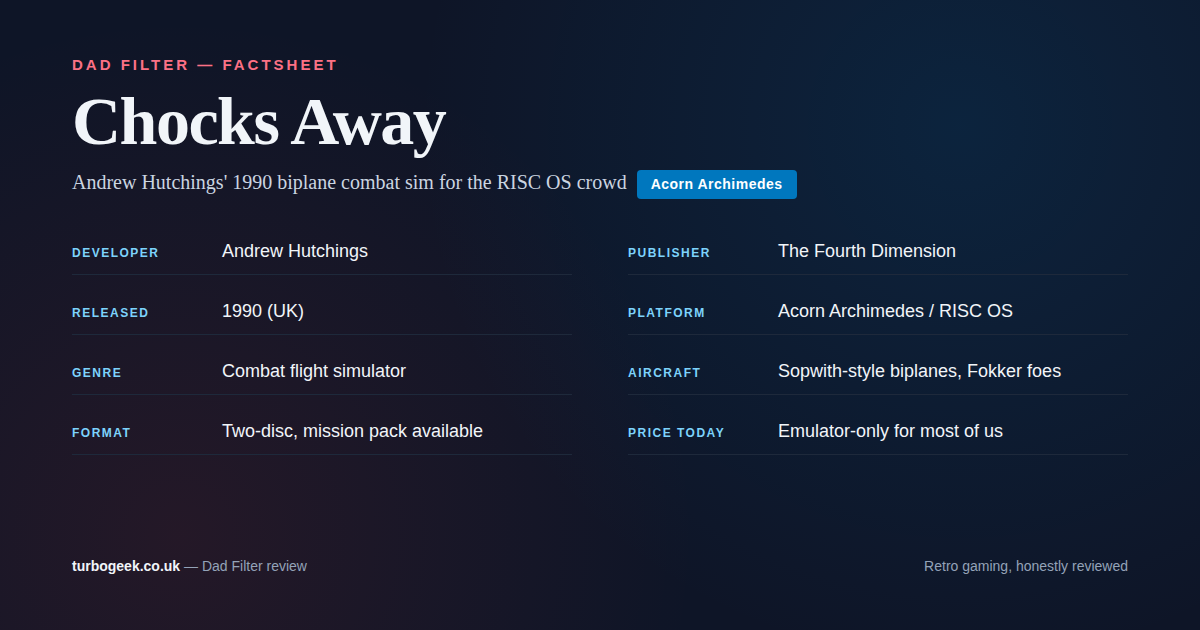
- Developer: Andrew Hutchings
- Publisher: The Fourth Dimension
- Original release: Acorn Archimedes, 1990
- Dad Filter: Worth playing for British computing history and accessible flight
- Kid appeal: Low
- Family play: Genuine simultaneous two-player split screen
A combat flight game that cares about flying
Chocks Away puts the player in a manoeuvrable biplane with a rapid-fire cannon, missions, enemy aircraft and ground targets. It is loosely First World War-themed rather than a strict historical simulation.
I previously subtitled the review “No explosions.” That was plainly the wrong shorthand for a combat game with destructible targets. What I meant was that Chocks Away does not rely on constant spectacle. The better distinction is that take-off, control, navigation and landing carry as much of the experience as firing the cannon.
The controls are approachable, but the aircraft still needs to be flown. Banking changes direction gradually. Losing height matters. Returning to base and landing is an activity, not a cutscene.
Why it stayed in my memory
Flight games on 8-bit home computers often asked your imagination to fill in the missing frames. The Archimedes could make the ground move smoothly enough that the relationship between pitch, roll and horizon felt immediate.
I had previously inserted an Ian Bell comparison into this section. I could not support a direct connection between him and Chocks Away, and the comparison distracted from Andrew Hutchings’ own work. It has been removed.
The game does not need borrowed prestige. Its place in the Archimedes library is clear on its own.
The two-player mode was not hot-seat
My original review called the split-screen option “two-player hot-seat.” That was inaccurate. Two players fly simultaneously, using the same machine and separate control inputs, in practice, dogfights or missions.
The later Compendium and Mark II material describes dual joystick, mouse and keyboard options, plus a serial-link mode for two computers. In 1990 and 1991, smooth simultaneous 3D flight on a home computer was a meaningful technical achievement.
It also changes the family verdict. Chocks Away is not naturally appealing to my boys as a solo historical simulation, but a simultaneous dogfight gives them a much clearer reason to participate.
What happened with my children
The older one watched long enough to decide the plane was too slow. The younger one wanted missiles. Neither was interested in the pleasure of trimming a turn or approaching a runway cleanly.
That reaction is useful. Chocks Away does not disguise its pace with progression systems or cinematic noise. A child who enjoys aircraft may engage with the controls. A child who wants rapid spectacle will understand the game and reject it within minutes.
I found the restraint more appealing than I did as a child. A short mission and a successful landing fit the end of a day better than another game asking for an hour before it reaches a stopping point.
The legal way to access it now
The JASPP archive distributes Chocks Away Compendium with rights granted by Andrew Hutchings as author and David Bradforth on behalf of APDL. That is a stronger recommendation than vaguely telling readers to find a disc image.
The archive contains game images and installation notes. You still need a compatible RISC OS environment, original hardware or an emulator. Arculator is one established Archimedes emulator.
Configuration matters. Record the emulated Archimedes model, RISC OS version and control setup, especially when comparing performance or trying simultaneous multiplayer.
The Dad Filter
Worth playing?
Yes, if the Archimedes or early 3D flight interests you. The rights-cleared community archive removes much of the uncertainty around obtaining the game.
Kid appeal
Low in solo play; higher in a dogfight. The aircraft and visible horizon are easy to understand. The pace is the barrier.
Parent tolerance
High. The sound and presentation are restrained, sessions are bounded and learning to land creates a satisfying goal.
Family play
Simultaneous split screen. This is the section that most needed correcting. Two people can fly at once, which is considerably more interesting than taking turns.
Time respect
Good. Choose a mission, fly and stop. The game does not punish a short evening session.
What has aged
- The sparse terrain and objects demand historical tolerance.
- Control setup is less convenient than a modern flight game.
- The pace will feel slow to players raised on action-first aircraft games.
- Emulation requires more work than buying a current store release.
Verdict
Chocks Away is a specific piece of British computing history, but that does not mean it belongs behind glass. The aircraft remains understandable, landing remains satisfying and simultaneous split-screen flight remains an excellent feature.
My children were not converted into Archimedes enthusiasts. That was never a realistic test. The useful discovery was that I no longer needed the game to feel futuristic. I could appreciate it as a carefully made flight game that values control over spectacle.
Sources
Related: read another British-computing family replay in Lemmings on Amiga, compare the constraints of the Commodore 16 Bomb Jack conversion, or browse the Gaming hub.
Leave a Reply