

My seven-year-old understood the most important Lemmings lesson inside ten minutes: stopping the crowd is often more important than moving it.
He had a blocker holding the line, a builder making a bridge and a bomber positioned with the sort of confidence that usually ends badly. My older son had already begun treating the level as a shared planning problem. They were not indulging my nostalgia. They were playing.
That is the strongest recommendation I can give a game from 1991. Lemmings does not merely survive because adults remember the music. Its visual rules and limited set of actions still make sense to children who have never seen an Amiga.
Quick verdict
- Original release: DMA Design and Psygnosis, Amiga, 14 February 1991
- Campaign: 120 single-player levels across Fun, Tricky, Taxing and Mayhem difficulty ratings
- Core tools: eight assignable skills
- Dad Filter: Buy or play legally wherever you can access the original
- Kid appeal: High
- Family play: Strong, including simultaneous two-player levels on the Amiga
Eight verbs are enough
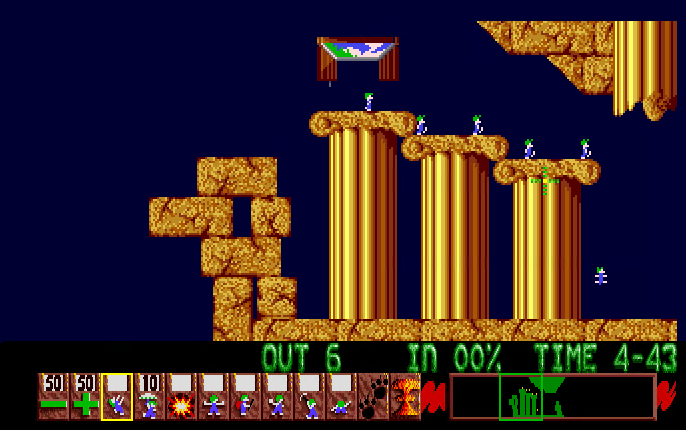
A stream of green-haired lemmings walks into a hazardous landscape. Left alone, they continue until a wall turns them around or a trap, fall, flame or pool stops them permanently. You assign one of eight skills: climber, floater, bomber, blocker, builder, basher, miner or digger.
The game’s brilliance is not the number of tools but how clearly they combine. A blocker buys time. A builder crosses a gap. A basher creates a route through a wall. The levels ration those actions, so the puzzle is partly about geometry and partly about budget.
Modern games often add mechanics to maintain novelty. Lemmings keeps asking better questions with the same compact vocabulary.
The tiny animation that became a game
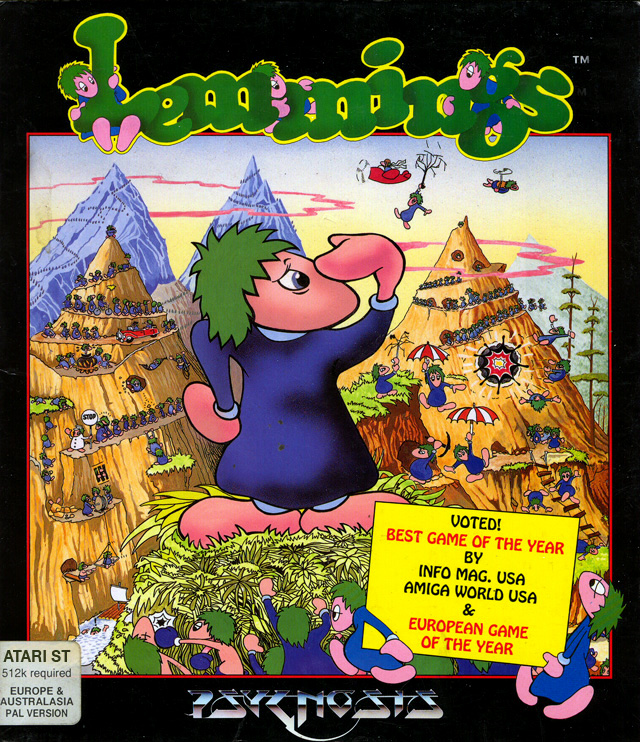
Mike Dailly’s history of DMA Design describes the tiny character experiment that led towards Lemmings and records the game’s release on 14 February 1991. He estimates that the original game, after its many conversions, passed 15 million copies worldwide.
I previously used a rough figure of 16 million. The sourced estimate from somebody who was there is the better number.
The origin story matters because the finished game retains the clarity of that tiny sprite. Even at a glance, you can tell which way a lemming is walking, whether it is building and where the danger lies.
Why it still works with my boys
The game makes failure legible. When a plan collapses, you can usually see why. The bridge began too late. The blocker faced the wrong crowd. The miner emerged below the exit. The children laughed at the disaster, then wanted another attempt.
That is different from an opaque failure where the game withholds the rule. Lemmings can be difficult, but the screen contains most of the information you need.
My older son completed the early Fun levels and started explaining solutions back to me. My younger son preferred the emergency decisions: pause, choose a skill, rescue the one lemming approaching the cliff. Both were participating rather than waiting for me to finish remembering 1991.
The Amiga version today
The original Amiga release remains the version I associate with the game: Psygnosis presentation, mouse control, familiar music and local two-player levels. It used level passwords rather than a modern save system, so describe it to children as a game from the password era rather than promising the convenience of a current puzzle game.
If you use an emulator, use your own legally acquired game image and document the emulator, model and controller or mouse settings. Timing and input feel are part of the experience.
Do not confuse the original with the mobile game
The current official iOS and Android title is a modern free-to-play reinterpretation. It contains advertising, in-app purchases, boosters, seasons, progression systems and a very large set of new levels. It may be enjoyable, but it is not a straight mobile edition of the 120-level Amiga campaign.
I previously said the original was available on Steam and described the mobile version as though it were a clean reissue. That was inaccurate. I could not find an official Steam release of the 1991 original during this update.
The Dad Filter
Worth buying?
Yes, when you can buy or legally access the version you want. A physical Amiga copy is a collector purchase. The modern mobile game is readily available but offers a different progression and business model.
Kid appeal
High. The objective is visible, the creatures are expressive and the skills can be demonstrated without a long tutorial.
Parent tolerance
High. This is a puzzle game adults can genuinely think about while a child contributes. The repeated music may eventually encourage use of the volume control.
Family play
Excellent. The single-player campaign naturally becomes collaborative because everybody can see the plan. The Amiga version also includes simultaneous two-player levels, where each side tries to save its own lemmings and interfere with the other player.
Time respect
Good. A level is a clear unit of play. The later levels can consume far more than the optimistic “five to fifteen minutes” I previously gave them, but you always know what problem you are attempting.
What has aged
- Selecting one lemming in a crowd can be fiddly.
- The password system is less convenient than modern saves.
- Later puzzles can demand precise timing and repeated attempts.
- Legal access to the original is less straightforward than it should be.
None of those weaknesses damages the central design. The skills remain readable and the levels still reward a good plan.
Verdict
Lemmings is not great “for its age.” It is a great puzzle game whose age explains some friction around saving, input and availability.
The personal test was straightforward. I put it in front of two boys who have access to much newer games. They understood the problem, began making plans and asked for another level. Nostalgia got the game onto the screen; design kept it there.
Sources
Related: read my Tomb Raider family replay, revisit another British home-computing memory in Chocks Away, or browse the TurboGeek Gaming hub.
Leave a Reply