
How Much Does It Cost to Make a PlayStation 5? (The Answer Has Changed a Lot)
Sony launched the PlayStation 5 at $499 in November 2020 — and immediately lost money on every unit it sold. That fact alone tells you something important about how consoles work. But the story of what it actually costs to build a PS5 has changed significantly since then, and understanding that story explains everything from the Slim redesign to the 2026 price hike.
TL;DR — PS5 Manufacturing Cost at a Glance
- What Goes Into a PS5? — Custom AMD chip, fast SSD, and vapour chamber cooling are the biggest cost drivers
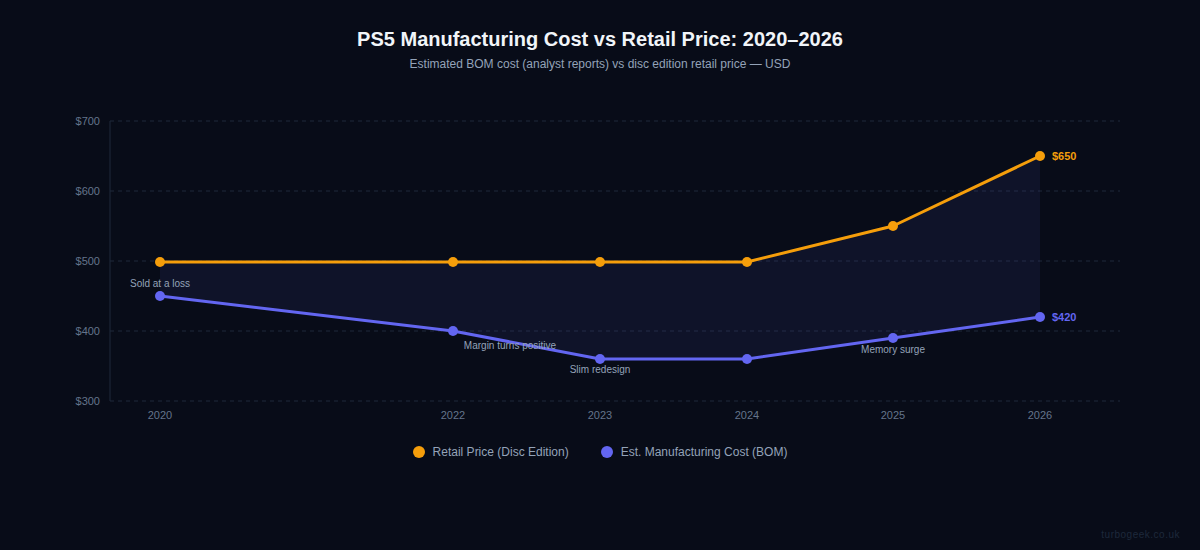
- Launch (2020) — ~$450 BOM, sold at a loss by design; Sony bet on software revenues
- Die-shrink era (2022–23) — AMD node shrink cut costs; margin turned positive for the first time
- PS5 Slim (2023–24) — Redesign for profit; BOM dropped to ~$360 at its lowest
- 2026 — Memory prices reversed the curve; BOM back to ~$420, prompting the retail price hike
| Year | Est. BOM Cost | Retail Price (Disc) |
|---|---|---|
| 2020 (launch) | ~$450 | $499.99 |
| 2022 | ~$400 | $499.99 |
| 2023 (Slim) | ~$360 | $499.99 |
| 2025 | ~$390 | $549.99 |
| 2026 | ~$420 | $649.99 |
New to console economics? Start with What Goes Into a PS5? — it sets up the components that drive the cost before we trace what happened to those costs over time.
What Goes Into a PS5?
The PS5’s price is driven by a handful of expensive components. Understanding them makes the cost story that follows much easier to follow.
The biggest single cost is the custom AMD APU — a chip that combines an 8-core Zen 2 CPU and an RDNA 2 GPU capable of 10.28 TFLOPS on a single die. It is a large, complex piece of silicon, and large silicon is expensive. Next is the 16GB GDDR6 unified memory — a shared pool used by both the CPU and GPU, which was already expensive at launch and has remained volatile. Third is the 825GB custom NVMe SSD: Sony designed a proprietary high-bandwidth interface that was significantly faster than anything in a consumer PC at the time, and that speed came at a cost.
Beyond the core silicon, the PS5 uses an unusually large vapour chamber cooling system — necessary to manage the heat output of that AMD chip, but more expensive than the heat pipes used in most consumer electronics. Add the Blu-ray drive, the DualSense controller with its haptic feedback and adaptive triggers, the chassis, PCB, assembly, and packaging, and you can see where $450 goes.
The Launch Cost (2020): Selling at a Loss
At launch in November 2020, industry teardown reports from iFixit, Bloomberg, and Nikkei Asia estimated the PS5’s bill of materials at around $450. At a retail price of $499.99, Sony was making roughly $50 per unit before distribution, marketing, and retail margin — which meant the real margin on hardware was close to zero, or negative.
Sony CFO Hiroki Totoki confirmed in 2021 that the company expected to sell the PS5 at a loss initially. This was a deliberate strategy, not an accident. The PlayStation model is to subsidise the hardware and recover profit through game sales (Sony takes roughly a 30% cut on every digital title) and PS Plus subscriptions. The PS3 launched at a staggering loss. The PS4 was near breakeven. The $499 launch price was not generous — it was the minimum Sony could charge without collapsing demand.
The Die-Shrink Era (2022–2023): Costs Start Falling
In 2022, Sony revised the PS5 motherboard. The CFI-1100 series introduced a smaller version of the AMD chip — what the industry calls a die-shrink. AMD moved the Oberon chip to a more refined manufacturing node, meaning the same transistor design is physically smaller. Smaller transistors mean more chips per wafer, fewer defective units, and a lower cost per chip.
The result was a meaningful BOM drop. Bloomberg and analyst estimates put it around $400 by end of 2022. With the retail price still at $499.99, Sony’s hardware margin turned positive for the first time — probably $70–$80 per unit before distribution costs. Three years of continued engineering had converted a loss-making product into a profitable one, without changing what the customer paid.
The PS5 Slim (2023–2024): Redesign for Profit
The PS5 Slim, launched in November 2023, was not just a cosmetic refresh. The CFI-2000 is a ground-up redesign with a smaller chassis, a revised mainboard, and a detachable disc drive sold separately for ~$80 rather than built in. BOM estimates by mid-2024 came in around $360.
At $499.99 retail, that left Sony clearing approximately $100–$120 per unit margin before distribution. The detachable drive also created a new revenue line. This is the product of three years of continuous cost engineering — and in a real sense, the people who bought the launch PS5 subsidised this version. Sony’s hardware business, which had been loss-making in 2020, was now consistently profitable.
Where Are We Now (2026)?
The cost curve reversed in 2025. AI data centre buildout accelerated demand for GDDR6 — the same memory used in the PS5 — and NAND flash. Production capacity that would have gone to consumer electronics was redirected to AI infrastructure. Prices rose. The PS5’s BOM crept back up to an estimated $420 by early 2026.
Sony raised retail prices by $100–$150 effective April 2, 2026. Even at $649.99 for the disc edition, Sony is clearing better margin than it was in 2022 at $499.99 — but the cost pressure is real. If memory prices remain elevated, the PS6’s launch price will be shaped by the same forces. Expect it to start higher than $499.
Frequently Asked Questions
How much does it cost Sony to make a PS5?
Around $420 in early 2026, based on analyst estimates. That is up from the Slim’s low of ~$360 in 2024, driven by rising GDDR6 and NAND prices caused by AI data centre demand consuming production capacity.
Did Sony lose money on the PS5?
Yes, at launch. The original PS5 cost around $450 to manufacture and sold for $499.99. After distribution and retail costs, Sony was close to breakeven or slightly loss-making per unit — by design. The strategy was to recover profit through game sales and PS Plus subscriptions.
Why does the PS5 cost so much to make?
Three main drivers: the custom AMD chip (a large, powerful piece of silicon), the high-speed proprietary SSD (faster than anything in a consumer PC at launch), and the oversized vapour chamber cooling system required to manage the chip’s heat output.
Related: Why Has the PS5 Gone Up in Price? Sony’s $100–$150 Hike Explained — the 2026 retail price hike in full detail.


Recent Comments