
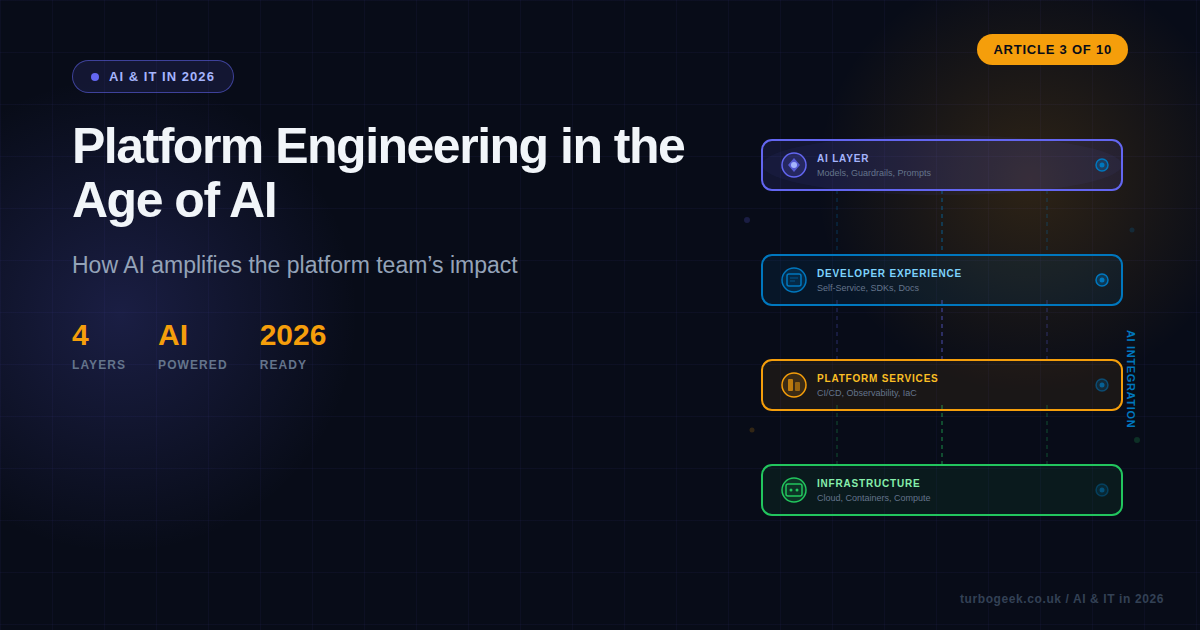
Platform engineering was already one of the fastest-growing disciplines in IT before AI entered the conversation. Now, in 2026, AI has not replaced the platform team — it has made them more important than ever. The organisations getting the most value from AI are the ones whose platform engineers built the foundations that make AI safe, scalable, and accessible to every development team.
This article explores how AI is changing the platform engineer’s toolkit, expanding their scope, and turning the platform team into the de facto AI enablement team for the entire organisation.
AI & IT in 2026 — Full Series
- 1. Where Businesses Are Actually Investing in AI in 2026
- 2. How AI Is Reshaping the Developer’s Daily Workflow
- 3. Platform Engineering in the Age of AI
- 4. The Security Risks Businesses Aren’t Talking About
- 5. The Hidden Risks of Embedding AI Into Your Workflows
- 6. AI and the IT Job Market: What’s Really Happening
- 7. What Happens to Engineers Who Refuse to Use AI
- 8. Is AI a Paradigm Shift? Lessons from Cloud and Virtualisation
- 9. The AI-Augmented IT Team: What 2027 Looks Like
- 10. Your Move: A Practical Framework for IT Professionals
TL;DR
- AI amplifies platform engineering rather than replacing it — the best AI adopters have the strongest platform teams.
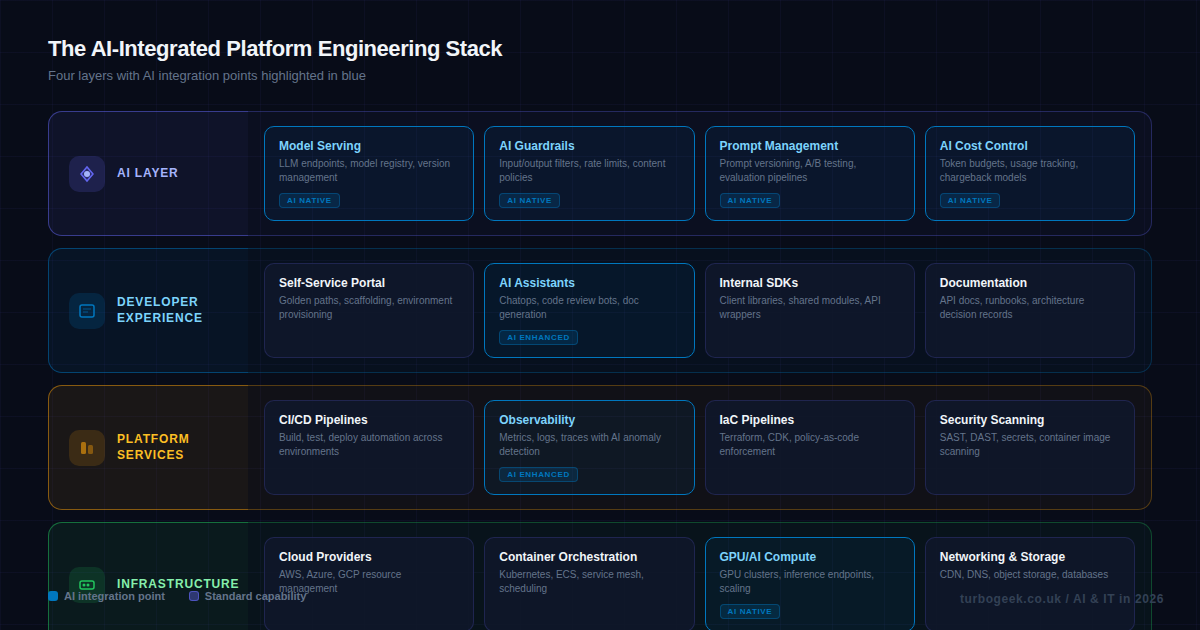
- Internal developer platforms now include AI capabilities: model serving, guardrails, prompt management, and cost control.
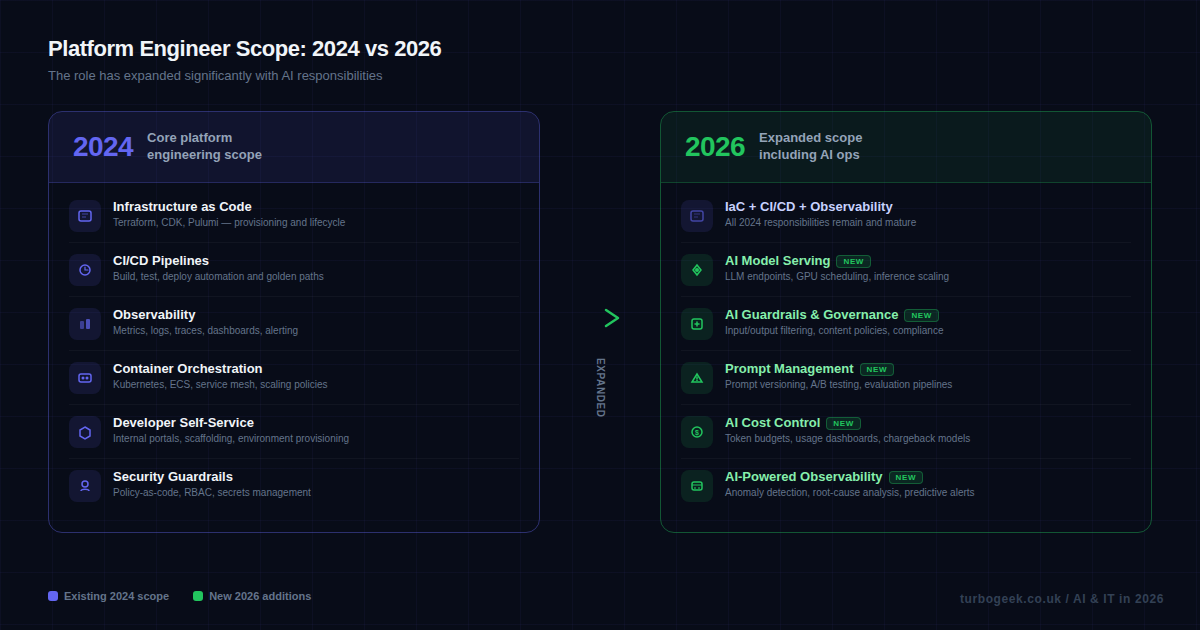
- The platform engineer’s scope has expanded significantly — from IaC and CI/CD to AI governance and AI ops.
- AI-powered observability, IaC generation, and self-service assistants are already changing how platform teams work day to day.
- Platform engineers who learn AI fundamentals now will define how their organisations use AI for years to come.
Start here: If you want the practical takeaway, skip to What platform engineers need to learn now — that section maps the skills gap and where to focus your time.
Platform engineering was already growing — AI accelerated it
Before AI became the boardroom topic it is today, platform engineering was already solving one of the hardest problems in software delivery: how do you give development teams the autonomy they need without letting every team reinvent the wheel on infrastructure, security, and deployment?
The answer was the internal developer platform (IDP) — a curated set of tools, golden paths, and self-service capabilities that let developers ship faster while the platform team maintained consistency and governance underneath.
AI has not changed that mission. It has expanded it. Now the platform team is not only responsible for making infrastructure accessible — they are responsible for making AI accessible, safe, and cost-effective across the entire organisation. Every team that wants to embed an LLM, run an AI-assisted code review, or deploy a model to production needs the platform team to have built the foundations first.
This is why platform engineering has accelerated rather than stalled. Organisations that tried to skip the platform layer and let individual teams adopt AI independently ended up with fragmented tooling, inconsistent security policies, and spiralling costs. The ones that got it right had a platform team that treated AI as another set of services to be integrated, governed, and offered through the same self-service model that already worked for infrastructure.
How AI changes the platform engineer’s toolkit
The day-to-day work of a platform engineer in 2026 looks noticeably different from even two years ago. The fundamentals — Terraform, Kubernetes, CI/CD pipelines, observability stacks — are all still there. But AI has introduced new capabilities that change how platform engineers build and operate their platforms.
AI-assisted IaC generation
Writing Terraform modules or CDK constructs has always been one of the more time-consuming parts of platform work. In 2026, AI coding assistants can generate first drafts of infrastructure code that are surprisingly close to production-ready. Tools like Claude Code and GitHub Copilot understand Terraform syntax, AWS provider schemas, and common patterns well enough to scaffold a module in minutes rather than hours.
The platform engineer’s job has not disappeared — it has shifted upstream. Instead of writing every line of HCL from scratch, they review AI-generated code against organisational standards, ensure policy compliance, and maintain the golden paths that other teams consume. The craft is in knowing what good infrastructure looks like and being able to evaluate whether AI output meets that bar.
AI-powered observability
Observability has always been a core platform concern. What has changed is that AI can now process the volume of signals — metrics, logs, traces — at a speed and scale that no human team could match. AI-powered anomaly detection spots patterns that rule-based alerting misses. Root-cause analysis tools correlate events across services and suggest probable causes before an engineer has finished reading the first alert.
This does not make the platform engineer redundant. It makes them faster. They spend less time on triage and more time on prevention. They configure the AI models that power detection, tune the thresholds, and decide which signals matter. The observability stack is still a platform concern — it just has a much more capable engine underneath.
Smarter CI/CD pipelines
AI is also making pipelines more intelligent. Predictive test selection — running only the tests most likely to catch regressions based on the code changes in a pull request — reduces build times without sacrificing confidence. AI-powered security scanning catches vulnerabilities earlier and with fewer false positives. Some teams are using AI to automatically generate release notes, changelog entries, and deployment summaries.
None of this replaces the pipeline. It makes it better. And it is the platform team that integrates, configures, and maintains these AI-enhanced pipeline stages.
AI-powered self-service — the developer experience shift
The biggest visible change for developers consuming the platform is the rise of AI-powered self-service. Instead of searching through a wiki or filing a ticket to understand how to deploy a new service, developers can ask an AI assistant that has been trained on the organisation’s internal documentation, runbooks, and architecture decision records.
This is not a hypothetical. Organisations are already building internal chatbots that sit on top of their platform documentation and can answer questions like “how do I set up a new microservice with our standard observability stack?” or “what is the approved way to connect to the shared PostgreSQL cluster?” The AI does not replace the documentation — it makes it discoverable.
Platform engineers are the ones building and maintaining these assistants. They curate the knowledge base, manage the prompt templates, set up the retrieval-augmented generation (RAG) pipeline, and ensure the assistant gives accurate answers that align with current platform standards. When the assistant gives wrong advice, it is the platform team that fixes it — just as they would fix a broken Terraform module or an incorrect runbook.
The result is a measurably better developer experience. Teams onboard faster, ask fewer repetitive questions in Slack, and follow golden paths more consistently because the AI assistant actively guides them there. For the platform team, it is a force multiplier — they can support more teams without growing headcount proportionally.
The expanded scope — governance, safety, AI ops
Perhaps the most significant shift is in scope. Platform engineers have always been responsible for making infrastructure safe and consistent. In 2026, that responsibility extends to AI.
AI guardrails and governance
When a product team wants to embed an LLM into a customer-facing feature, someone has to ensure that the model cannot leak sensitive data, generate harmful content, or produce outputs that violate regulatory requirements. That “someone” is increasingly the platform team. They build the guardrails layer — input/output filters, content policies, rate limits, and audit logging — as a shared service that product teams consume rather than reinvent.
This is governance engineering, and it is a natural extension of the policy-as-code work that platform teams were already doing for infrastructure. The principles are the same: define rules centrally, enforce them automatically, give teams visibility into what was blocked and why.
AI cost control
AI is expensive. LLM API calls, GPU compute for inference, fine-tuning jobs — the costs add up quickly, and without visibility they can spiral. Platform teams are building AI cost dashboards, implementing token budgets per team or project, and creating chargeback models that make consumption visible.
This is FinOps for AI, and it follows the same pattern as cloud cost management. The platform team provides the tooling and visibility; the product teams make informed decisions about how much AI capability they actually need.
Model serving and AI ops
Running models in production is an operational concern that looks a lot like running any other service — except with GPUs, larger memory footprints, and different scaling characteristics. Platform teams are adding model serving to their portfolio: managing inference endpoints, handling model versioning and rollback, scheduling GPU resources, and monitoring model performance and drift.
For many platform teams, this is the biggest new capability they have had to build since containers went mainstream. It requires new skills, new tooling, and new patterns — but the engineering discipline is the same.
What platform engineers need to learn now
If you are a platform engineer reading this and wondering where to focus, here is a practical breakdown of the skills that matter most right now.
| Skill Area | Why It Matters | Where to Start |
|---|---|---|
| AI/ML fundamentals | You need to understand models, inference, and training at a conceptual level to make good platform decisions | Fast.ai practical courses, Anthropic docs |
| GPU infrastructure | GPU scheduling, CUDA drivers, and inference optimisation are becoming core platform concerns | NVIDIA developer docs, Ray/vLLM |
| LLM API patterns | Understanding tokens, context windows, and rate limits is essential for building guardrails and cost controls | Build a RAG prototype with your own docs |
| AI security | Prompt injection, data leakage, and adversarial inputs are new attack surfaces you need to defend | OWASP Top 10 for LLMs |
| FinOps for AI | AI costs scale differently from traditional compute — you need new models for budgeting and chargeback | FinOps Foundation AI cost resources |
You do not need to become a machine learning engineer. You need to understand enough about how models work to make sound infrastructure and governance decisions. The parallel is cloud computing: you did not need to build a hypervisor to be a good platform engineer, but you needed to understand how VMs, containers, and networking worked well enough to build reliable platforms on top of them.
The platform engineers who invest time in AI fundamentals now will be the ones defining how their organisations use AI for years to come. That is not a threat — it is an opportunity. Platform engineering has always been about making complex capabilities accessible and safe. AI is simply the next complex capability.
The platform team is the AI enablement team
Here is the bottom line: in most organisations, the platform team is becoming the AI enablement team whether they planned to or not. They are the ones with the infrastructure skills, the governance mindset, and the engineering discipline to make AI work at scale. Product teams build the features, data teams build the models, but the platform team builds the foundation that makes it all production-ready.
If you are a platform engineer, this is your moment. The skills you have spent years building — IaC, CI/CD, observability, security, developer experience — are exactly the skills needed to make AI work in practice. You are not being replaced. You are being promoted to a bigger, harder, and more impactful version of the same job.
And if you are a leader wondering where to invest, invest in your platform team. Give them the time and resources to learn AI fundamentals, experiment with new tooling, and build the AI layer into your internal developer platform. The organisations that do this well will ship AI features faster, more safely, and more cost-effectively than those that treat AI adoption as something every team should figure out on their own.
I would love to hear how your platform team is approaching AI. Are you already building AI guardrails? Struggling with GPU scheduling? Wrestling with AI cost visibility? Let me know in the comments — this is a conversation worth having.
Previous: How AI Is Reshaping the Developer’s Daily Workflow | Next: The Security Risks Businesses Aren’t Talking About
Leave a Reply