
AI & IT in 2026 — Full Series
- 1. Where Businesses Are Actually Investing in AI in 2026
- 2. How AI Is Reshaping the Developer’s Daily Workflow
- 3. Platform Engineering in the Age of AI
- 4. The Security Risks Businesses Aren’t Talking About
- 5. The Hidden Risks of Embedding AI Into Your Workflows
- 6. AI and the IT Job Market: What’s Really Happening
- 7. What Happens to Engineers Who Refuse to Use AI
- 8. Is AI a Paradigm Shift? Lessons from Cloud and Virtualisation
- 9. The AI-Augmented IT Team: What 2027 Looks Like
- 10. Your Move: A Practical Framework for IT Professionals
TL;DR
- The productivity gap between AI-augmented and non-augmented engineers is now visible to management, and that gap is widening
- Healthy scepticism is valuable — AI hallucinations, data privacy, and over-reliance are legitimate concerns that deserve attention
- Total refusal is different from caution — opting out entirely carries genuine career risks around hiring, role scope, and team dynamics
- AI sceptics serve a vital function — they catch errors, enforce quality, and prevent the uncritical adoption that creates real damage
- The middle path — engage critically, use AI where it helps, push back where it does not, and keep your judgement sharp
New to this series? Start with Article 1: Where Businesses Are Actually Investing in AI for the business context, or Article 6: AI and the IT Job Market for the employment landscape that sets the scene for this piece.
Not Everyone Is Wrong to Resist
Let me be direct from the start: this is not a threat piece. I am not here to tell you that refusing to use AI will end your career, and I am not here to suggest that everyone who has reservations about AI is a Luddite clinging to irrelevance. The reality is more nuanced than either of those positions, and it deserves an honest look.
AI adoption across IT engineering is not universal. Some engineers have embraced it fully, some use it selectively, and some have opted out entirely. Each of those positions exists for reasons worth understanding. What I want to explore in this article is what actually happens — practically, professionally, and within teams — when an engineer decides that AI tools are not for them.
The answer is not simple. There are valid reasons for caution and real consequences of total refusal. Both of those things can be true simultaneously.
Where We Are on the Adoption Curve
Before we get into the arguments, it helps to understand where AI adoption currently sits in IT engineering. The technology adoption lifecycle — that classic bell curve from Everett Rogers — gives us a useful frame.
In early 2024, AI coding tools were firmly in the early adopter phase. By mid-2025, the early majority had arrived. Now, in April 2026, we are in transition between the early and late majority. Most engineering teams have at least some AI tooling in their workflow. It is no longer experimental — it is becoming expected.
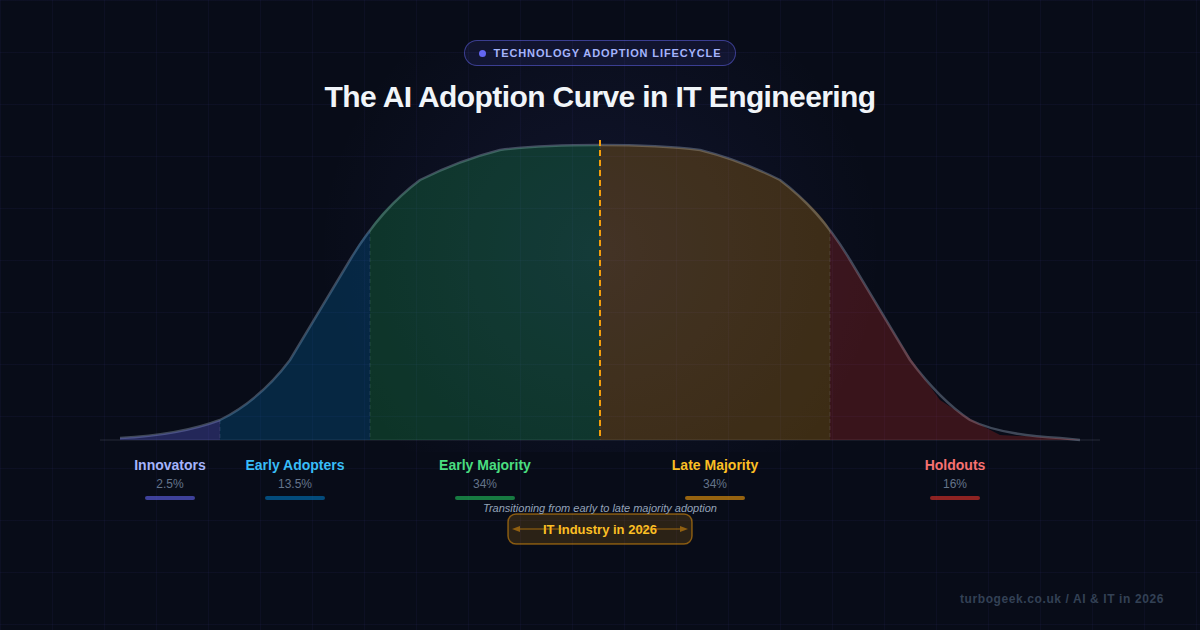
That positioning matters because the dynamics change at each stage. When AI was a novelty, not using it was unremarkable. When it is mainstream, not using it becomes a visible choice — one that colleagues, managers, and hiring panels increasingly notice.
The Productivity Gap — How Visible Is It?
The most immediate consequence of refusing AI tools is a productivity difference. This is not theoretical. Engineering managers are now seeing measurable differences in output between teams that use AI and those that do not.
GitHub’s own controlled study measured developers completing a coded task 55% faster with Copilot than without. Independent work tells a similar story: Accenture’s longitudinal RCT reported an 8.7% lift in pull requests per developer and an 84% increase in successful builds, with 90% of developers saying they felt more fulfilled in their job. The shape of the effect is consistent across studies, even where the magnitude varies. These are not small differences, and they are becoming harder to ignore in sprint retrospectives and performance reviews.
But — and this is a critical “but” — speed is not the only metric that matters. The engineer who takes longer but produces code with fewer bugs, better abstractions, and clearer documentation is not automatically less valuable than the one who ships faster with AI assistance. The problem is that organizations do not always measure those things well. Throughput is visible. Quality is often invisible until something breaks.
If you choose not to use AI, you need to be aware that the productivity gap exists and is visible. You do not have to agree with the way it is measured, but pretending it is not there will not serve you well.
Healthy Skepticism vs Total Refusal
There is an important distinction that often gets lost in discussions about AI adoption: the difference between healthy skepticism and total refusal. They are not the same thing, and they lead to very different outcomes.
Healthy skepticism looks like this: you use AI tools but verify their output. You understand their limitations. You refuse to let AI-generated code go into production without review. You raise concerns about data privacy, hallucinations, and vendor lock-in. You push back when leadership treats AI as a magic productivity multiplier without accounting for its costs. This position is not only defensible — it is valuable.
Total refusal looks different: you will not use any AI tools, full stop. You will not learn how they work. You will not engage with the conversation about where they might or might not be appropriate. You have made a binary decision, and you expect the world to respect it.
The first position makes you a better engineer. The second position creates friction—not because you are wrong about AI’s limitations, but because you have removed yourself entirely from the conversation.
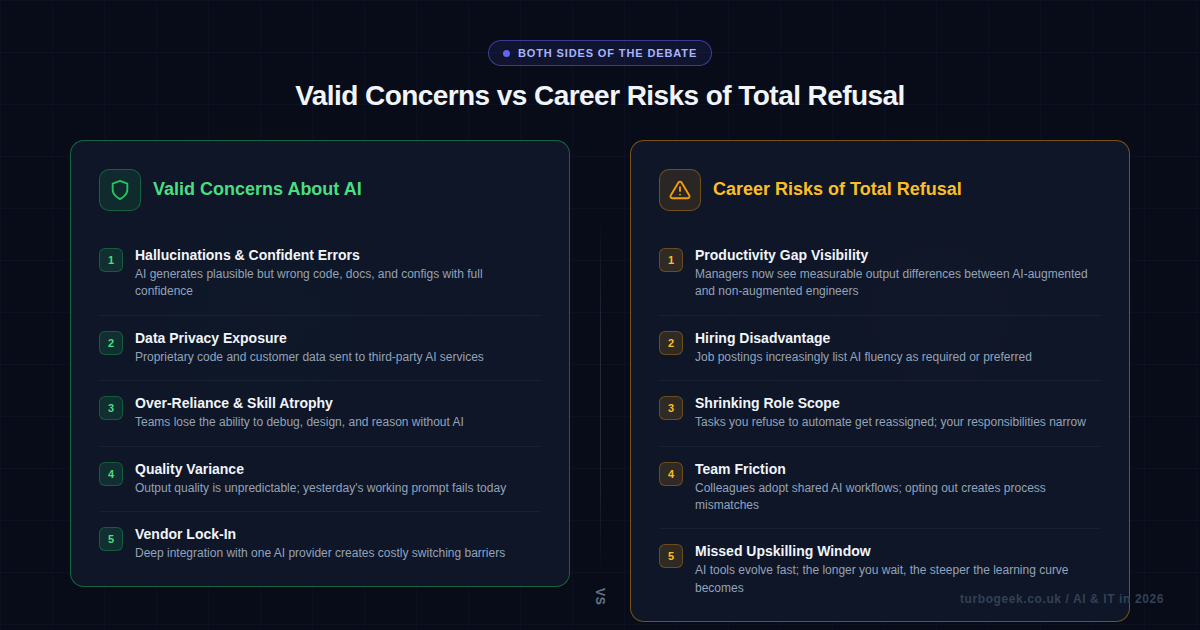
Both columns in the diagram above are real. AI does hallucinate, it creates privacy risks, and it encourages over-reliance. But total refusal also narrows your role, creates team friction, and closes a window that gets harder to open later. The question is not which column is right — it is how you navigate between them.
The Hiring Signal — What Job Posts Are Saying
Whether we like it or not, AI fluency is becoming part of the hiring conversation. A quick search on any major job board in 2026 shows the trend clearly: “experience with AI coding tools” or “familiarity with LLM-based development workflows” now appear in a significant minority of engineering job descriptions. It is not yet universal, but it is growing.
This does not mean you cannot get hired without AI skills. Plenty of roles, particularly in regulated industries, embedded systems, and infrastructure, do not mention AI at all. But the trajectory is clear. In five years, AI fluency will likely be as expected as Git proficiency is today. Nobody puts “must know version control” on job posts anymore because it is simply assumed.
For engineers who are mid-career, this creates a strategic question: do you want to learn these tools on your own terms, at your own pace, while you have the luxury of time? Or do you want to learn them under pressure when a future job search demands it?
I am not saying you must adopt AI tools today. I am saying that understanding what they do and where they fall short is becoming part of professional literacy in this field. You can be critical of AI and still know how it works. In fact, the most effective critics are the ones who understand the technology deeply enough to identify its real problems rather than its imagined ones.
The Devil’s Advocate Value — Why Skeptics Matter
Here is something that rarely gets acknowledged in the AI enthusiasm cycle: skeptics are essential. They serve a function that enthusiasts cannot.
When an AI coding assistant generates 200 lines of plausible-looking code, it takes a skeptical engineer to ask: Does this actually handle edge cases? Has it introduced a security vulnerability? Is it following our architectural patterns or has it invented its own? Is this even the right approach, or has the AI just given us the most statistically likely solution?
The engineers who ask these questions are not obstacles to progress. They are guardrails against the very real risk of uncritical AI adoption — the kind that produces subtle bugs, security holes, and technical debt that only becomes visible months or years later.
Every team needs someone who is willing to say, “I do not trust this output — show me why it is correct.” That is not resistance. That is quality engineering. The best AI-augmented teams I have seen are not the ones where everyone blindly accepts AI output. They are the ones where AI enthusiasm and healthy skepticism exist in productive tension.
The problem arises when skepticism becomes dogma. When “I want to verify this” turns into “I refuse to engage with this at all,” you lose the ability to be an effective critic. You cannot meaningfully challenge AI-generated code if you do not understand how the tools produce it. The most powerful position is informed skepticism — deep enough knowledge to know exactly where AI fails, paired with the willingness to use it where it genuinely helps.
The Cost of Refusal vs the Cost of Blind Adoption
If I had to summarise the entire debate, it would be this: both refusal and blind adoption have costs, and the engineers who thrive will be the ones who avoid both extremes.
| Position | Strengths | Risks |
|---|---|---|
| Total refusal | Avoids AI pitfalls, maintains deep manual skills | Productivity gap, hiring disadvantage, shrinking role |
| Critical adoption | Best of both worlds: speed with quality checks | Requires ongoing effort to evaluate and verify |
| Blind adoption | Maximum short-term speed | Skill atrophy, undetected errors, and security risks |
The engineer who refuses all AI tools pays a cost in visibility, productivity perception, and career optionality. The engineer who accepts all AI output uncritically pays a cost in quality, security, and professional judgment. The middle ground — critical, informed, selective adoption — is harder work than either extreme, but it is where the real professionals will land.
This is not about AI being good or bad. It is about how you engage with a tool that is becoming part of software engineering’s infrastructure. You can choose your level of engagement. But choosing no engagement at all, in a field that is changing around you, is itself a decision with consequences.
My advice, for what it is worth: be the skeptic who knows, not the skeptic who refuses to look. Use the tools enough to understand their failure modes. Push back where they fall short. Demand better from the vendors, the managers, and the colleagues who treat AI as infallible. That position — informed, critical, engaged — is not a compromise. It is the strongest place to stand.
In the next article in this series, we will zoom out and ask a bigger question: is AI actually a paradigm shift on the scale of cloud computing and virtualization, or is it something else entirely? The historical parallels — and the differences — might surprise you.
AI & IT in 2026 — Full Series
- 1. Where Businesses Are Actually Investing in AI in 2026
- 2. How AI Is Reshaping the Developer’s Daily Workflow
- 3. Platform Engineering in the Age of AI
- 4. The Security Risks Businesses Aren’t Talking About
- 5. The Hidden Risks of Embedding AI Into Your Workflows
- 6. AI and the IT Job Market: What’s Really Happening
- 7. What Happens to Engineers Who Refuse to Use AI
- 8. Is AI a Paradigm Shift? Lessons from Cloud and Virtualization
- 9. The AI-Augmented IT Team: What 2027 Looks Like
- 10. Your Move: A Practical Framework for IT Professionals
Leave a Reply