
We have spent nine articles examining how AI is reshaping IT from every angle — where businesses are investing, how developer workflows have changed, what platform engineering looks like, the security risks nobody talks about, the hidden dangers of embedding AI into workflows, the job market reality, what happens when engineers refuse to adapt, whether this is truly a paradigm shift, and what the AI-augmented team of 2027 will look like. That is a lot of analysis. But analysis without action is just commentary.
This final article is different. It is not about trends or predictions. It is about you — specifically, what you should actually do with everything we have discussed. I want to give you a practical framework for assessing where you stand, understanding your risks, and building a concrete plan to strengthen your position. Whether you are a senior architect or a junior engineer, the framework applies.
AI & IT in 2026 — Full Series
- 1. Where Businesses Are Actually Investing in AI in 2026
- 2. How AI Is Reshaping the Developer’s Daily Workflow
- 3. Platform Engineering in the Age of AI
- 4. The Security Risks Businesses Aren’t Talking About
- 5. The Hidden Risks of Embedding AI Into Your Workflows
- 6. AI and the IT Job Market: What’s Really Happening
- 7. What Happens to Engineers Who Refuse to Use AI
- 8. Is AI a Paradigm Shift? Lessons from Cloud and Virtualisation
- 9. The AI-Augmented IT Team: What 2027 Looks Like
- 10. Your Move: A Practical Framework for IT Professionals
TL;DR — Your Career Framework at a Glance
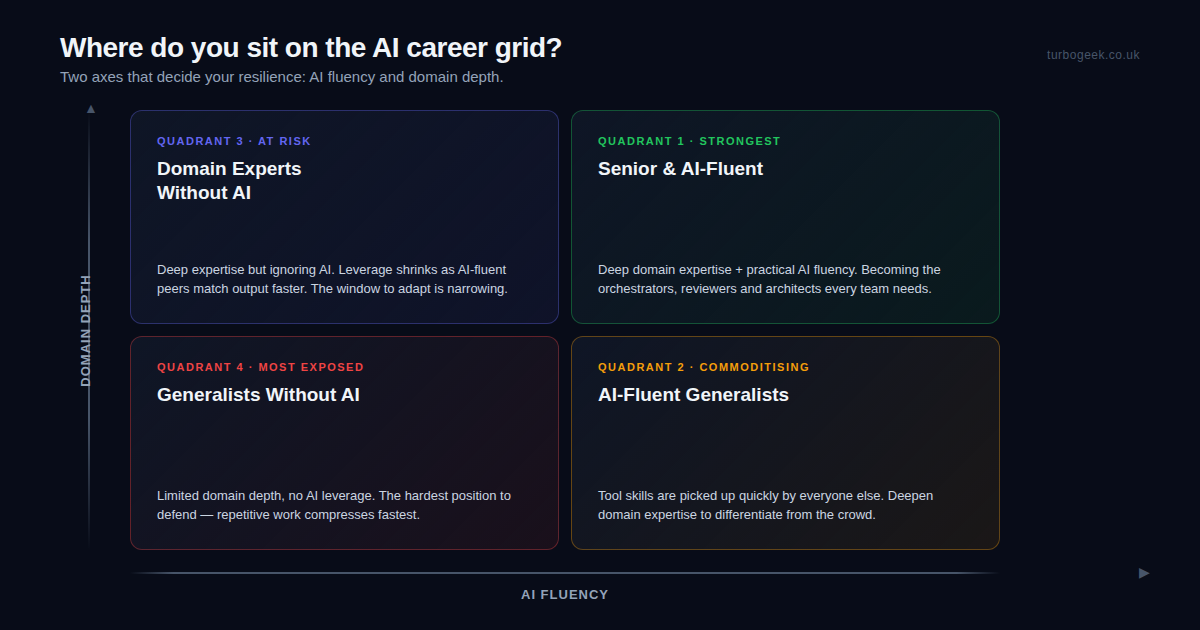
- The 2×2 framework: Your career resilience sits on two axes — AI fluency and domain depth. The strongest position combines both; the riskiest has neither
- Domain experts who ignore AI: Your leverage is declining as AI-fluent peers achieve comparable results faster — the window to adapt is narrowing
- AI-fluent generalists: Tool skills alone are commoditised quickly — deepen your domain expertise to differentiate yourself from everyone else who learnt the same tools
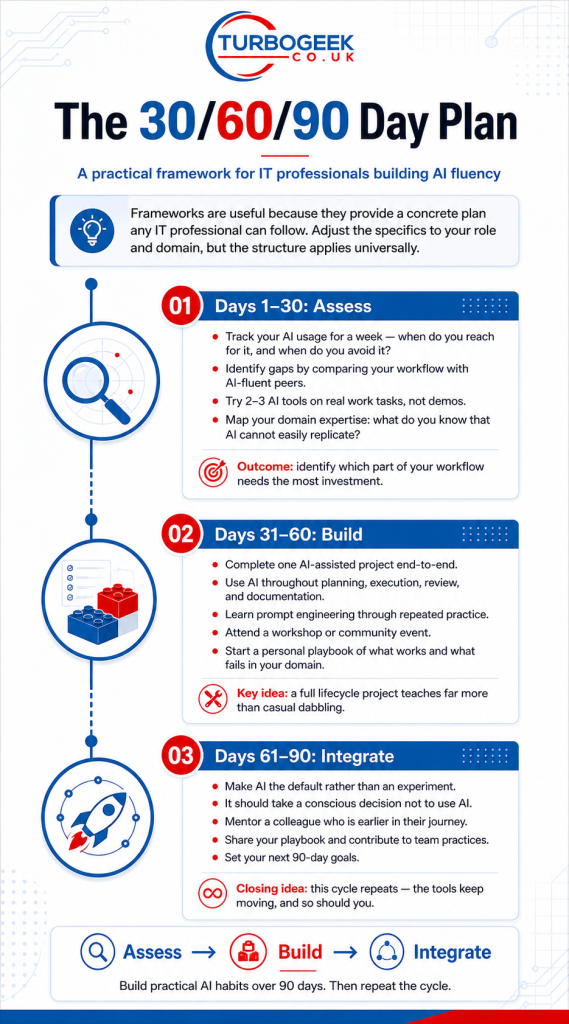
- The 30/60/90 plan: Assess your position (days 1-30), build real AI skills through a complete project (days 31-60), then integrate AI into your daily workflow and share knowledge (days 61-90)
- The meta-skill: The ability to adapt when tools change matters more than mastery of any single tool — this has always been true in IT, and it has never been more important
The Framework: Two Axes That Define Your Position
I have been thinking about this for months, and the simplest way to understand where any IT professional stands currently comes down to two dimensions: AI fluency and domain depth.
AI fluency is about practical, working competence — can you use AI assistants effectively in your daily work? Can you craft prompts that get useful results? Do you know when to trust AI output and when to question it? Can you integrate AI into real workflows, not just toy experiments?
Domain depth is the expertise you have built in your specific area — networking, security, cloud architecture, database design, front-end engineering, DevOps, whatever your specialisation is. It is the knowledge that takes years to develop, the understanding of why things work the way they do, the pattern recognition that comes from solving hundreds of similar problems.
Plot those two dimensions on a 2×2 grid, and four distinct patterns emerge. Each one carries different risks and requires different actions.
Step 1: High AI Fluency + Deep Domain — The Strongest Position
If you have genuine expertise in your domain and you are fluent with AI tools, you are in the strongest possible position. This is the ideal that every IT professional should strive for.
Why is this combination so powerful? AI amplifies existing expertise rather than replacing it. As we explored in Article 2, the developers thriving in 2026 are the ones who combine deep technical knowledge with AI fluency to produce work that neither skill alone could achieve. The AI handles the mechanical parts; the domain expert handles the judgment calls.
The key advantage is that domain depth gives you something AI doesn’t have: judgment. You know which AI suggestions are plausible but wrong. You can spot the subtle errors that look correct to someone without your experience. As we discussed in Article 5, AI makes mistakes that require human expertise to catch, and domain experts are best equipped to do that. For example, a senior network engineer with 15 years of expertise is faster and operates at a fundamentally different level with AI fluency.
If you are here, your priority is maintenance: keep your domain knowledge current, stay engaged with AI tool developments, and look for opportunities to combine the two to create outsized value. You are likely already doing this naturally — the challenge is to avoid complacency.
Step 2: High AI Fluency + Shallow Domain — The Commoditisation Risk
This part is deceptively comfortable; you can produce impressive output quickly. You might even outperform domain experts who have not yet adopted AI. But your position is easily replicated. AI tool skills can be learned relatively quickly, and anyone who learns the same tools reaches the same level of capability you have.
We saw this play out in Article 6: the job market is polarising between people who can be replaced by AI-assisted generalists and people who bring irreplaceable domain knowledge. Your prompt engineering skills are valuable today, but they are replaceable as AI tools get easier to use and more people develop the same competencies.
If you are here, your priority is depth. Pick a domain and go deep. Learn the theory behind the practice, understand failure modes and edge cases. Learn the historical context of why things work the way they do and combine your existing AI fluency with genuine domain expertise.
Steps 3 and 4: The AI-Resistant Positions
The remaining two parts share a common characteristic: low AI fluency. The difference between them is whether you have domain depth to fall back on — and that difference matters enormously.
High domain depth, low AI fluency (Declining Leverage). Your situation is not yet critical, but the trajectory might be concerning. As we explored in Article 7, peers who have embraced AI are achieving comparable results in less time. Your deep knowledge still gives you an edge in complex judgment calls, but that gap is widening. And as Article 8 illustrates, change follows a pattern — gradual adoption, then a tipping point, then rapid normalization. I argue that we are approaching that tipping point.
If you are here, start with AI tools that complement your existing expertise. Security specialist? Try AI-assisted threat analysis. Database expert? Use AI for query optimization. You do not need to become an AI expert — you need to use AI within your domain. The barrier is lower than you think.
Low domain depth, low AI fluency (Highest Risk). Unfortunately, this is the most exposed position. Without deep expertise or AI skills to fall back on, you are most vulnerable to being replaced by AI. If you have an aptitude for a particular domain, lean into that while picking up basic AI fluency alongside it. If you are early in your career, consider developing AI fluency first—it will make you more productive faster. Either way, start this week.
The 30/60/90 Day Plan
Frameworks are useful because they provide a concrete plan that any IT professional can follow, regardless of where they currently sit. Here are some ideas for adjusting the specifics to your role and domain.
Days 1-30: Assess
The first month is about honest self-assessment. Track your AI usage for a week — when do you reach for it, when do you avoid it? Identify gaps by comparing your workflow to AI-fluent peers. Try 2-3 AI tools on real work tasks, not demos. Map your domain expertise: what do you know that AI cannot easily replicate? This will help show which framework axis needs the most investment.
Days 31-60: Build
The second month shifts from assessment to construction. The single most important action is completing one AI-assisted project end-to-end — something real, in your domain, using AI for planning, execution, review, and documentation. The experience of a complete lifecycle with AI is qualitatively different from dabbling. Learn prompt engineering, attend a workshop or team event about AI (I bet there are some taking place in your business), and start building a personal playbook of what works and what fails in your specific area.
Days 61-90: Integrate
In the third month, AI should start becoming the default rather than an experiment. You should require a conscious decision not to use AI, rather than a conscious decision to use it. Mentor a colleague who is earlier in their journey, teaching consolidates learning and builds collective fluency. Share your playbook, contribute to team practices, and set your next 90-day goals.
Adaptability
If there is one overarching lesson from this entire series, it is this: the specific tools matter far less than the ability to adapt when tools change.
This has always been true in IT. The engineers who thrived through the cloud transition were not necessarily the first to learn AWS; they were the ones who could learn any cloud platform quickly because they understood the underlying principles.
It’s the same with AI: Claude, Copilot, Gemini — these are the current generation. The next generation will be different. What will not change is the skill of integrating new tools into effective workflows, evaluating their output critically, and combining them with deep domain knowledge.
Closing the Series
Across ten articles, we have traced AI’s impact on IT from business investment through developer workflows, platform engineering, security risks, embedding dangers, the job market, the consequences of refusal, historical parallels, and the shape of tomorrow’s teams. The picture is nuanced: AI is genuinely transformative but not magic. It amplifies competence and exposes gaps in equal measure. It rewards adaptability and punishes rigidity.
Your move. You know the score. You have the framework. You have a 90-day plan you can start tomorrow. The only question is whether you will. I would love to hear where you place yourself on the 2×2 — drop a comment below or find me on social media.
This is the final article in the AI & IT in 2026 series. If you have missed any of the earlier articles, the series navigation box above will take you to each one. Thank you for reading the full series.
Leave a Reply