
The productivity story around AI is well established by now. Developers shipping faster. Ops teams automating toil. Entire workflows compressed from hours to minutes. But there is a conversation that most organisations are not having loudly enough: what happens when those same AI tools become attack vectors?
This is not a theoretical concern. In 2026, businesses are deploying AI into production at speed, often without the security frameworks to match. The risks are real, they are growing, and most teams are only just starting to acknowledge them.
AI & IT in 2026 — Full Series
- 1. Where Businesses Are Actually Investing in AI in 2026
- 2. How AI Is Reshaping the Developer’s Daily Workflow
- 3. Platform Engineering in the Age of AI
- 4. The Security Risks Businesses Aren’t Talking About
- 5. The Hidden Risks of Embedding AI Into Your Workflows
- 6. AI and the IT Job Market: What’s Really Happening
- 7. What Happens to Engineers Who Refuse to Use AI
- 8. Is AI a Paradigm Shift? Lessons from Cloud and Virtualisation
- 9. The AI-Augmented IT Team: What 2027 Looks Like
- 10. Your Move: A Practical Framework for IT Professionals
TL;DR
- AI-generated code introduces subtle vulnerabilities at a scale that manual review cannot keep pace with.
- Prompt injection is the new SQL injection — and most organisations have no defences against it.
- Data leakage through AI services is a compliance blind spot, especially for regulated industries.
- Shadow AI usage means your security team does not even know which tools are processing your data.
- The policy gap is the biggest risk of all — most organisations have no AI security policy whatsoever.
AI-Generated Code and the Vulnerability Factory
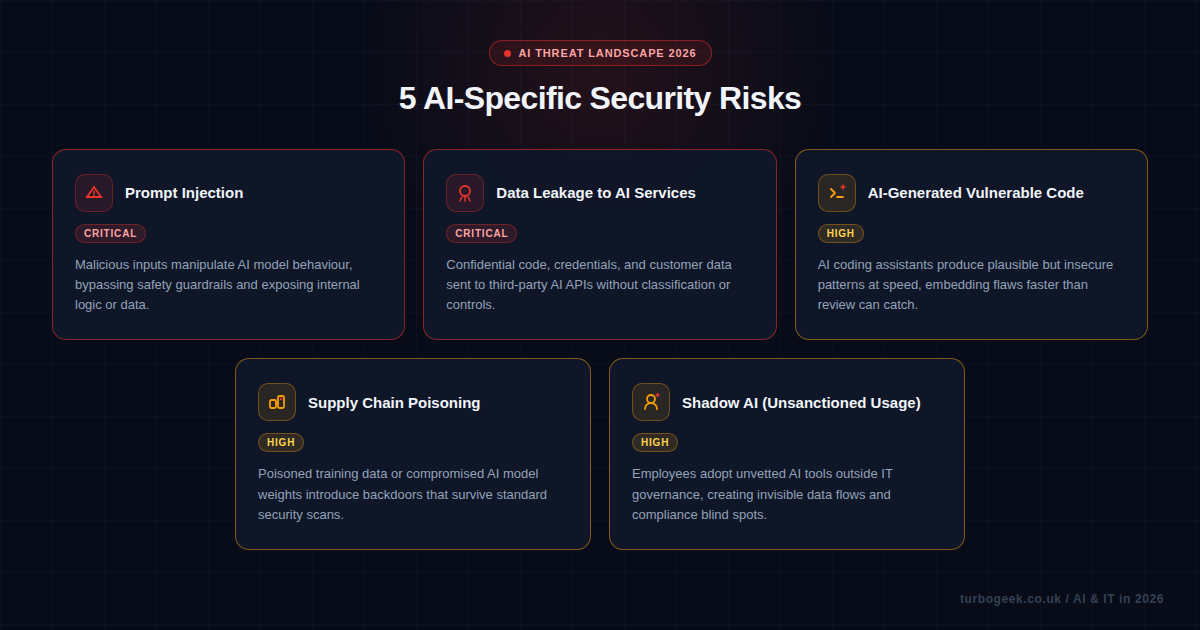
Let me start with the risk that sits closest to home for any development team. AI coding assistants are now embedded in most developer workflows. They suggest functions, complete boilerplate, and generate entire modules. The output looks clean, the tests pass, and the PR gets merged. Job done.
Except that AI models learn from the vast corpus of open-source code — including code with known vulnerabilities. When a model suggests a database query, it might produce something that works perfectly but is vulnerable to injection. When it generates authentication logic, it might omit edge cases that a seasoned security engineer would catch instinctively. The code compiles. It passes linting. It even passes a cursory code review. But the vulnerability is there, waiting.
The scale problem is what makes this genuinely dangerous. A single developer might introduce a vulnerability once a quarter through carelessness. An AI coding assistant can introduce the same class of vulnerability across dozens of files in a single afternoon. When every developer on a team is accepting AI suggestions at speed, the attack surface grows proportionally.
This does not mean AI coding tools are inherently unsafe. It means that teams need to treat AI-generated code with the same rigour they would apply to any third-party library — static analysis, security scanning, and human review with security explicitly in scope. The problem is that most teams are not doing this. They review AI code for correctness, not for security.
Prompt Injection: The Attack Nobody Is Ready For
If you have been in IT long enough, you remember the era when SQL injection was a novelty. Developers were building web applications that concatenated user input directly into database queries, and nobody thought twice about it — until the first wave of breaches made it impossible to ignore. Prompt injection is following the same trajectory, and we are still in the “nobody thinks twice about it” phase.
Prompt injection works by crafting inputs that manipulate an AI model’s behaviour. If your application uses a large language model to process customer queries, a carefully constructed input can override the system prompt, extract internal instructions, or cause the model to behave in ways it was explicitly designed not to. This is not a hypothetical attack — it has been demonstrated repeatedly against production systems throughout 2025 and into 2026.
What makes prompt injection particularly challenging is that there is no simple fix. SQL injection has parameterised queries. Cross-site scripting has content security policies. Prompt injection has… nothing definitive yet. The AI security community is developing guardrails, input validation layers, and output filtering, but there is no equivalent of a prepared statement for natural language inputs. Every mitigation is probabilistic rather than deterministic.
For businesses building AI-powered features — chatbots, document summarisers, code assistants, customer service agents — this is a live risk right now. If your product accepts user input and passes it to a language model, you need to assume that adversarial users will attempt prompt injection. The question is not whether it will happen, but whether your team has thought about it at all.
Data Leakage: Where Does Your Code End Up?
Every time a developer pastes code into a cloud AI service, that data leaves your organisation’s control. Every time a support agent feeds a customer transcript into ChatGPT to draft a response, that conversation data enters a third-party system. Every time a marketing team uploads a strategy document to an AI summariser, that intellectual property is processed by infrastructure you do not own.
This is happening at enormous scale, and most organisations have no visibility into it. Shadow AI — the use of unsanctioned AI tools by employees — is the 2026 equivalent of shadow IT. The difference is that shadow IT involved employees installing Dropbox; shadow AI involves employees sending proprietary data to external services that may retain, train on, or expose that data.
The compliance implications are significant. If your organisation is subject to GDPR, sending personal data to an AI service without appropriate data processing agreements is a breach. If you work in financial services, healthcare, or defence, the data classification requirements are even more stringent. Yet the average employee using an AI tool does not think about data classification — they think about getting their task done faster.
Some AI providers have responded with enterprise tiers that promise data isolation, no training on customer data, and regional data residency. These are welcome developments. But they only apply when the organisation has deliberately chosen and configured them. The developer using the free tier of an AI coding tool, or the analyst pasting financial data into a public chatbot, is operating entirely outside those protections.
The AI Security Policy Gap
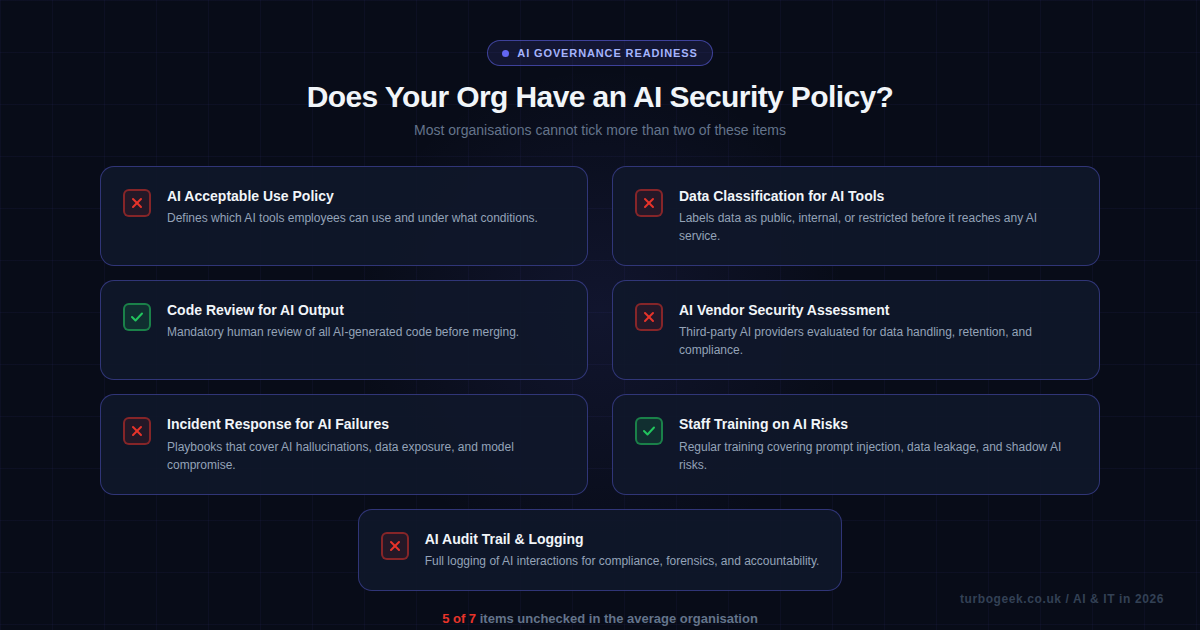
Here is the uncomfortable truth that ties all of these risks together: most organisations have no AI security policy. Not a weak one. Not an incomplete one. None at all.
They have acceptable use policies that were written before AI tools existed. They have data classification frameworks that do not account for data being sent to AI services. They have incident response playbooks that do not cover AI-specific failure modes. They have vendor assessment processes that do not evaluate AI providers’ data handling practices.
The gap is understandable. AI adoption has moved faster than governance in almost every organisation. The tools arrived, the productivity gains were immediate, and the security implications were deferred. But “deferred” is rapidly becoming “overdue.”
An AI security policy does not need to be a hundred-page document. At minimum, it should answer these questions:
- Which AI tools are approved for use? Distinguish between enterprise-licensed tools with data protections and free-tier public services.
- What data can be sent to AI services? Define clear boundaries — public data only, anonymised data, or specific classifications.
- How is AI-generated code reviewed? Ensure security scanning is part of the review process, not just functional testing.
- What happens when an AI system fails? Define incident response procedures for hallucinations, data exposure, or adversarial attacks.
- Who is accountable? Assign clear ownership for AI security within the organisation — typically shared between security, engineering, and legal.
If your organisation cannot answer these questions today, you are not alone. But you are exposed.
Supply Chain Risks and Model Integrity
Beyond the immediate risks of AI usage, there is a deeper concern around the AI supply chain itself. The models your organisation relies on were trained on data you did not curate, by teams you may not have vetted, using infrastructure you do not control. This is an enormous trust assumption.
Training data poisoning — where malicious data is deliberately introduced into training sets — can embed subtle biases or backdoors into models. A compromised model might behave normally in most scenarios but produce manipulated outputs when triggered by specific inputs. Detecting this is extraordinarily difficult because the model’s behaviour looks correct in standard testing.
Open-source AI models, increasingly popular for on-premises deployment, add another dimension. Downloading a model from a public repository is analogous to pulling an unverified Docker image — you inherit whatever was built into it. Model provenance, integrity verification, and supply chain security are areas that the industry is only beginning to address.
For most organisations, the practical advice is straightforward: know your model providers, understand their security posture, and do not assume that “open source” means “audited.” Apply the same supply chain scrutiny to AI models that you would to any critical software dependency.
Security Must Catch Up With Adoption
None of this is an argument against AI adoption. The productivity benefits are genuine, and organisations that refuse to adopt AI tools will fall behind. But there is a difference between informed adoption and reckless deployment, and too many organisations are closer to the latter than they would like to admit.
The pattern is familiar. Every major technology shift — cloud computing, mobile, APIs, containers — has gone through an adoption phase where capability outpaced security. The organisations that navigated those transitions successfully were the ones that built security into their adoption strategy rather than bolting it on after the first breach.
AI is no different. The window to be proactive is closing. Start with a policy. Build awareness across your teams. Integrate security scanning into your AI-assisted development workflows. Assess your AI vendors. Map your data flows. These are not heroic efforts — they are table stakes for responsible AI adoption in 2026.
The security risks are real, but they are manageable. The only unmanageable risk is the one you refuse to acknowledge.
What does your organisation’s AI security posture look like? Have you seen any of these risks play out in practice? I would love to hear your experiences — drop a comment below or find me on LinkedIn.
Leave a Reply