
TL;DR — AI and the IT Job Market
- Not disappearing — IT jobs are being restructured, not eliminated; the market is shifting shape rather than shrinking
- Roles are evolving — junior devs, DevOps, QA, security and support roles all still exist but the daily work looks fundamentally different
- New categories — AI ops, prompt engineering, AI safety, and human-AI workflow design are now real job titles with real salaries
- Mid-level squeeze — the biggest pressure is on repetitive mid-level work, not entry-level or senior positions
- Hiring hasn’t slowed — companies still can’t hire fast enough; the bottleneck shifted from writing code to reviewing it
AI & IT in 2026 — Full Series
- 1. Where Businesses Are Actually Investing in AI in 2026
- 2. How AI Is Reshaping the Developer’s Daily Workflow
- 3. Platform Engineering in the Age of AI
- 4. The Security Risks Businesses Aren’t Talking About
- 5. The Hidden Risks of Embedding AI Into Your Workflows
- 6. AI and the IT Job Market: What’s Really Happening
- 7. What Happens to Engineers Who Refuse to Use AI
- 8. Is AI a Paradigm Shift? Lessons from Cloud and Virtualisation
- 9. The AI-Augmented IT Team: What 2027 Looks Like
- 10. Your Move: A Practical Framework for IT Professionals
“AI will take your job.” You’ve heard it. I’ve heard it. Your manager has heard it and is quietly wondering whether to mention it in the next all-hands. The narrative has been running hot for two years now, swinging between two extremes: either we’re all about to be replaced by machines, or AI is a minor tool that changes nothing fundamental. Neither position is close to accurate.
I’ve spent the last year watching what’s actually happening on the ground — in hiring pipelines, in team structures, in job descriptions that have quietly shifted underneath the same titles. The reality is far more nuanced than the headlines suggest, and in many cases far more interesting. The IT job market isn’t shrinking. It’s restructuring. And if you understand the shape of that restructuring, you can position yourself on the right side of it.
This is article six in the AI & IT in 2026 series. If you’ve been following along, you’ll know the previous articles covered the risks of embedding AI into workflows and the security blind spots that most businesses are ignoring. This one tackles the question that sits underneath all of that: what does this mean for the people doing the work?
Which Roles Are Actually Changing (and How)
Let’s start with the five IT roles that have changed the most visibly. Not hypothetically — these shifts are already happening in teams I work with and organisations I talk to.
The diagram below maps it out. Each role still exists, but the daily work has transformed.
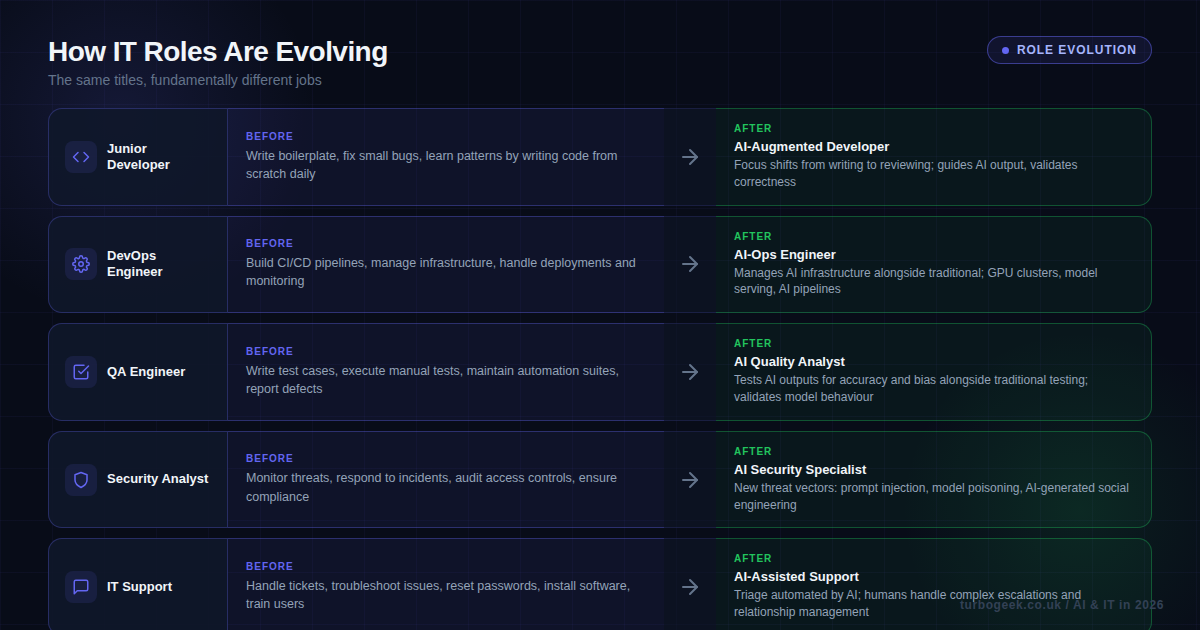
Junior developers haven’t been replaced — but the job has changed fundamentally. Two years ago, a junior’s day was writing boilerplate, fixing small bugs, and learning patterns through repetition. Today, AI generates the boilerplate. The junior’s value has shifted to reviewing that output, spotting when the AI has made subtly wrong assumptions, and understanding why a particular pattern is correct rather than just reproducing it. That’s actually a harder skill. The juniors who thrive now are the ones who can read critically, not just write quickly.
DevOps engineers have seen their scope widen rather than narrow. They still manage CI/CD pipelines and infrastructure, but now they’re also responsible for GPU clusters, model serving infrastructure, and AI-specific monitoring. The title is shifting toward “AI-Ops” in some organisations, though many still use the DevOps label for a role that’s substantially different from what it was in 2024.
QA engineers face the most interesting evolution. Traditional test automation hasn’t gone away — you still need regression suites and integration tests. But now there’s an entire additional dimension: testing AI outputs. Is the model producing accurate results? Is it biased? Does it behave differently with different input demographics? This is specialised work that requires a different mindset from traditional QA, and teams are struggling to find people who can do both.
Security analysts are dealing with threat vectors that simply didn’t exist before. Prompt injection, model poisoning, AI-generated phishing at scale, data exfiltration through model outputs — these are new attack surfaces that require new expertise. The role hasn’t shrunk; it’s expanded into territory that most security professionals weren’t trained for.
IT support has been the most visibly affected by automation, but not in the way people expected. AI handles the simple tickets — password resets, standard software installations, basic troubleshooting. But the complex cases still require humans, and those cases now come pre-triaged by AI, which means support staff spend more time on genuinely difficult problems. The role has become more skilled, not less.
The New Roles That Didn’t Exist Two Years Ago
While existing roles evolve, entirely new job categories have appeared. These aren’t theoretical — they’re on job boards right now, with competitive salaries and growing demand.
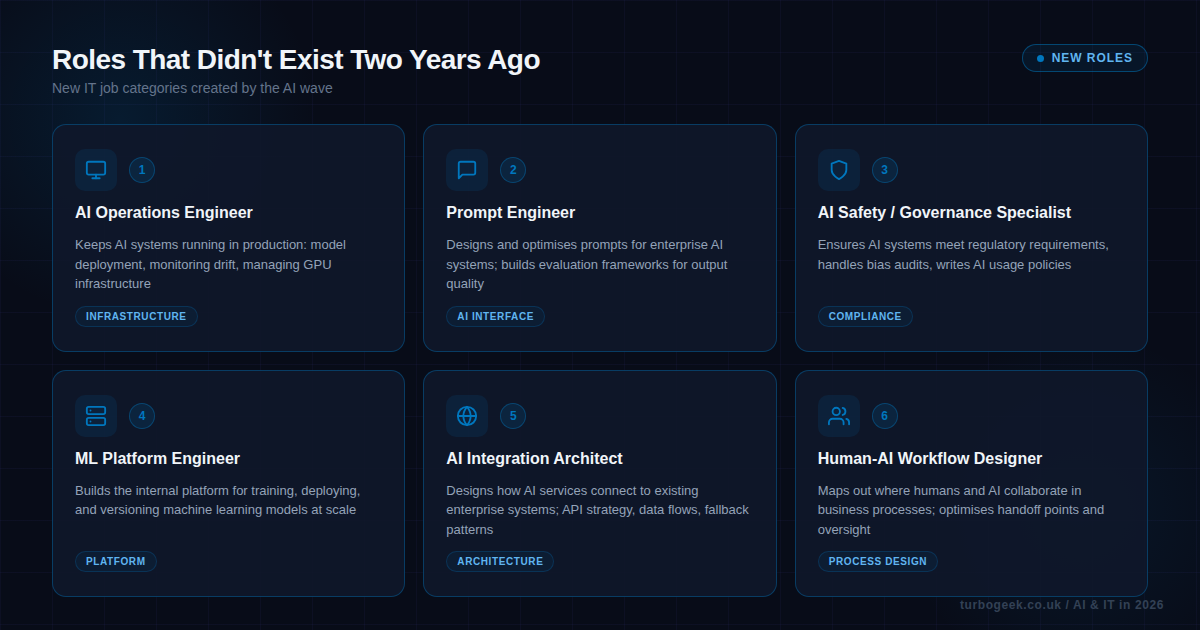
AI Operations Engineers keep AI systems running in production. This isn’t data science — it’s infrastructure engineering with a specialisation in model deployment, drift monitoring, and GPU resource management. Think of it as DevOps for machine learning, and it’s one of the hardest roles to fill right now.
Prompt Engineers were briefly treated as a joke title — “you’re paying someone to talk to ChatGPT?” — but the enterprise reality is different. When an AI system handles thousands of customer interactions daily, the quality of the prompt architecture directly affects revenue. Good prompt engineers build evaluation frameworks, design systematic testing approaches, and iterate on prompt chains that can be version-controlled and deployed like any other code.
AI Safety and Governance Specialists sit at the intersection of technology, law, and ethics. With the EU AI Act now in effect and similar legislation appearing globally, every company deploying AI at scale needs someone who understands both the technical systems and the regulatory landscape. These roles are often filled by people who moved sideways from compliance, legal, or senior engineering positions.
ML Platform Engineers build the internal infrastructure that makes machine learning possible at scale — training pipelines, model registries, feature stores, experiment tracking. It’s platform engineering, but for a completely new stack.
AI Integration Architects design how AI services connect to existing enterprise systems. This is where the real complexity lives: API strategy, data flow design, fallback patterns for when models fail, and ensuring that AI capabilities degrade gracefully rather than catastrophically.
Human-AI Workflow Designers are perhaps the most interesting new role. They map out business processes and determine where humans and AI should collaborate, where handoffs happen, and what level of human oversight each step requires. It’s part business analysis, part UX design, part systems thinking.
The Mid-Level Squeeze
Here’s the finding that surprises most people: the biggest pressure isn’t on junior roles or senior roles. It’s on the middle.
Specifically, it’s on mid-level work that’s repetitive and well-defined. Writing CRUD endpoints. Building standard integrations. Producing reports from structured data. Creating documentation from existing code. These are tasks that AI handles competently, and they represent a significant portion of what many mid-level engineers spend their time doing.
This doesn’t mean mid-level engineers are being made redundant. What it means is that the definition of “mid-level” is shifting upward. The work that used to justify a mid-level salary — competent execution of well-understood patterns — is now partially automated. To stay at that level, you need to bring something that AI can’t: judgement about trade-offs, understanding of business context, the ability to mentor juniors who are now reviewing AI output rather than writing from scratch.
Entry-level roles, counterintuitively, are somewhat protected. Companies still need people learning the fundamentals, and the learning process itself hasn’t been automated. You can’t skip understanding how systems work just because AI can generate the code. Senior roles are protected for the opposite reason: the judgement, architecture decisions, and leadership they provide are precisely the things AI is worst at.
The squeeze is real, but it’s not about losing jobs. It’s about the bar for “mid-level” rising. The engineer who was comfortable executing tickets without questioning the approach needs to become the engineer who questions the approach, because the execution is increasingly handled by tooling.
What Hiring Managers Are Actually Looking For
I’ve spoken to hiring managers across a range of organisations — startups, enterprises, consultancies — and the patterns are remarkably consistent. Here’s what’s actually changed in hiring criteria:
Code review skills matter more than code writing skills. When AI generates the first draft, the human value is in reviewing, catching subtle errors, and knowing when the AI’s approach is technically correct but architecturally wrong. Interviewers are increasingly testing candidates’ ability to critique code rather than produce it from a blank page.
Systems thinking trumps syntax knowledge. Nobody cares whether you can write a binary search from memory when AI can generate one in seconds. What matters is understanding when a binary search is the right approach, what its limitations are, and how it fits into the broader system. Hiring has shifted toward design discussions and architecture problems rather than algorithmic coding challenges.
AI fluency is table stakes, not a differentiator. Eighteen months ago, “experience with AI coding tools” was a nice-to-have on job specs. Now it’s assumed. The differentiator has moved to how effectively you use these tools — whether you can prompt well, when you know to override the AI’s suggestion, and how you verify AI-generated output.
Communication skills have become more important, not less. This surprises people, but it makes sense. When AI handles more of the execution, the human’s job increasingly involves explaining decisions, aligning stakeholders, and translating between technical and business domains. The “heads-down coder who doesn’t talk to anyone” archetype is becoming harder to justify.
Adaptability is the number one trait. Every hiring manager I spoke to mentioned some version of this. They’re not looking for people who know a specific tool or framework — they’re looking for people who can learn new tools quickly, because the tooling landscape is changing so fast that today’s expertise is next year’s legacy knowledge.
The Bottom Line: Restructuring, Not Shrinking
The IT job market in 2026 is not shrinking. Total IT employment continues to grow. What’s happening is a redistribution: some types of work are being automated, new types of work are appearing, and existing roles are being redefined around what humans do best — judgement, creativity, communication, and oversight.
Companies still can’t hire fast enough. The bottleneck has shifted — it used to be “we can’t find enough people to write code,” and now it’s “we can’t find enough people to review, architect, and oversee AI-assisted work.” That’s not a smaller problem; it’s a different one.
If you’re an IT professional reading this and feeling anxious, here’s the honest assessment: the doomsayers are wrong, but so are the people telling you nothing needs to change. The ground is moving under everyone’s feet. The professionals who will thrive are the ones who understand the shift and move with it, rather than either panicking or pretending it isn’t happening.
In the next article, I’ll look at the flip side of this question: what actually happens to engineers who refuse to use AI tools? The answer is more complex than you’d think.
Leave a Reply