
AI & IT in 2026 — Full Series
- 1. Where Businesses Are Actually Investing in AI in 2026
- 2. How AI Is Reshaping the Developer’s Daily Workflow
- 3. Platform Engineering in the Age of AI
- 4. The Security Risks Businesses Aren’t Talking About
- 5. The Hidden Risks of Embedding AI Into Your Workflows
- 6. AI and the IT Job Market: What’s Really Happening
- 7. What Happens to Engineers Who Refuse to Use AI
- 8. Is AI a Paradigm Shift? Lessons from Cloud and Virtualisation
- 9. The AI-Augmented IT Team: What 2027 Looks Like
- 10. Your Move: A Practical Framework for IT Professionals
TL;DR
- AI is becoming a first-class team member, not just a tool in someone’s IDE
- Teams are getting smaller but more senior — reviewers and orchestrators replace individual contributors
- The split: AI handles generation, triage, and routine fixes; humans own architecture, judgement, and customer decisions
- New roles are emerging: AI Integration Specialist, AI Safety/Quality Lead, AI Orchestrator
- The best teams treat AI as a capability multiplier, not a headcount replacement
New to this series? Start with Article 1: Where Businesses Are Actually Investing for the full context on how AI is reshaping IT in 2026.
A Morning in 2027
It is 8:47 on a Tuesday morning. Sarah, a senior developer at a mid-sized fintech company, opens her laptop and checks the overnight summary. Not from a colleague — from the team’s AI systems.
Three pull requests were generated overnight from the backlog. Two dependency updates were already tested and merged by the automated review pipeline. A production alert at 3am was triaged, root-caused, and a fix was proposed — waiting for human approval before deployment.
Sarah’s job this morning is not to write code. It is to review what the AI produced, approve the incident fix, and spend two hours on the architectural design for a new payments integration that no AI system can reliably handle alone.
This is not science fiction. This is the trajectory we are on right now. And it is going to change what IT teams look like in ways that most organisations have not started planning for.
What AI Handles vs What Humans Handle
The mistake most people make when thinking about AI in teams is imagining a binary: either AI does the job or a human does. Reality is far more nuanced. Every task sits somewhere on a spectrum, and the split varies dramatically depending on what you are doing.
Here is where things are heading based on what I am seeing right now across teams adopting AI tooling seriously:
AI takes the lead (60-70% AI): Code generation, boilerplate, test scaffolding, documentation drafts, log analysis, and routine bug fixes. These are the tasks where AI is already faster and often good enough on the first pass. The human role here is review and refinement — catching the 15% of cases where the AI gets it subtly wrong.
Genuine partnership (40-50% each): Debugging complex issues, incident response triage, performance optimisation, and refactoring legacy code. AI does the initial investigation and suggests approaches. Humans bring the contextual knowledge — why was this code written this way? What business constraint shaped this decision three years ago?
Humans take the lead (70-95% human): Architecture decisions, code review for correctness and intent, customer-facing product decisions, cross-team coordination, and anything involving organisational politics or stakeholder management. AI can surface options and data, but humans make the calls.
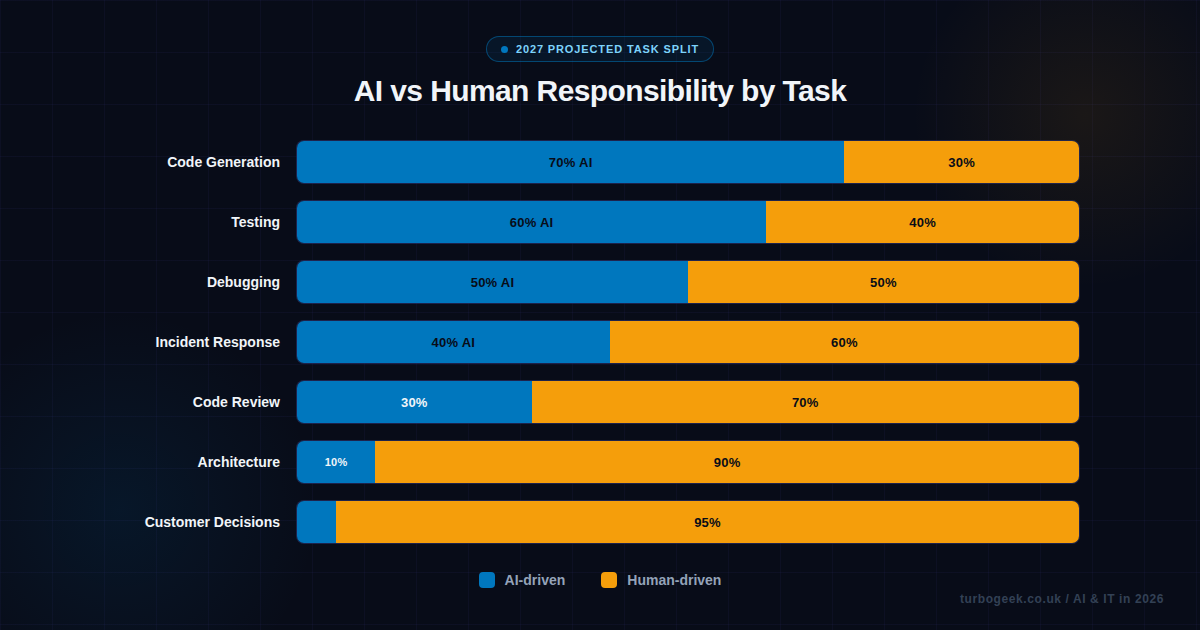
The pattern is clear: the more a task requires context, judgement, and understanding of human needs, the more it remains human. The more it requires speed, pattern matching, and processing volume, the more it shifts to AI.
Team Structure Evolution — The Ratios Are Changing
If you look at a typical 12-person development team in 2024, you will find a familiar structure. A tech lead, four seniors, three mid-level developers, two juniors, a QA engineer, and a DevOps specialist. It is the pyramid shape that most of us grew up in professionally.
By 2027, that same team’s output could be delivered by eight people — but the composition changes significantly. The pyramid flattens. The junior and mid-level “production” roles shrink because AI handles much of the code generation that those roles traditionally performed. What grows is the review, orchestration, and quality assurance layer.
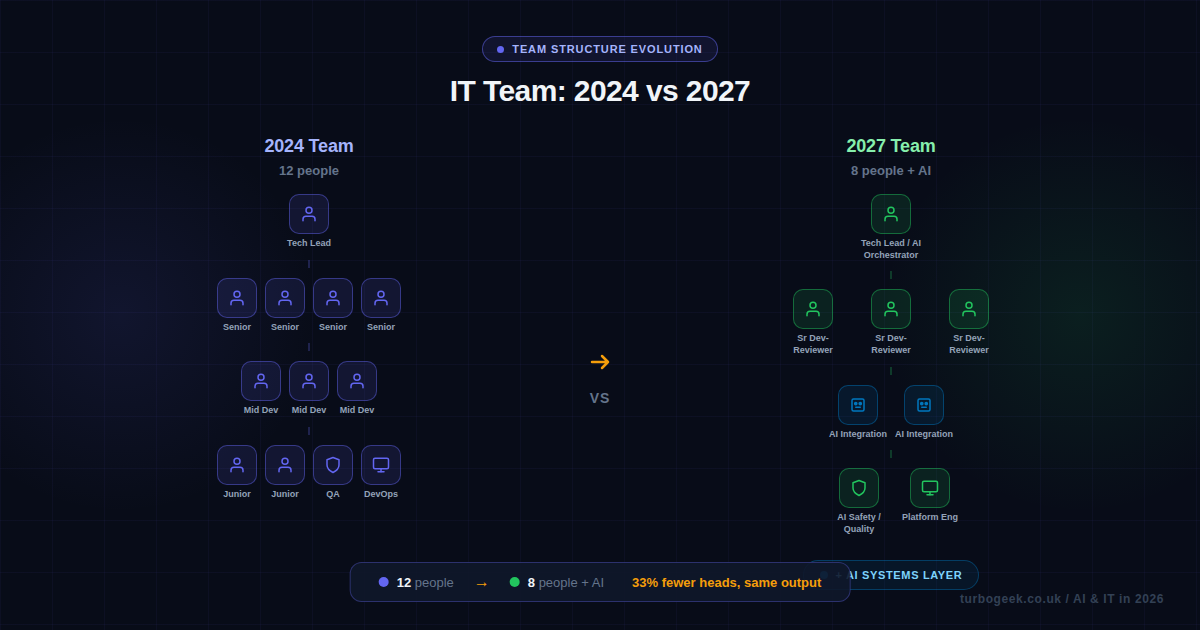
The 2027 team looks different in several important ways:
- Tech Lead becomes AI Orchestrator — their job shifts from managing people writing code to managing the workflow between AI systems and human reviewers. They define what gets delegated to AI and what requires human attention.
- Senior Devs become Dev-Reviewers — they spend less time writing code from scratch and more time reviewing, correcting, and guiding AI-generated output. Their deep domain knowledge becomes the quality gate.
- AI Integration Specialists emerge — a new role focused on maintaining the AI toolchain, fine-tuning models on company codebases, building custom prompts and workflows, and ensuring AI systems integrate properly with existing infrastructure.
- AI Safety/Quality becomes essential — someone must own the question: “Is the AI-generated output actually correct, secure, and aligned with our standards?” This is not traditional QA. It requires understanding both the AI systems and the domain.
I want to be clear about something: this is not about sacking four people and calling it efficiency. The best organisations I am watching are using this shift to redeploy talent, not eliminate it. The developers who were writing boilerplate are moving into review roles, learning architecture, or specialising in AI integration. The team gets smaller but significantly more senior.
The Review-and-Orchestrate Model
The biggest mental shift for most developers is moving from a “write” culture to a “review-and-orchestrate” culture. This sounds abstract until you see it in practice.
In a traditional workflow, a developer receives a ticket, designs a solution, writes the code, writes the tests, submits a PR, and iterates on feedback. They might spend 60-70% of their day writing code.
In the review-and-orchestrate model, the flow looks more like this:
- Define the task — write a clear specification or prompt that describes what needs to be built, including edge cases, constraints, and quality requirements
- Delegate to AI — the AI system generates an initial implementation, tests, and documentation
- Review critically — examine the output for correctness, security issues, performance concerns, and alignment with architectural standards
- Iterate and refine — provide feedback to the AI, request changes, or manually adjust where needed
- Approve and integrate — merge the work, monitor the deployment, and capture learnings for future tasks
The developer still needs deep technical skill — arguably more than before, because reviewing code for subtle errors requires stronger understanding than writing it yourself. But the nature of the work shifts from production to curation.
I have spoken to several team leads who describe it as similar to the shift from individual contributor to manager, but without the people management overhead. You are directing output rather than producing it directly. The skill becomes knowing what good looks like and being able to spot when the AI has produced something that looks correct but is not.
The developers who thrive in 2027 will not be the fastest coders. They will be the best reviewers — the ones who can look at AI-generated output and instantly know whether it is right, almost right, or dangerously wrong.
What to Build Toward Now
If you are leading a team, or you are an individual contributor thinking about where to focus your development, here is what I would prioritise based on everything we have covered in this series:
| Skill Area | Why It Matters | How to Start |
|---|---|---|
| Code Review Depth | You become the quality gate for AI output | Review PRs daily with a focus on intent, not just syntax |
| Architecture and System Design | AI cannot design systems — only implement within them | Take on design tasks, study distributed systems patterns |
| AI Toolchain Literacy | Understanding how to configure, prompt, and manage AI tools | Experiment with multiple AI coding assistants in depth |
| Specification Writing | Clear specs produce better AI output — garbage in, garbage out | Practice writing detailed task descriptions with constraints |
| Security and Quality Assessment | AI-generated code needs human security review | Learn OWASP patterns, study common AI code vulnerabilities |
For team leads and managers: Start experimenting now. Run a pilot where one team member spends a sprint using AI for 80% of their code generation and documents the experience. Measure not just velocity but quality, security, and developer satisfaction. The teams that figure out the review-and-orchestrate model earliest will have a significant advantage.
For individual contributors: Do not wait for your organisation to hand you an AI strategy. Start using AI tools in your daily work and develop an opinion about where they help and where they do not. The engineers who understand AI’s limitations from experience — not just from reading articles like this one — will be the ones who move into the orchestrator and specialist roles.
For organisations: Think carefully about how you frame this transition. “We are replacing developers with AI” is a recipe for talent flight and poor morale. “We are augmenting our teams so our best people can focus on the hardest problems” is not only a better message — it is closer to the truth. The companies getting this right are investing in their existing people, not replacing them.
The Teams That Get This Right Will Define the Next Era
Every technology shift creates a period where some teams adapt faster than others. Cloud computing, DevOps, containerisation — each time, the teams that figured out the new model early gained a compounding advantage over those that waited.
AI augmentation is no different, except the pace is faster. We are not talking about a five-year migration to the cloud. We are talking about a fundamental shift in how code gets written, reviewed, and deployed that is happening right now.
The AI-augmented team of 2027 is not a smaller team doing the same work. It is a different kind of team — one where human expertise is amplified rather than replaced, where the ratio of thinking to typing shifts dramatically, and where the most valuable skill is not how fast you can code but how well you can judge what good code looks like.
That future is closer than most people think. And the teams that start building toward it now — investing in review skills, experimenting with AI workflows, and reshaping their structures around orchestration rather than production — are the ones that will define what great engineering looks like in 2027 and beyond.
I would love to hear how your team is approaching this. Are you already seeing the shift from writing to reviewing? Have new roles emerged? Drop a comment below or connect with me — these conversations matter.
Next up: Article 10 — Your Move: A Practical Framework for IT Professionals. We will wrap the series with an actionable career framework you can use regardless of where you are in your career.
AI & IT in 2026 — Full Series
- 1. Where Businesses Are Actually Investing in AI in 2026
- 2. How AI Is Reshaping the Developer’s Daily Workflow
- 3. Platform Engineering in the Age of AI
- 4. The Security Risks Businesses Aren’t Talking About
- 5. The Hidden Risks of Embedding AI Into Your Workflows
- 6. AI and the IT Job Market: What’s Really Happening
- 7. What Happens to Engineers Who Refuse to Use AI
- 8. Is AI a Paradigm Shift? Lessons from Cloud and Virtualisation
- 9. The AI-Augmented IT Team: What 2027 Looks Like
- 10. Your Move: A Practical Framework for IT Professionals
Leave a Reply