
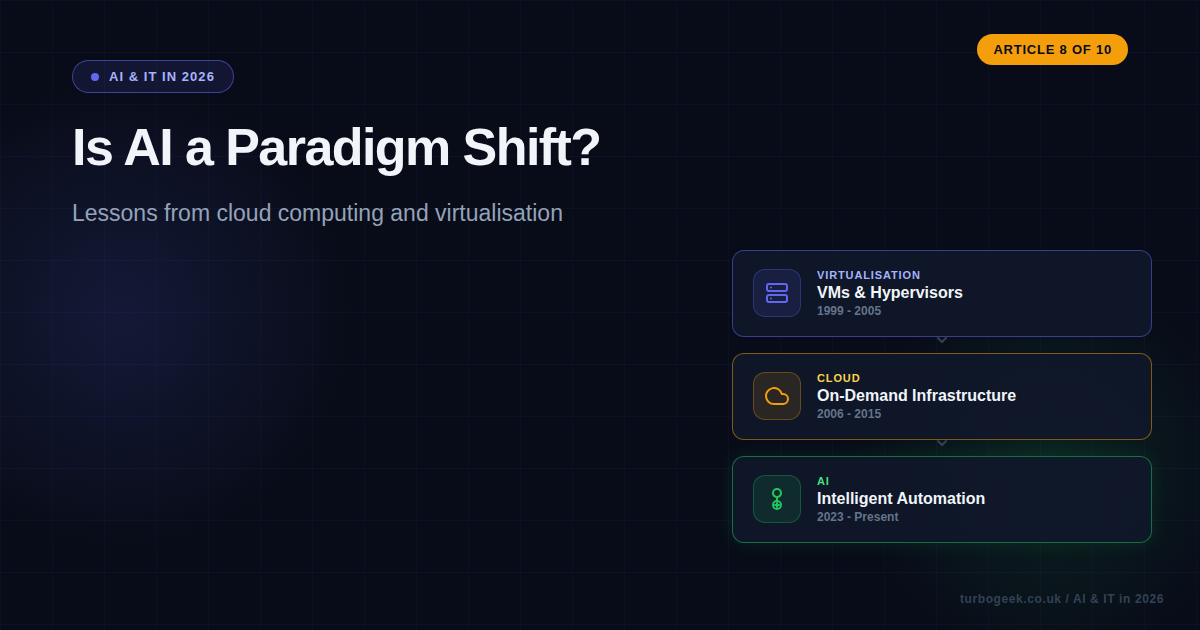
TL;DR — Is AI a Paradigm Shift?
- Same pattern, different decade — virtualisation, cloud, and AI all followed the same adoption curve: scepticism, pilot projects, then wholesale transformation
- The resistance playbook never changes — “too risky,” “compliance won’t allow it,” “it makes mistakes” — every shift gets the same objections
- AI is different in one crucial way — virtualisation changed where work runs, cloud changed how it deploys, but AI changes who does the work
- The cost of waiting is real — companies that dismissed cloud early spent a decade catching up; the same risk applies to AI
New to this series? Start with Article 1: Where Businesses Are Actually Investing in AI for the full picture of how AI is reshaping IT in 2026, then come back here for the historical perspective.
We Have Been Here Before
Every decade or so, a technology comes along that makes the IT industry collectively lose its mind. Half of us declare it the future. The other half explain, with considerable patience, why it will never work in a serious enterprise environment.
Virtualisation got the treatment in the early 2000s. Cloud computing received an even more thorough round of scepticism a few years later. And now AI is getting the full works — the breathless predictions, the dismissive counter-arguments, and the quiet early adopters who are getting on with it while everyone else debates.
I have been in IT long enough to have lived through all three. And what strikes me most is not the technology itself, but how remarkably similar the human response has been each time. The arguments change their clothes, but underneath they are wearing exactly the same outfit.
So let us look at what actually happened with virtualisation and cloud, what the pattern tells us about AI, and why there is one crucial difference that makes this shift potentially more significant than the others.
The Virtualisation Shift: What Actually Happened
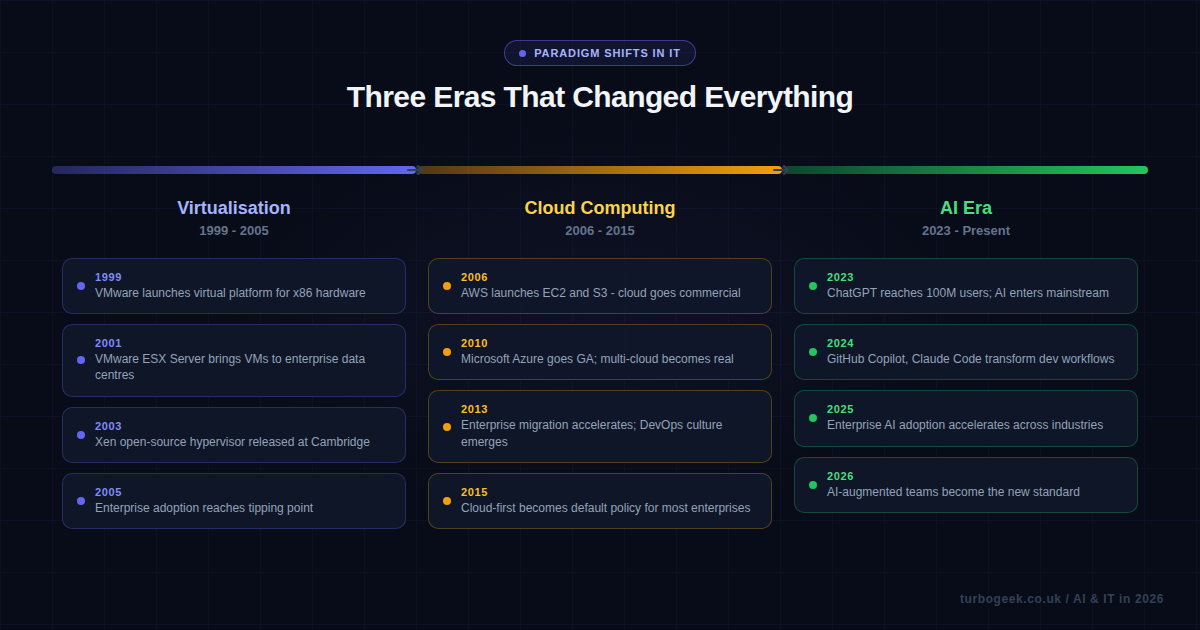
If you were working in IT in 2001, you remember the reaction to VMware ESX. The idea of running production workloads on virtual machines — on shared hardware, no less — was met with genuine alarm by a significant portion of the industry.
The objections were entirely reasonable at the time. Performance overhead was real. The tools were immature. And the suggestion that you could consolidate dozens of physical servers onto a handful of hosts sounded like the kind of thing a vendor would say right before your production database fell over.
“Too risky for production” was the standard response. And for a year or two, it was a fair assessment. Early hypervisors had rough edges. But the economics were so compelling that pilot projects kept happening anyway. One team would virtualise a test environment. Then a staging server. Then, when nobody died, a low-priority production workload.
By 2005, the conversation had shifted entirely. It was no longer about whether virtualisation worked in production. It was about how fast you could migrate. The holdouts found themselves managing sprawling physical estates while their competitors were provisioning new servers in minutes instead of weeks.
The people who adapted thrived. Server administrators who learned VMware, Hyper-V, and Xen became indispensable. Those who insisted that “real servers” were the only option found their roles quietly shrinking. Not overnight — these things never happen overnight — but steadily and irreversibly.
The Cloud Shift: Same Playbook, Different Decade
AWS launched EC2 and S3 in 2006, and the whole cycle started again. This time the sceptics had even better arguments. You are going to put our data where? On someone else’s computers? In a data centre we cannot visit? What about compliance? What about latency? What happens when their entire region goes down?
These were legitimate concerns. Early AWS was not the mature platform it is today. Outages happened. Security models were immature. And the compliance frameworks that govern industries like finance and healthcare genuinely did not have provisions for public cloud infrastructure.
But something interesting happened between 2006 and 2015. Startups built entire companies on cloud infrastructure. They moved faster, spent less on infrastructure, and scaled in ways that traditional enterprises could not match. Meanwhile, the compliance frameworks caught up. AWS achieved FedRAMP authorisation. Azure got its ISO certifications. The “compliance won’t allow it” argument gradually lost its teeth.
The enterprises that moved early gained a structural advantage. They had years of operational experience, refined architectures, and teams who understood cloud-native patterns. The ones that waited until 2015 to start their “cloud journey” were effectively a decade behind — not just in technology, but in institutional knowledge.
And the impact on roles was profound. The operations engineer who managed racks and cables became the DevOps engineer who wrote Terraform modules and managed CI/CD pipelines. The job did not disappear — it transformed. But the transformation required genuine effort, and those who refused to make that effort found themselves in a shrinking market for a shrinking set of skills.
AI: Same Pattern or Something New?
Now look at where we are with AI in 2026, and the parallels become almost uncomfortable.
The sceptic arguments follow the same template. “It makes mistakes.” “You can’t trust it for anything serious.” “It’s fine for toy projects but not for enterprise work.” These are the 2026 versions of “too risky for production” and “compliance won’t allow it.”
And just like before, they contain a grain of truth. AI does make mistakes. Large language models do hallucinate. Generating code with an AI assistant does require careful review. These are real limitations that deserve serious attention.
But the early adopters are already past these objections. They have built review processes around AI-generated code. They have established governance frameworks for AI use in their organisations. They are not ignoring the risks — they are managing them, just as previous generations managed the risks of virtualisation and cloud.
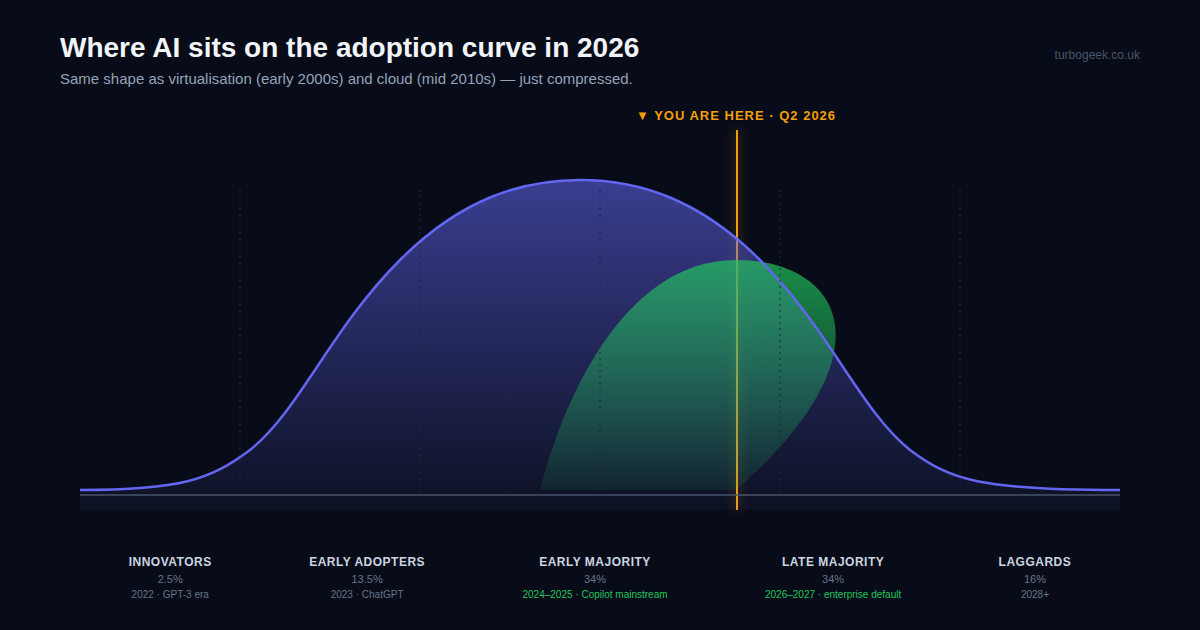
The adoption curve is following the same trajectory, possibly faster. ChatGPT went from zero to 100 million users in two months. GitHub Copilot, Claude Code, and similar tools went from curiosities to standard development tooling in under two years. Enterprise AI budgets are growing at rates that would make the early cloud migration spending look modest. As I covered in Article 1 of this series, the investment is real and accelerating.
| Topic | When It Mattered | Key Lesson |
|---|---|---|
| Virtualisation resistance | 2001-2005 | “Too risky” became “too late” within 4 years |
| Cloud resistance | 2006-2015 | Compliance objections dissolved as frameworks adapted |
| AI resistance | 2023-present | “It makes mistakes” is the new “compliance won’t allow it” |
| Role transformation | Every shift | Roles do not vanish — they transform for those willing to adapt |
The Key Difference: Who Does the Work
Here is where AI diverges from the pattern in a way that matters.
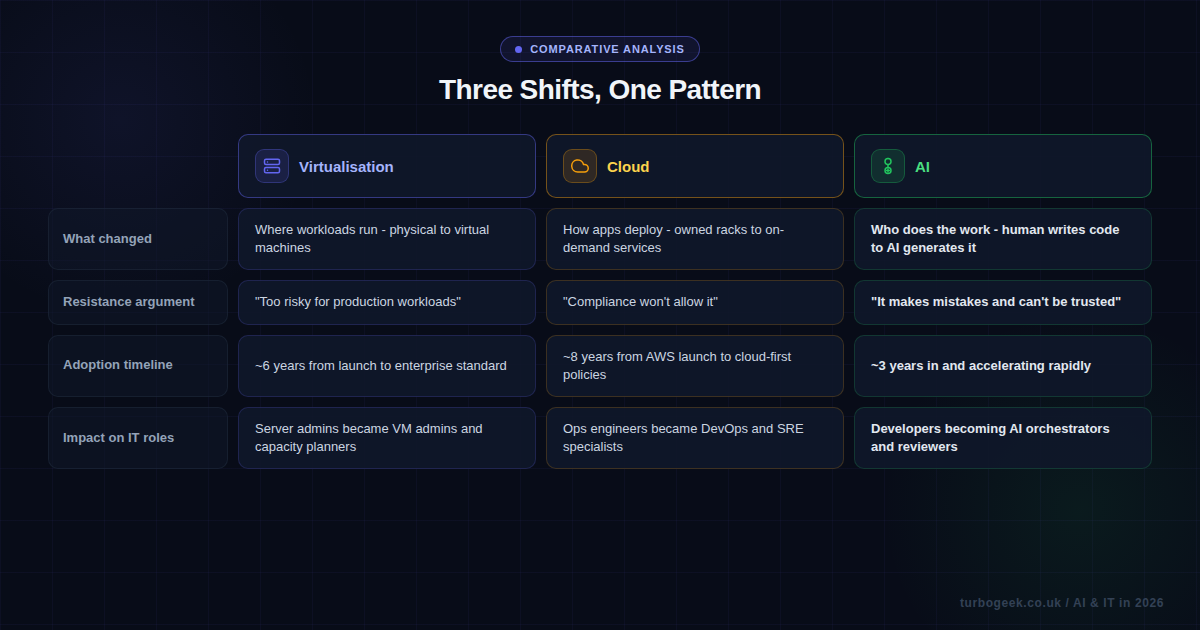
Virtualisation changed where workloads run. Instead of one application per physical server, you could run many on shared hardware. The work itself — writing code, designing systems, making architectural decisions — stayed firmly in human hands. You still needed the same skills. You just deployed them differently.
Cloud changed how applications deploy and scale. Instead of buying, racking, and managing hardware, you consumed it as a service. Again, the fundamental nature of the work did not change. You still wrote the code. You still designed the architecture. The infrastructure just got more abstract.
AI changes who does the work. And that is a fundamentally different kind of shift.
When a developer uses Copilot or Claude Code to generate a function, the AI is not changing where that code runs or how it deploys. It is writing the code itself. The human role shifts from author to reviewer, from creator to orchestrator. You still need to understand what the code should do, why it should do it, and whether it does it correctly. But the act of translating that understanding into syntax — the thing that defined the developer’s job for decades — is increasingly shared with a machine.
This is why the “it makes mistakes” objection, while valid, misses the larger point. Early VMs had performance issues too. Early cloud had reliability gaps. The technology improved. AI is improving at a pace that makes those earlier improvements look glacial. The question is not whether AI will get good enough — it is whether you will be ready when it does.
As I explored in Article 6, the job market is already reflecting this shift. And Article 7 looked at what happens to those who choose not to engage. The pattern from virtualisation and cloud is clear: adaptation is not optional.
The Cost of Waiting to Find Out
The most expensive lesson from both previous paradigm shifts was not a technology failure. It was the cost of institutional delay.
Companies that dismissed virtualisation in 2002 and cloud in 2008 did not just miss a technology trend. They fell behind in operational efficiency, developer velocity, and talent acquisition. By the time they started catching up, their competitors had years of accumulated knowledge, optimised processes, and battle-tested architectures.
The same dynamic is playing out with AI. Organisations that are building AI competency now — training their teams, establishing governance, running pilots — are accumulating institutional knowledge that will be extraordinarily difficult to replicate later. The gap between “started early” and “started late” compounds over time.
This does not mean you should rush headlong into AI adoption without thought. The companies that did best with cloud were not the ones who lifted and shifted everything on day one. They were the ones who started thoughtfully, learned continuously, and scaled deliberately. The same approach applies to AI.
But “waiting for it to mature” is the same argument that cost companies five years on virtualisation and eight years on cloud. The technology will mature whether you are learning alongside it or scrambling to catch up after the fact.
Three paradigm shifts. Three sets of objections. Three adoption curves that proved the sceptics wrong — not because the risks were imaginary, but because the technology improved faster than the objections predicted. AI is following the same trajectory, but with one additional dimension that makes it potentially more transformative than either of its predecessors.
The question is not whether this is a paradigm shift. Looking at the evidence, it clearly is. The question is what you are doing about it.
Next in this series: The AI-Augmented IT Team: What 2027 Looks Like — a practical look at how AI-augmented teams will operate in the near future.
AI & IT in 2026 — Full Series
- 1. Where Businesses Are Actually Investing in AI in 2026
- 2. How AI Is Reshaping the Developer’s Daily Workflow
- 3. Platform Engineering in the Age of AI
- 4. The Security Risks Businesses Aren’t Talking About
- 5. The Hidden Risks of Embedding AI Into Your Workflows
- 6. AI and the IT Job Market: What’s Really Happening
- 7. What Happens to Engineers Who Refuse to Use AI
- 8. Is AI a Paradigm Shift? Lessons from Cloud and Virtualisation
- 9. The AI-Augmented IT Team: What 2027 Looks Like
- 10. Your Move: A Practical Framework for IT Professionals
Leave a Reply