
If you sat a developer from 2024 next to one from 2026, you’d struggle to find common ground in their daily routines. The tools are different. The rhythm is different. The skills that matter have shifted beneath everyone’s feet — quietly, and then all at once. This article explores what that shift actually looks like, and what it means for anyone writing code professionally today.
AI & IT in 2026 — Full Series
- 1. Where Businesses Are Actually Investing in AI in 2026
- 2. How AI Is Reshaping the Developer’s Daily Workflow
- 3. Platform Engineering in the Age of AI
- 4. The Security Risks Businesses Aren’t Talking About
- 5. The Hidden Risks of Embedding AI Into Your Workflows
- 6. AI and the IT Job Market: What’s Really Happening
- 7. What Happens to Engineers Who Refuse to Use AI
- 8. Is AI a Paradigm Shift? Lessons from Cloud and Virtualisation
- 9. The AI-Augmented IT Team: What 2027 Looks Like
- 10. Your Move: A Practical Framework for IT Professionals
TL;DR — Developer Workflow at a Glance
- Then vs now: Coding has gone from 55% to roughly 20% of the average developer’s day — architecture, review, and orchestration fill the gap
- The skill shift: Boilerplate coding and syntax memorisation are declining; prompt engineering, AI review, and systems thinking are rising fast
- The orchestrator mindset: The best developers now treat AI as a junior pair programmer — directing, reviewing, and correcting rather than typing everything themselves
- What hasn’t changed: Understanding the problem, owning the outcome, and communicating clearly still matter as much as they ever did
Then vs Now — A Typical Day Comparison
Two years ago, a developer’s day followed a pattern that had barely changed in a decade. You opened your IDE, picked up a ticket, and spent the bulk of your working hours writing code. Debugging consumed the next biggest chunk — stepping through logs, reproducing issues, guessing at root causes. Code review was something you did in bursts, usually right before a release. Architecture discussions happened in occasional meetings, not as a daily practice.
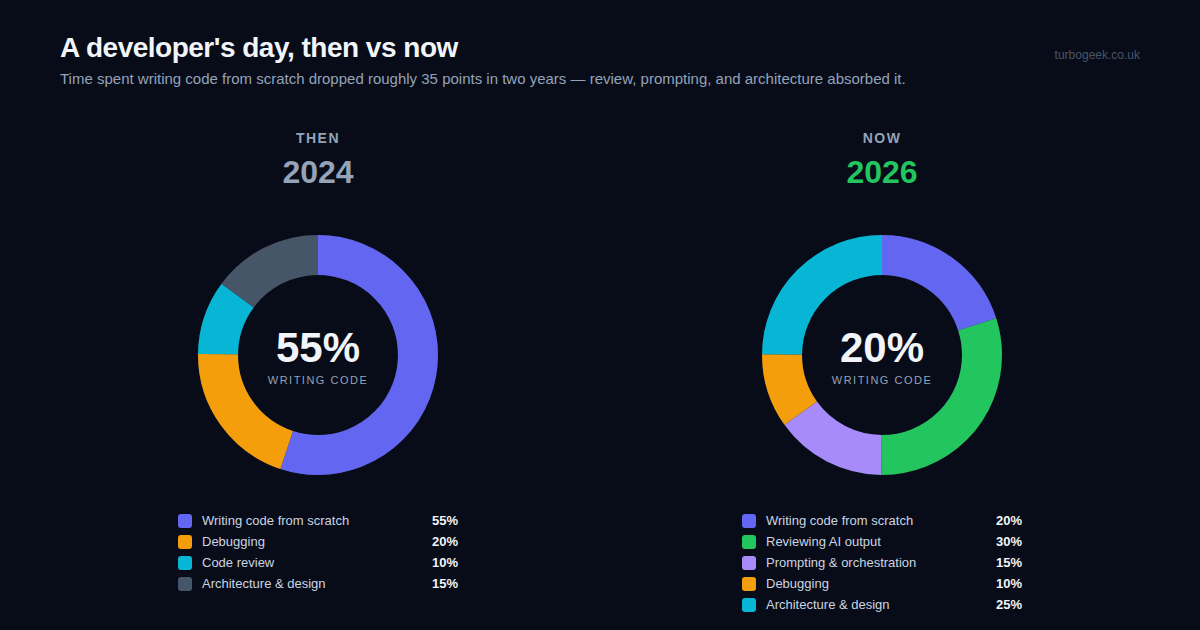
That daily rhythm has been comprehensively rewritten. In early 2026, the average developer spends roughly 20% of their day actually writing code from scratch. The rest has shifted toward activities that barely registered in 2024 time-tracking data: reviewing AI-generated output, crafting and refining prompts, making architectural decisions that used to be deferred to senior staff, and orchestrating workflows that chain multiple AI tools together.
This isn’t speculation — it’s what I’m seeing in my own work and hearing from teams across the industry. The developer who used to spend four and a half hours a day typing code now spends that same time directing AI assistants, reviewing their output, and making higher-level decisions about system design. The total output is often greater, but the nature of the work has fundamentally changed.
The shift isn’t uniform, of course. Some teams have embraced AI tooling aggressively; others are still experimenting. But even the cautious ones report that debugging time has dropped significantly — AI-assisted debugging catches issues faster, and often suggests fixes that would have taken a human developer considerably longer to work out. The net effect is that the mechanical parts of development are shrinking, and the strategic parts are expanding.
The Skills Shift — What’s Declining, What’s Rising
Every technology transition produces winners and losers in the skills market. The cloud transition made deep hardware knowledge less essential for most developers. Containerisation reduced the need for manual server configuration expertise. AI is doing something similar — but to the act of writing code itself.
On the declining side, the skills losing market value are predictable once you think about it. Boilerplate coding — the repetitive CRUD operations, scaffolding, and templated patterns that used to fill junior developer days — is exactly the kind of work AI handles well. Syntax memorisation matters less when your AI assistant knows every API signature in every language. Manual debugging, the painstaking step-through-and-inspect process, is increasingly handled by AI tools that can analyse stack traces and suggest fixes in seconds. And the “solo feature delivery” model, where a single developer owns every line of a feature from start to finish, is giving way to a more collaborative human-AI approach.
On the rising side, the picture is more interesting. Prompt engineering — the ability to craft precise, unambiguous instructions for AI tools — has gone from a novelty skill to a daily requirement. AI output review is arguably the most critical new competency: knowing when generated code is correct, when it’s subtly wrong, and when it’s confidently nonsensical. Systems thinking — understanding how components interact, where data flows, and what happens at scale — matters more than ever because AI tools can generate code faster than humans can reason about its implications. And workflow orchestration, the ability to chain AI tools together into productive pipelines, is becoming a genuine differentiator.
None of this means traditional coding skills are irrelevant. You still need to understand code to review it effectively. But the balance has shifted — from producing code to evaluating and directing it.
The Orchestrator Mindset
The developers who are thriving in this new landscape share a common approach: they treat AI as a junior pair programmer. Not a replacement. Not an oracle. A capable but unreliable colleague who can do impressive work but needs constant supervision.
This is a genuine mindset shift, and it’s worth unpacking. The “junior pair programmer” framing works because it captures both the strengths and the limitations of current AI coding tools. A good junior developer can produce a lot of code, quickly, and will often get the broad strokes right. But they’ll also make subtle mistakes, miss edge cases, over-engineer simple problems, and under-engineer complex ones. They need review. They need direction. They need someone who understands the bigger picture to guide their work.
The “10x developer” concept has always been contentious, but it’s worth revisiting in this context. In 2024, a 10x developer was someone who could write significantly more working code than their peers — faster, cleaner, more reliable. In 2026, a 10x developer is someone who can orchestrate AI tools to produce ten times the output of an unassisted developer while maintaining quality, consistency, and architectural coherence. The multiplier is the same, but the mechanism is completely different.
I’ve seen this play out in practice. The developers who resist AI tooling — who insist on writing everything themselves — aren’t necessarily producing worse code, but they’re producing less of it. And in a world where competing teams are using AI to iterate faster, “less code” increasingly means “falling behind.” The orchestrator mindset isn’t about replacing your own judgement. It’s about amplifying it.
Practically speaking, the orchestrator approach involves several daily habits: writing detailed, structured prompts rather than vague requests; reviewing AI output line by line rather than accepting it wholesale; maintaining a mental model of the system architecture that the AI doesn’t have; and knowing when to override the AI’s suggestion with your own solution. The best AI-augmented developers aren’t the ones who delegate everything — they’re the ones who delegate intelligently.
What Hasn’t Changed (And Shouldn’t)
For all the disruption, some things about software development remain stubbornly, reassuringly constant. Understanding the problem still matters more than writing the solution. No AI tool, however sophisticated, can compensate for a developer who doesn’t understand what the user actually needs. Requirements gathering, stakeholder communication, and domain knowledge are as valuable as they’ve ever been — arguably more so, because the ability to translate human needs into precise AI instructions is becoming a core competency.
Owning the outcome still matters. AI can generate code, but it can’t take responsibility when that code breaks in production at 3am. The accountability, the on-call mindset, the willingness to trace a bug from a customer complaint through six layers of abstraction to a misconfigured environment variable — that’s still a human job. And it’s still the thing that separates professional developers from hobbyists.
Communication still matters. If anything, it matters more. When you’re orchestrating AI tools alongside human colleagues, the ability to explain what you’re doing, why you’re doing it, and what risks you see is essential. The developer who can clearly articulate a technical decision to a non-technical stakeholder has always been valuable. In an AI-augmented team, where the pace of change is faster and the tooling is less transparent, that clarity is critical.
And code quality still matters — perhaps more than ever. When AI generates code at scale, the risk of accumulated technical debt increases. The developer who insists on clean architecture, sensible abstractions, and thorough testing isn’t being old-fashioned. They’re being essential. The speed that AI provides is only valuable if the output is maintainable. Fast rubbish is still rubbish.
The Developer Role Is Evolving, Not Ending
Every few years, someone declares that developers are about to become obsolete. It happened with visual programming tools in the 1990s. It happened with low-code platforms in the 2010s. It’s happening again now with AI. And like every previous prediction, it’s missing the point.
The developer role isn’t disappearing. It’s moving up the abstraction stack, just as it has done repeatedly throughout the history of computing. Assembly language developers weren’t replaced by C developers — they became C developers. And C developers weren’t replaced by Python developers — the role evolved. What we’re seeing now is the same pattern: the developer role is moving from primarily producing code to primarily directing, reviewing, and orchestrating it.
That’s an evolution, not an ending. But it does require adaptation. The developers who will thrive in the coming years are the ones who treat AI as a tool to be mastered, not a threat to be resisted. They’ll invest in the rising skills — prompt engineering, output review, systems thinking, workflow orchestration — while maintaining the fundamentals that no AI can replicate: understanding problems, owning outcomes, and communicating clearly.
The daily workflow has changed. The role is changing. But the need for people who can turn complex problems into working software? That hasn’t changed at all.
What does your day look like now compared to two years ago? I’d be interested to hear how your workflow has (or hasn’t) shifted — get in touch or leave a comment below.
Previously: Article 1 — Where Businesses Are Actually Investing in AI in 2026
Leave a Reply