
TL;DR
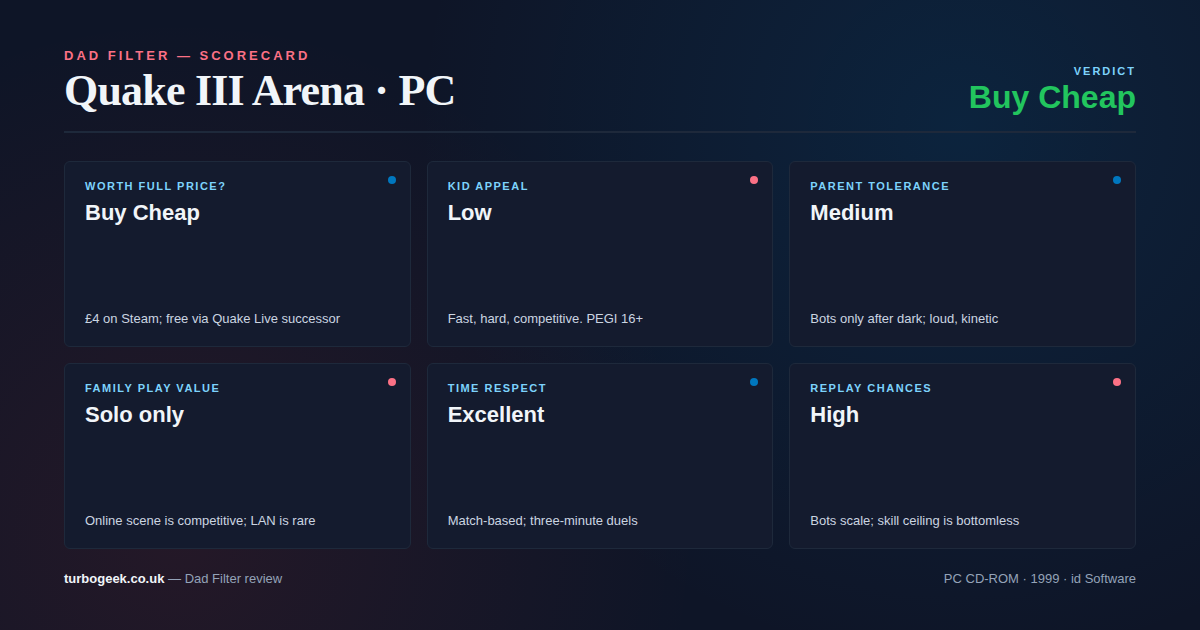
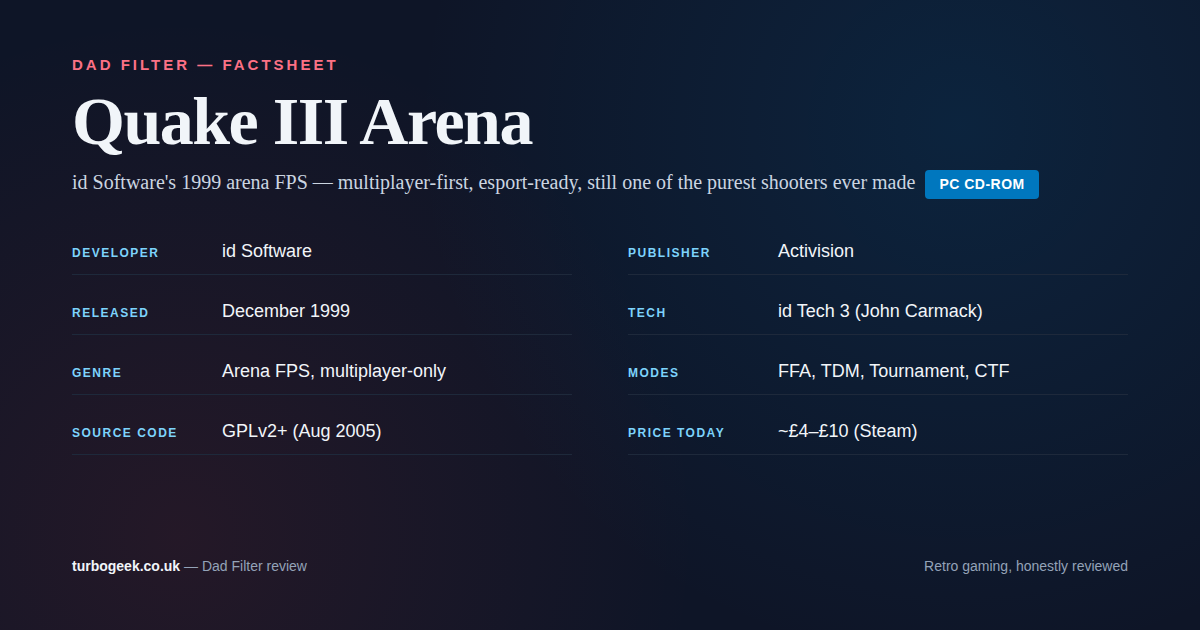
- What it is: id Software’s 1999 multiplayer-only arena FPS, built on id Tech 3
- Platform/Price: Steam — around £4; Quake Live (successor, browser-era) was free
- Dad Filter verdict: Buy Cheap — the skill ceiling is higher than in any modern shooter
- One thing to know: Nine people made this in 18 months. id Software operated differently.
New to TurboGeek Gaming? Start with the Dad Filter manifesto to understand how I review games — as a 46-year-old dad with two boys aged 10 and 7, not as a professional games journalist. Then check the Gaming hub for every review.
What It Is
Quake III Arena is a multiplayer-first arena first-person shooter developed by id Software and published by Activision in December 1999. It was built on John Carmack’s id Tech 3 engine — the technical leap that made OpenGL-only rendering a mainstream assumption — and it abandoned the traditional single-player campaign entirely. Instead it shipped with a tiered bot-match system and a set of multiplayer modes (deathmatch, tournament 1v1, team deathmatch, capture the flag) and assumed its players would spend most of their time in one of those.
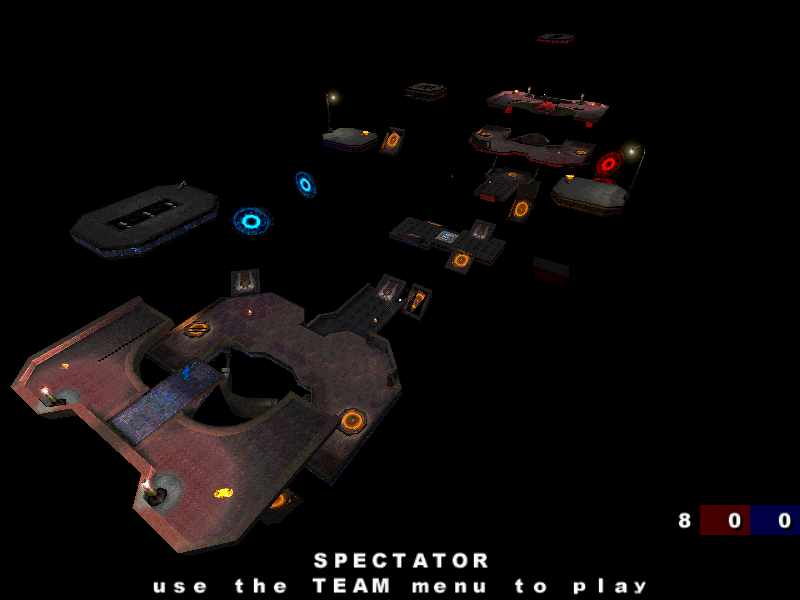
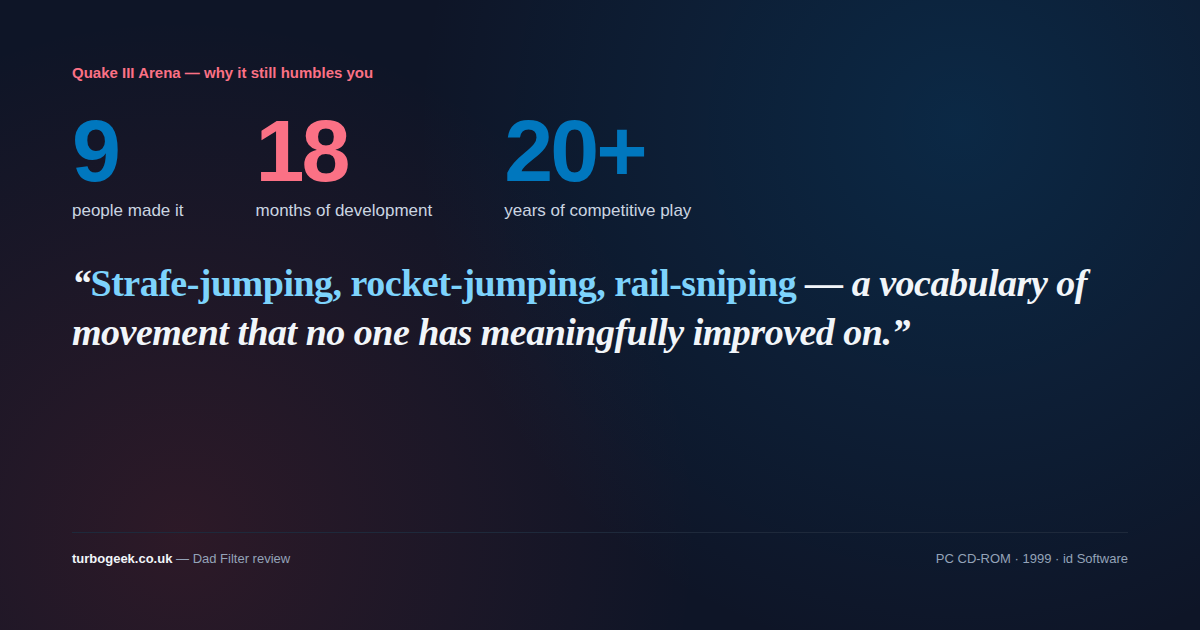
Nine people made Quake III Arena in 18 months. That is extraordinary by any standard, but particularly by the standards of 1999, when competing AAA games typically took teams of 40 or more. id’s structural minimalism was the point — every weapon had a clear role, every map was hand-tuned, every movement mechanic was stripped to its essentials. id Software released the engine source code under GPLv2+ in August 2005, which is why there are more active Quake III-derived communities today than there are active Call of Duty communities from any individual release year.
Why This One Matters To Me
In 1999 I was 19, at university, in student halls with a surprising amount of ethernet cabling and a LAN night that had organically formed on Thursdays. Quake III Arena was the game on the LAN. Not because it was new — Unreal Tournament came out the same month — but because it was faster. You could feel every missed rocket. You could feel every railgun line. It rewarded practice and punished hesitation with the precision of a metronome.
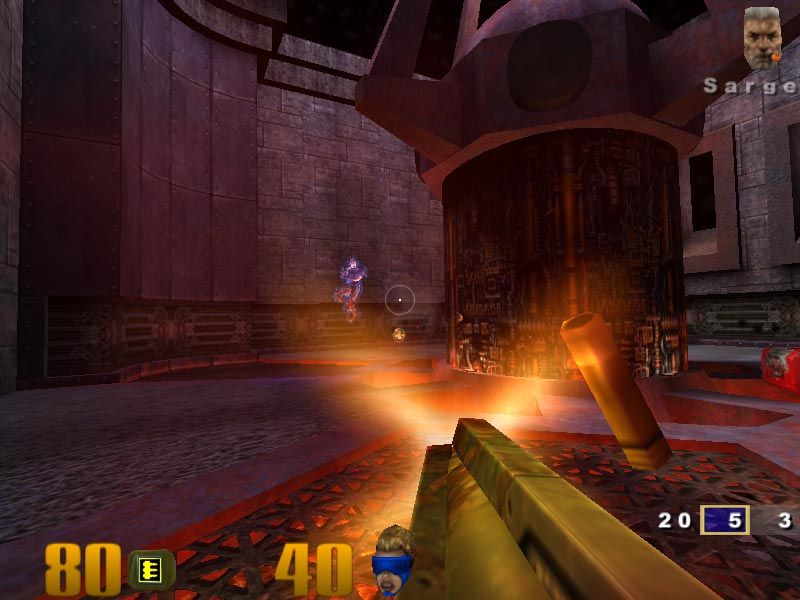
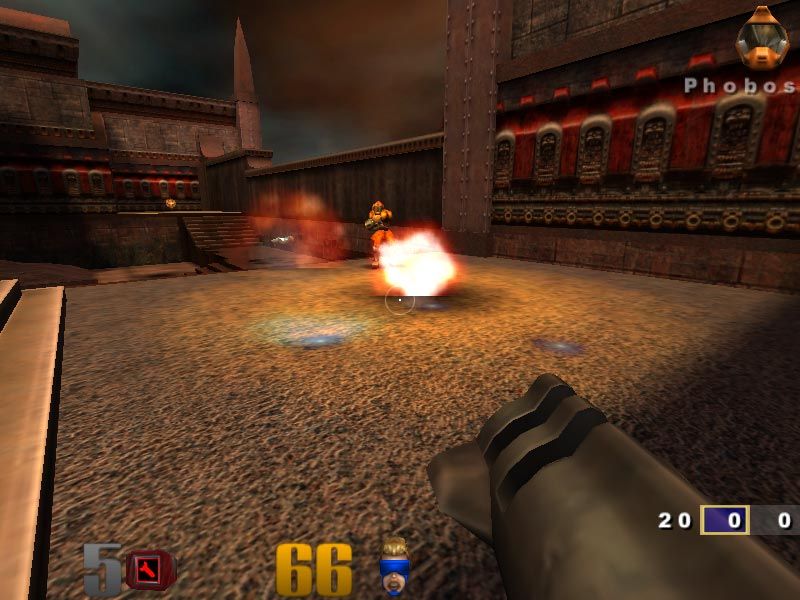
Coming back to it now, after twenty years of FPS design iteration, the thing that hits hardest is how little it feels like it needs. The weapon set is eight or nine guns, all balanced. The movement is three verbs — run, jump, strafe — plus advanced techniques (strafe-jumping, rocket-jumping) that emerged from the physics rather than being designed into them. The maps are tight and closed. That is the game.
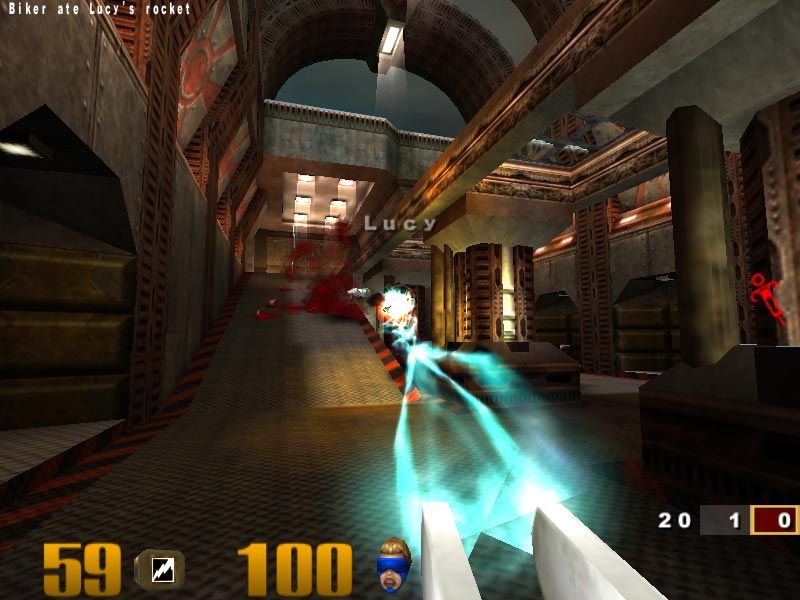
Modern shooters have tried to match this and overshot. Loadouts. Killstreaks. Unlockable attachments. Battle passes. Live-service roadmaps. Quake III Arena does not need any of them, and playing it for an evening reminds you that most of those things are content farms rather than design features.
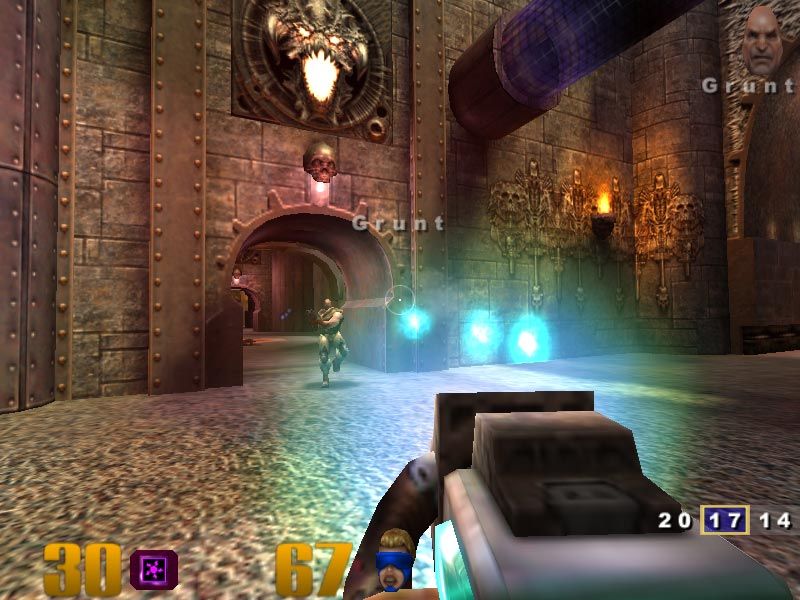
The boys watched for about four minutes. The ten-year-old said it looked dated. The seven-year-old asked where the skins were. Neither of them was ready for the speed. Quake III is PEGI 16 for a reason — the gore is not the main feature but it is present — and it is absolutely not a family game. This one is strictly for dads and dads-at-LAN-nights.
The Dad Filter
Worth Full Price?
Buy Cheap. Quake III Arena is on Steam for around four pounds. Quake Live, its successor, was free for years and playable in a browser. Various open-source clients (ioquake3, OpenArena) extend the life indefinitely.
Four pounds for one of the finest competitive shooters ever designed is a simple yes. The only real question is whether you will find someone to play it with, which is a function of your social network more than the game’s quality.
Kid Appeal
Low. The PEGI 16 rating is earned. The gore is period-accurate. Kids raised on Fortnite and Valorant will find the movement too fast and the lack of progression systems disorienting.
This is a dad game in the narrowest sense. Do not share it with pre-teens. Save it for the post-bedtime LAN party that you are not having because it is 2026 and LAN parties are an archaic form.
Parent Tolerance
Medium. The game is loud and kinetic. Rocket explosions, railgun hiss, hard industrial music. For short sessions it is invigorating. For longer sessions it is draining.
The bot system is genuinely good. You can play against tuned bot opponents at any skill level. Do not feel obligated to go online to get the full experience — the offline bot matches are a high-quality game in themselves.
Family Play Value
Solo only. In theory, split-screen exists via source ports. In practice, Quake III Arena is a one-player-at-a-time experience. The competitive scene is its own ecosystem and is not family-friendly territory.
If you have a LAN setup at home — and some households genuinely do — it can work as a dad-and-teenager game. Otherwise, this is solo entertainment.
Time Respect
Excellent. Matches are three to ten minutes long. You can play one match, one tournament round, one bot session, and walk away at any clean break.
No progression to protect, no save file, no daily login. The purest form of pick-up-and-put-down PC gaming. This is how all multiplayer games should feel about your time.
Replay Chances
High. The skill ceiling is functionally bottomless. Competitive players are still finding new movement techniques on maps that have been played for 25 years. The mapping community is deep and active.
For a casual dad, bot matches scale with you. The game grows as you improve. Few games from any era are this accommodating to a decade of casual engagement.
The Verdict
Buy Cheap. Quake III Arena is still the benchmark arena FPS. Twenty-five years of shooter design has failed to improve on the core loop. The movement system alone is more interesting than most modern shooters’ entire feature sets. Four pounds on Steam is not even a decision.
This is not a family game. It is a shooter for people who remember 1999 PC gaming and miss the purity. It is loud, it is fast, and it is extremely unforgiving. Those are features, not flaws.
If you played it in 1999, you remember what the rail gun feels like when it connects. Reboot it tonight and you will remember within five minutes. That is the mark of a great piece of game design. It does not have to be relearned because it never became obsolete.
Related Reviews
- Bomb Jack on C16/Plus 4 — Dad Review — The arcade in a cassette box, reviewed forty years on.
- V-Rally ’97 — Dad Review — Another nostalgia-first review, this time the PS1 rally classic.
- TurboGeek Gaming Hub — Every review, guide, and parent resource in one place.
- The Dad Filter Manifesto — How and why I review games as a dad, not a gamer.
Leave a Reply