
TL;DR
- What it is: Rally racing — you versus the road, no wheel-to-wheel combat
- Platform/Price: V-Rally PS1 — around £2 on Ebay
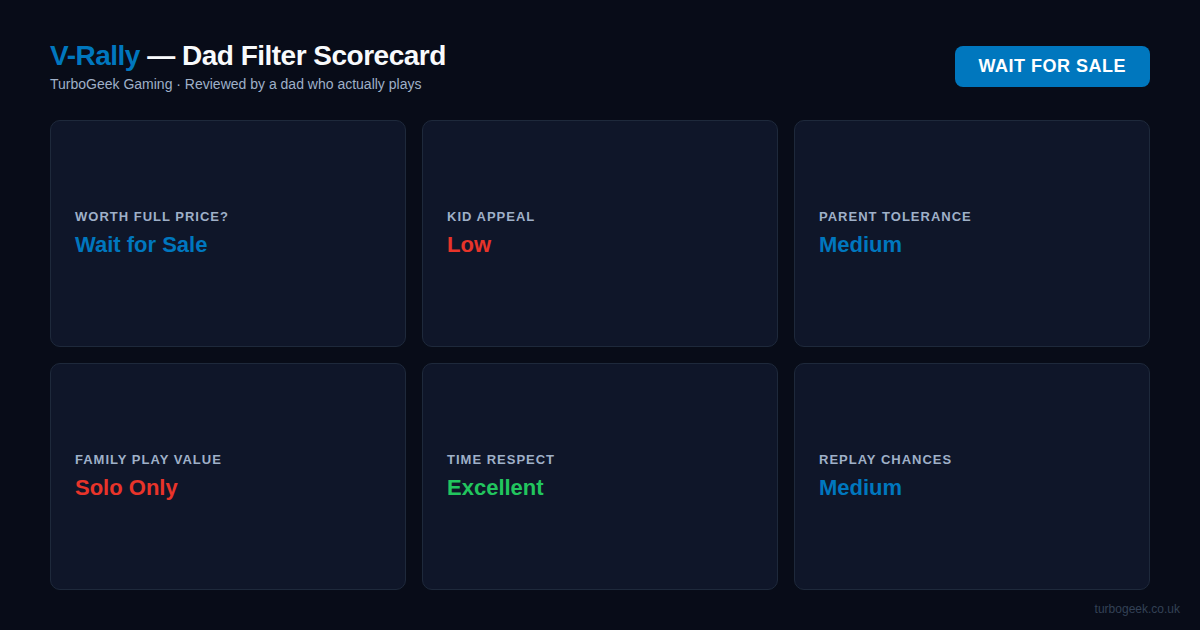
- Dad Filter verdict: Wait for Sale — a nostalgia pick for rally fans, not a family game
- One thing to know: This is a recommendation for dads who want their own game, not a family pick
New to TurboGeek Gaming? Start with the Dad Filter manifesto to understand how I review games — as a 46-year-old dad with two boys aged 10 and 7, not as a professional games journalist. Then check the Gaming hub for every review.
What It Is
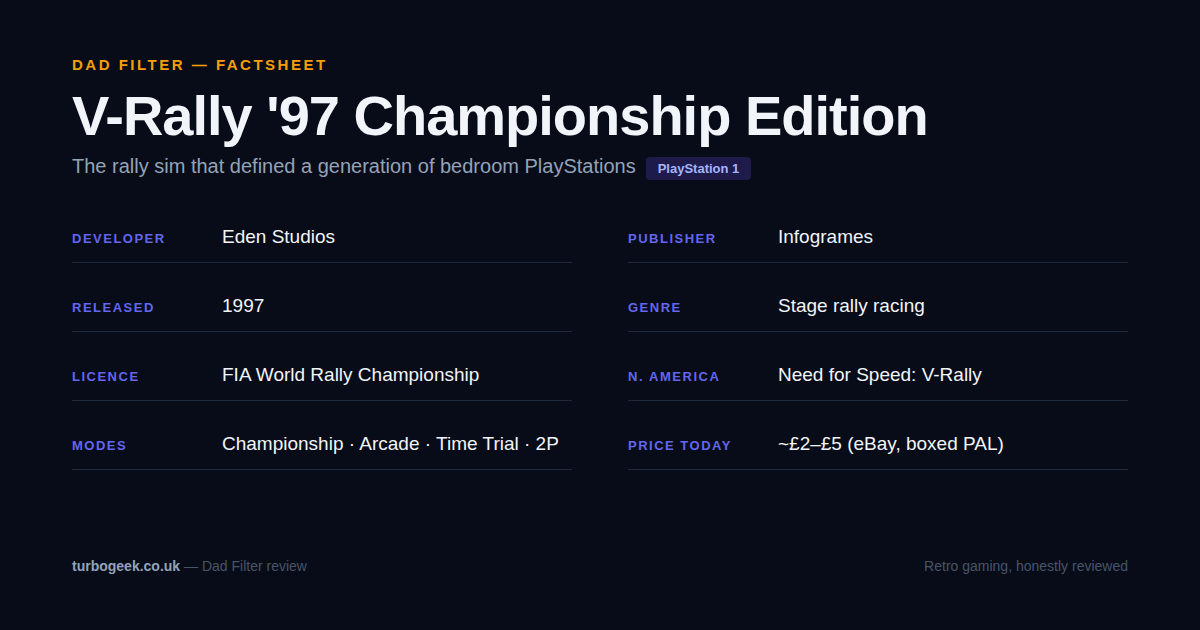
V-Rally is a rally racing franchise that started life on the original PlayStation in 1997. Developed by Eden Games (then Infogrames), the original V-Rally — known as Need for Speed: V-Rally in North America — was one of the defining rally games of the PS1 era. It was raw, challenging, and had that particular late-nineties aesthetic that anyone who grew up with a PlayStation will recognize instantly.
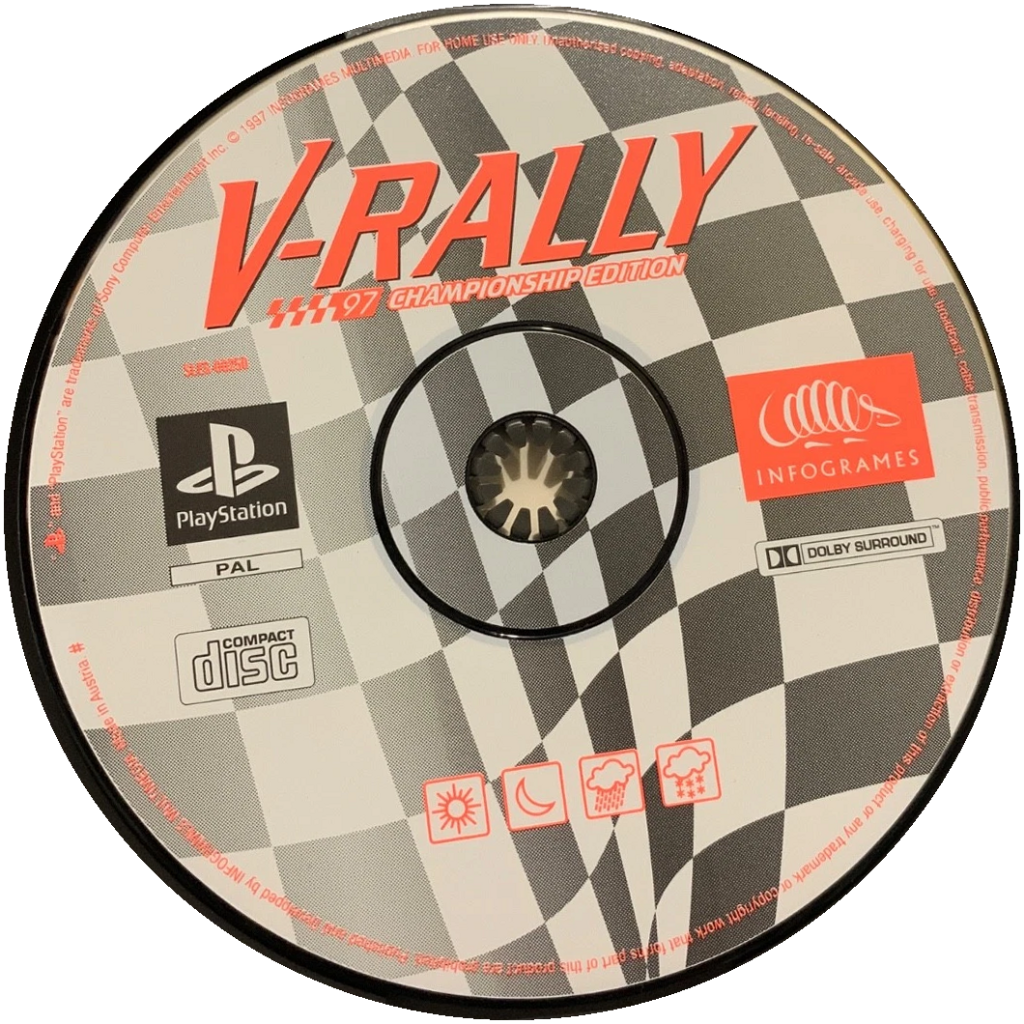
The full title was V-Rally ’97 Championship Edition, and it packed in licensed FIA World Rally Championship cars, stages set in rally locations around the world, and a co-driver barking pace notes at you. A full championship mode, arcade mode, time trials, and a split-screen two-player option for a mate on the sofa. Suitable for all ages — no combat, no crashes-as-entertainment, just you against the road.
At the time, V-Rally was a flagship rally sim on console and sold by the lorryload. Today, a boxed PAL copy turns up on eBay for £2 to £5, disc-only for less. If you still own a working PS1 (or a PS2 with backwards compatibility), it is probably the cheapest properly good rally game you can buy.
Why This One Matters To Me
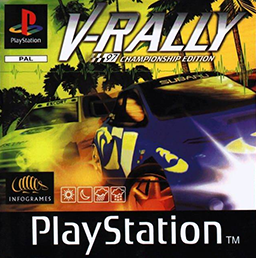
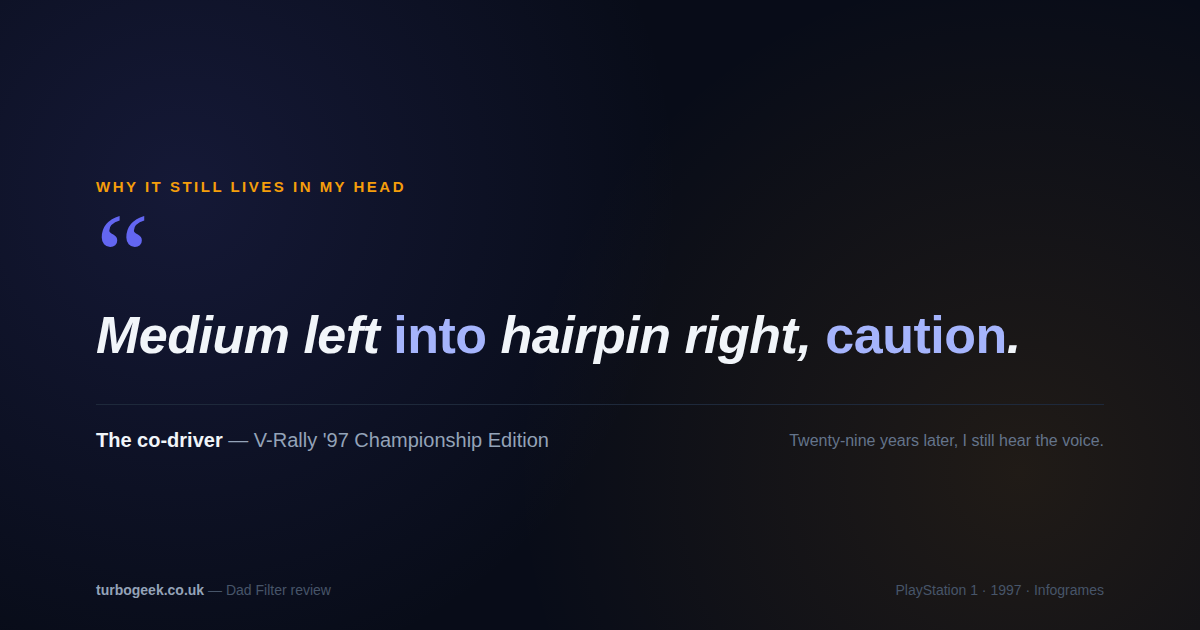
V-Rally on PS1 was one of the first games I ever owned. Not rented from Blockbuster, not borrowed from a mate — actually mine. I can still picture the box art. I can still hear the co-driver calling out pace notes: “medium left into hairpin right, caution.” I can still feel the Corolla sliding through gravel stages in Corsica, overcorrecting into a barrier, and somehow clawing back three seconds over the next kilometer.
Rally games occupy a specific niche in racing that nothing else quite replicates. There is no direct wheel-to-wheel competition. It is you versus the road. You against your own concentration, your own nerve, your own ability to process pace notes quickly enough to keep the car pointing the right way. There is something genuinely meditative about it when you get into a flow state — the kind of focused calm that is increasingly rare in adult life.
Let me be honest — by 2026 standards, V-Rally ’97 feels rough. The polygon count is what it is. The handling has that slightly floaty PS1 feel. Modern rally games like EA Sports WRC and DiRT Rally 2.0 are superior in every measurable way — handling, stage design, visual fidelity, sheer immersion. A 29-year-old game cannot compete on those terms. But V-Rally ’97 does not need to compete. It has a DNA all its own — the liveries, the pace notes, the satisfying grind of gravel under the tyres, the shudder when you clip a tree. It scratches a very specific itch that the newer games, for all their polish, do not quite reach.
The contrast between my feelings about this game and the boys’ reaction is telling. I fired up V-Rally ’97 one evening and they wandered over, watched for about ten minutes, and wandered off again. No explosions. No crashes worth replaying. No opponents to ram off the road. Just a blocky car on a narrow track, going quickly, trying not to hit trees — and the whole thing rendered in late-90s polygons that look like Lego to eyes raised on modern graphics. To a ten-year-old and a seven-year-old, this is approximately as exciting as watching someone parallel park.
And honestly? That is fine. Not every game needs to appeal to the whole family. Sometimes a dad needs a game that is just his. Rally games teach patience, precision, and the ability to stay calm when everything is happening too fast — the opposite of what kids want from gaming. This is a recommendation for parents who want their own game, played after bedtime, with a cup of tea and the volume down low.
The Dad Filter
Worth Full Price?
Wait for Sale — though “full price” is a bit of a stretch here. This is a 1997 PS1 game. You are not paying retail. You are paying whatever a cardboard box and a CD can go for on eBay, which by 2026 is about £2 to £5 for a boxed PAL copy. For modern rally gaming, EA Sports WRC is the officially licensed option with superior handling and presentation. DiRT Rally 2.0 remains the benchmark for stage rally simulation. V-Rally ’97 does not compete with either on any measurable axis.
But at £2 on eBay, the question is not “is it better than modern rally games?” The question is “is it worth two quid?” And if you remember the original, or you want to see what rally sims looked like before they got good, or you just want a PS1 game that still holds up on its own terms — yes. Entirely yes.
Kid Appeal
Low. Rally racing is a niche interest even among adult gamers. For kids who have grown up with Forza Horizon’s open worlds and Need for Speed’s police chases, a point-to-point stage through a forest in Finland holds approximately zero appeal. No explosions. No combat. No instant gratification. No multiplayer chaos.
My boys tried it once and were back playing BeamNG.drive within ten minutes. They like the crash physics, the destruction, the immediate visual feedback. Rally is the opposite of all of that — it rewards restraint, not aggression. Not every game needs to appeal to kids, and that is genuinely fine. I am not disappointed. I am relieved. This one is mine.
Parent Tolerance
Medium. Rally stages are relaxing in short bursts. The rhythm of the co-driver’s pace notes is satisfying once you learn to trust them. There is a particular pleasure in nailing a sequence of corners on a stage you have driven before, shaving a second off your time, feeling the car respond to your inputs exactly as you intended.
But rally fatigue is a real thing, and it arrives faster on a 1997 game. After an hour or so, the stages start to feel samey. Gravel, tarmac, snow — the terrain changes but the PS1’s ability to render them did not vary enough to make each rally feel genuinely different. V-Rally ’97’s handling model, acceptable for 1997, is nowhere near the depth of modern sims. It is a game best consumed in 20-minute portions, one rally at a time, nostalgia as the main course.
Family Play Value
Solo Only. Rally is inherently a solo discipline. You are on the stage alone, racing against the clock. V-Rally ’97 does have a split-screen two-player mode if you can wrangle a friend to the sofa, but it is time-trial competition at best — take turns on the same stage, compare times — and that requires the other person to actually care about rally times. My boys do not.
There is no cooperative play, no drop-in multiplayer, and no real way to make this a family activity. That is not a criticism — it is a statement of fact. Some games are solo experiences and that is part of their appeal.
Time Respect
Excellent. This is where V-Rally ’97 genuinely shines for dads. Rally stages are 3-5 minutes long. You can complete a stage, check your time, and put the controller down. There are natural stopping points between every stage in the championship mode. No cutscenes to skip, no ten-minute cinematic intros, no “just one more” progression hooks designed to keep you playing past midnight — just a CD-era menu, a car, and a road.
It is the perfect format for a quick session after the kids are in bed. Twenty minutes, four or five stages, a cup of tea, done. You feel like you have accomplished something without sacrificing sleep. For a dad game, time respect is arguably the most important criterion, and V-Rally ’97 nails it — partly by design, partly because a 1997 game simply did not have the design vocabulary for modern time-vampire patterns.
Replay Chances
Medium. The championship mode has enough depth for a proper run through the rally calendar — different locations, different surfaces, a roster of licensed cars to unlock. Arcade mode and time trials pad out the package. For a 1997 game, the content offering was generous, and it still holds up as a weekend of proper rally racing.
But rally fatigue is real, and on PS1 it arrives quicker than on a modern game. After a weekend or two the stages blur together. The handling model is not deep enough to make you want to master every car. The presentation, charming as it is in a retro way, does not have the atmosphere that keeps modern rally sims alive on your hard drive for years. You will pick it up, enjoy it for a fortnight, and then it will go back in the drawer until the next wave of nostalgia hits. At £2, that is a fair exchange.
The Verdict
Wait for Sale — which for a 1997 game means “buy it cheap on eBay”. V-Rally ’97 Championship Edition is a 29-year-old rally game. It is not the best rally game available. EA Sports WRC and DiRT Rally 2.0 are both superior in every measurable way. The handling is acceptable rather than exceptional, the presentation is of its era, and the stage design is good by 1997 standards rather than great by 2026 ones.
But for dads who remember it the first time round — who can still hear the co-driver’s voice, who remember the thrill of beating their own time on a stage they had driven fifty times before — V-Rally ’97 is exactly the game that lives in your head. It is the name on the box. It is the memory it triggers. It is the specific flavour of nostalgia that only works if you were there the first time.
Not a family game. Not trying to be. Sometimes a dad needs a game that is just for him — something quiet, something focused, something that asks for concentration rather than reflexes. V-Rally ’97 is that game, at two quid on eBay, for the right person.
Pick it up cheap. Play it after bedtime. Do not expect your kids to understand why you love it. That is part of the point.
Related Reviews
- NFS Hot Pursuit Remastered — Dad Review — another racer, very different vibe. Arcade chaos versus rally precision.
- Wipeout HD — Dad Review — futuristic racing with a soundtrack. Another dad’s-own-game pick.
- TurboGeek Gaming Hub — every review, guide, and parent resource in one place.
- The Dad Filter Manifesto — how and why I review games as a dad, not a gamer.
Leave a Reply