
TL;DR
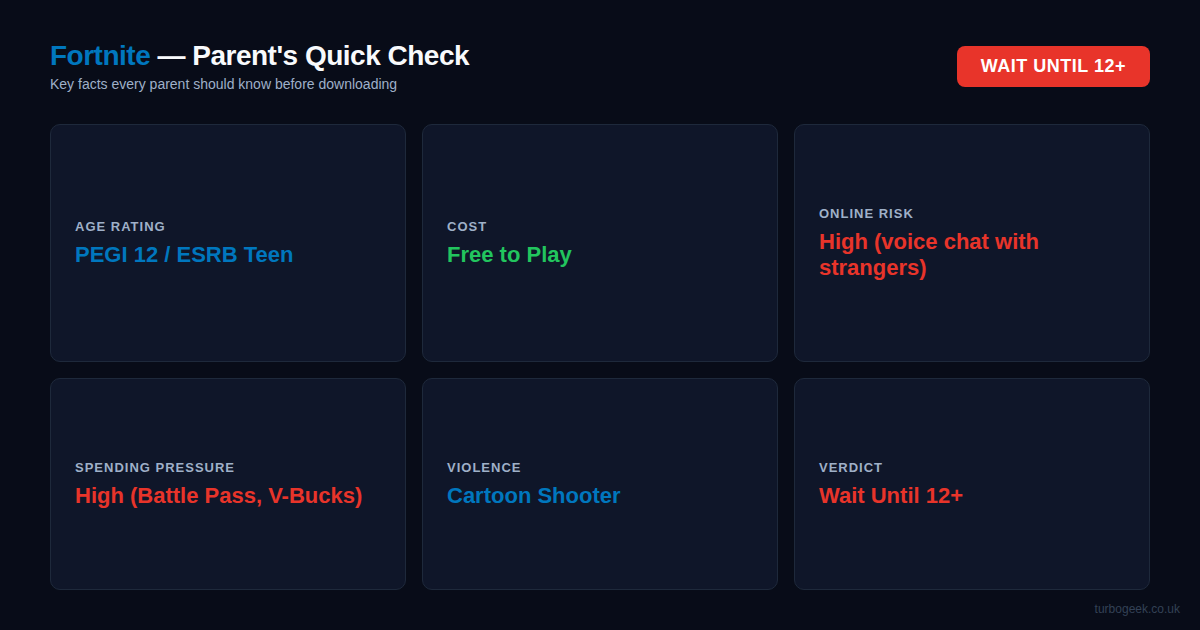
- What it is: A free-to-play competitive battle royale shooter — 100 players, last one standing wins
- Age rating: PEGI 12 / ESRB Teen — both my boys are under the rating
- The real cost: Free to download, but Battle Pass (800 V-Bucks/~£9 per season), constant cosmetic pressure
- Online risk: Always online with voice chat to strangers — no meaningful offline mode
- My verdict: Wait until 12+. LEGO Fortnite (PEGI 7) could be a middle ground if you set it up carefully
New to this series? Start with why I review games differently as a dad, then check our guides on Minecraft and Roblox. Browse all our family gaming content at TurboGeek Gaming.
What Fortnite Actually Is
Fortnite is a free-to-play battle royale game made by Epic Games. The core mode drops 100 players onto an island, and the last person (or team) standing wins. You find weapons, build structures for cover, and eliminate other players while a shrinking storm forces everyone closer together.
The art style is cartoon-like — bright colours, exaggerated characters, no blood or gore. But make no mistake: the core gameplay loop is a competitive shooter. You are pointing weapons at other players and eliminating them. The cartoon style makes it easier to dismiss, but the mechanic is the same.
Beyond Battle Royale, Fortnite now includes Creative mode (build your own maps), LEGO Fortnite (a survival/crafting game rated PEGI 7), and various limited-time modes. It is an enormous platform with over 400 million registered accounts. But when your child says “I want to play Fortnite,” they almost certainly mean the Battle Royale shooter — because that is what their friends are playing.
Why My Kids Want It
The same reason they wanted Roblox: everyone at school plays it. Fortnite is a social currency in primary school playgrounds. The dances, the skins, the “Victory Royale” stories — if you do not play, you are out of the conversation.
My boys are 10 and 7. Their friends play it. They have watched YouTube videos of it. They know the characters, the emotes, the weapons. The pressure is real, and I understand it. Being the kid who cannot join in is genuinely hard.
But peer pressure is not a reason to ignore an age rating. It is actually a reason to pay more attention to it.
The Age Rating Question
Fortnite Battle Royale is rated PEGI 12 in Europe and ESRB Teen (13+) in the US. Both of my boys are under those ratings. For me, that settles the question.
I know plenty of parents who let their 7 and 8-year-olds play it. I am not judging them — every family draws the line differently. But I respect age ratings the same way I respect film certificates. PEGI 12 exists because the content was assessed by people whose job is to evaluate what is appropriate for different ages. I trust that process more than I trust playground consensus.
The rating is not just about violence. It factors in the competitive intensity, the online interaction with strangers, and the pressure mechanics built into the game’s economy. All of those things matter when your child is 7 or 10.
The Spending Model — “Free” Does Not Mean Free
Fortnite is free to download. That is the hook. But the spending pressure is relentless.
The Battle Pass costs 800 V-Bucks per season — roughly £9. A new season launches every couple of months. If you complete the pass, you earn back 800 V-Bucks (enough for the next pass), but that requires significant playtime. Miss a few weeks and you have paid for content you never unlocked.
Then there are cosmetic skins, emotes, and wraps in the Item Shop. Individual skins can cost 800 to 2,000 V-Bucks (£9 to £16+). Popular collaboration skins — Marvel characters, Star Wars, musicians — drive enormous “I need that” pressure from kids. Epic raised V-Bucks prices in March 2026: the cheapest pack now gives you 800 V-Bucks for £8.99, down from 1,000 for the same price.
None of this spending affects gameplay — it is all cosmetic. But to a child, having the “default skin” while their friends have the latest collaboration outfit feels like showing up to school in the wrong uniform. The social pressure to spend is part of the design.
Online Interaction — Always Connected, Always Exposed
Fortnite has no meaningful offline mode. Every match is online against real people. If your child plays squads or duos with random players, they will be matched with strangers — including adults.
Voice chat is where the real risk lives. By default, players can talk to their teammates. That means your 10-year-old could be in a voice call with adults they have never met. The language, the behaviour, the potential for bullying or inappropriate contact — it is fundamentally different from playing Minecraft on a Switch in the living room.
Epic has improved its parental controls significantly. You can restrict voice chat to “Friends Only” or “Nobody,” and for children under 13, cabined accounts automatically limit communication features. Voice reporting is always on for under-18s, storing a rolling five-minute audio buffer that gets sent to Epic if someone files a report. These are good steps. But they require a parent to actively set them up and maintain them.
The question I keep coming back to: why would I put my 7-year-old in a position where I need to configure safety controls to protect him from the people he is playing with? With Minecraft on the Switch, I do not have that problem in the first place.
The Competitive Intensity
This is the part that gets overlooked. Fortnite is not a relaxing after-school game. It is a high-speed, high-pressure competitive shooter where you can be eliminated in seconds by someone with vastly more skill.
The skill gap in Fortnite is enormous. Experienced players build complex structures in fractions of a second while simultaneously shooting. A new player — especially a young child — will die quickly and repeatedly. That is frustrating for anyone, but for a 7 or 10-year-old it can be genuinely distressing.
Each match lasts around 20 minutes, but your participation might last 2 minutes if you land badly. Then you queue again, wait, drop in, and potentially die again quickly. The dopamine loop of “one more game” combined with the frustration of losing creates an emotional rollercoaster that younger children are not equipped to regulate.
Compare that to Minecraft, where there is no losing, no timer, and no pressure. Or even to LEGO Fortnite, which removes the elimination mechanic entirely. The core Battle Royale experience is built to be intense. That is what makes it exciting for teenagers and adults. It is also what makes it unsuitable for younger children.
What I Would Want to See Before Saying Yes
I am not saying Fortnite is a bad game. It is a well-made, incredibly popular game that millions of people enjoy responsibly. But for my household, there are conditions before it gets a yes:
- Age 12+ to match the PEGI rating. That is the minimum. The rating exists for a reason.
- Spending limits agreed in advance. A fixed budget per season, discussed before the Battle Pass is purchased. No surprise purchases.
- Voice chat disabled or friends-only. No talking to random strangers. Non-negotiable.
- Time limits enforced. Fortnite is designed to keep you playing. Clear stop times, agreed before the session starts.
- Playing in a shared space. Not behind a closed bedroom door with headphones on. In the living room where I can hear what is happening.
In the meantime, LEGO Fortnite could be a middle ground. It is rated PEGI 7, features survival and crafting gameplay without the elimination mechanic, and has Sandbox and Cozy modes that remove most of the pressure. It still sits within the Fortnite platform, so the same parental controls apply — and you need to make sure your child stays in LEGO Fortnite rather than wandering into Battle Royale. But as a stepping stone for younger children, it is a more age-appropriate option.
The Bottom Line
My boys are 7 and 10. Fortnite Battle Royale is rated PEGI 12. That is the line for me.
It is not that I think Fortnite is dangerous or evil. It is that I think age ratings exist for good reasons, and a competitive online shooter with voice chat, spending pressure, and intense gameplay is not the right fit for primary school children. The peer pressure is real, and I empathise with my kids when they feel left out. But my job is not to be popular — it is to make decisions I can stand behind.
When they hit 12, we will revisit the conversation. We will set up the parental controls together, agree spending rules, and probably start with LEGO Fortnite before moving to the main game. Until then, there are plenty of brilliant games that do not require me to build a safety framework around them.
Related: Read our Minecraft parent guide for a game that gets a yes in our house, or our Roblox parent guide for another game that gets a no — for different reasons. For all our family gaming content, visit TurboGeek Gaming.