

TL;DR – authd in 26.04
- Ubuntu 26.04 establishes authd as the supported cloud-auth framework, as per Canonical’s own phrasing in the 26.04 discussion.
- authd matters because it provides Ubuntu with a maintained path to modern cloud identity providers and OIDC-style workflows.
- This is bigger than desktop convenience: it affects how Linux fits into MFA, conditional access, and group-based privilege models.
- Pilot carefully: login, group mapping, fallback access, and recovery all need validation.
Start here: If your first question is ‘why should I care if SSSD already exists?’, jump straight to the section on why cloud identity on Linux suddenly matters, then compare the broader security angle with Secure Your Linux Login: Easy Google Authentication MFA Setup.
| Topic | When | What to do |
|---|---|---|
| Cloud-first organization | Identity already lives in Entra, Google, or similar | authd is strategically relevant now. |
| Mixed Linux estate | Servers and desktops need a modern identity | Pilot authd on low-risk endpoints first. |
| Traditional directory only | AD and classic LDAP dominate | Watch the direction, but do not force it unnecessarily. |
| Break-glass concern | You need guaranteed local recovery | Pilot with explicit fallback access in place. |
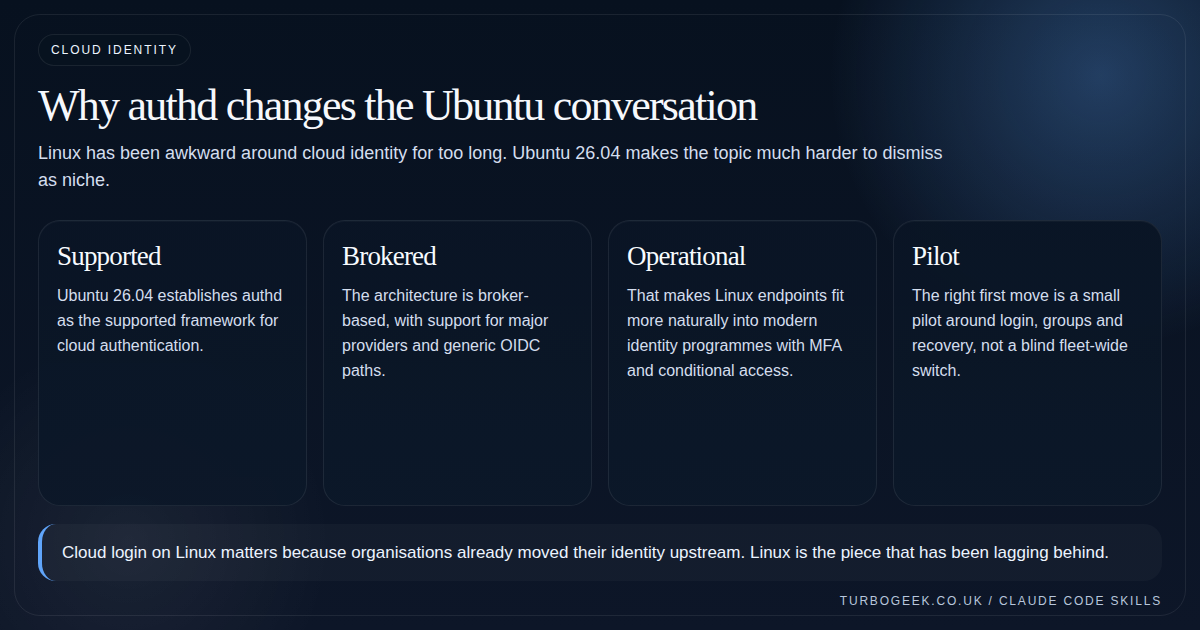
Ubuntu 26.04 makes authd part of the supported platform story, not just an interesting side project. Canonical’s own 26.04 messaging ties authd to modern standards such as OpenID Connect, and the dedicated 26.04 discussion says Ubuntu 26.04 establishes authd as the supported framework for cloud authentication on Ubuntu.
That matters because cloud identity is already the norm in many organizations. Linux endpoints have often been the awkward exception, which turns a simple identity strategy into a patchwork of special cases.
Why cloud login on Linux suddenly matters
Many organizations already use cloud identity providers for user management, MFA, and access policies. When Linux endpoints cannot participate cleanly, they become the annoying outlier that drags everyone back toward exceptions and one-off tooling.
authd matters because Canonical attempts to make Ubuntu a first-class citizen in that world rather than an awkward special case that needs separate handling.
What are the authenticated changes in practice
Canonical describes AuthD as a stable, broker-based architecture that supports major providers and provides a generic OIDC broker path. That is important because it avoids welding Ubuntu to a single identity vendor and instead provides the platform with a maintained framework to build on.
The practical outcomes are easier conversations around MFA, conditional access, and claim-based group mapping for Linux roles such as sudo. That is much more interesting than ‘log in with web identity’ as a gimmick.
- Think group mapping and privilege management, not just login screens.
- Think policy alignment with the identity platform your organization already uses.
- Think recovery and fallback paths before rollout, not after the first lockout.
How to pilot authd without being reckless
Start small. Pick a low-risk Ubuntu endpoint, validate package availability, test login behavior, confirm group mapping, and make sure you still have an explicit local break-glass path. Identity rollouts go bad when recovery is hand-waved away.
This is also a case where logs and service status matter more than opinions. Treat it like infrastructure, not like a desktop novelty.
# Inspect and validate authd on Ubuntu 26.04
apt policy authd
sudo apt install authd
systemctl status authd --no-pager
journalctl -u authd -n 50 --no-pagerThe real takeaway
authd matters in Ubuntu 26.04 because it closes a gap between where enterprise identity already is and where Linux access management has often lagged. That does not mean every Ubuntu box suddenly needs cloud login. It means the option is now much more credible and well-supported.
Read it as infrastructure, not hype. Pilot it carefully, pair it with your existing MFA thinking, and keep one reliable local recovery path no matter how confident the rollout looks.
Related next steps
- Secure Your Linux Login: Easy Google Authentication MFA Setup
- Linux SSH Hardening Checklist
- How to Install and Configure the SecurID Agent for SSH on Linux
- Ubuntu 26.04 LTS Security Changes That Actually Matter
- Post-Quantum SSH on Ubuntu 26.04: What It Means in Practice
- Ubuntu Core Desktop in 2026: Why Canonical Keeps Building Toward It
Leave a Reply