
TL;DR
- The generation gap is real — my kids play Minecraft and Teardown; I grew up on arcades and racing games
- Most reviews miss what parents need — will it run on our hardware, can the kids play together, is it worth the money
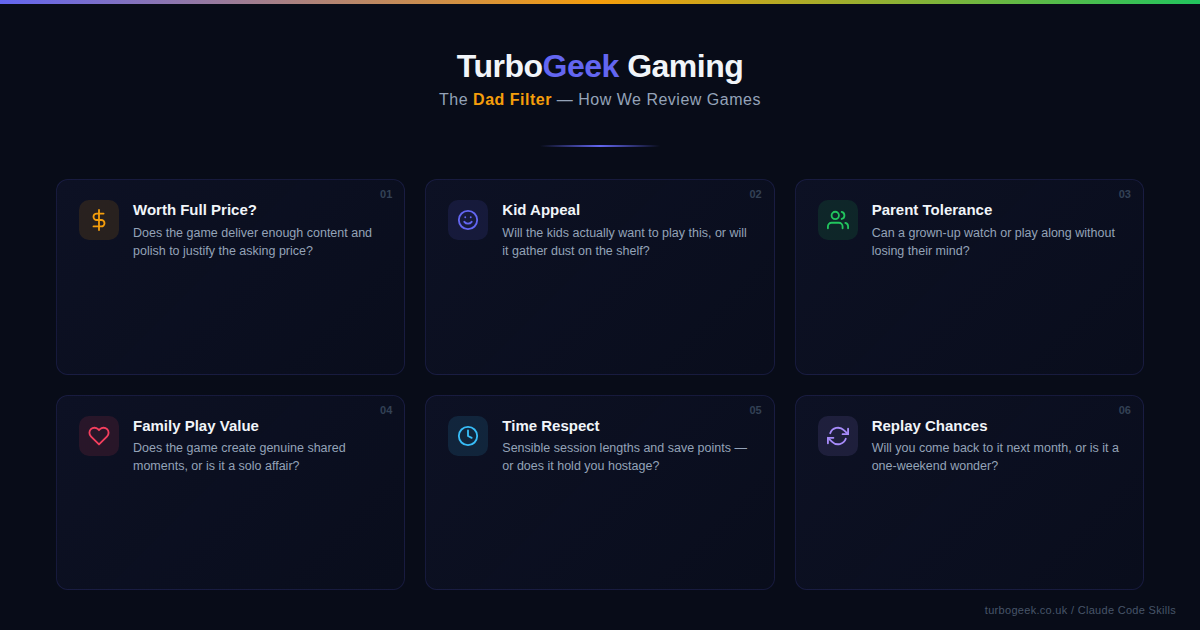
- The Dad Filter — six practical things I check before recommending any game
- Three players, one household — a 46-year-old, a 10-year-old, and a 7-year-old don’t want the same things
- What this site covers — honest reviews, family-tested picks, and the occasional rant about pricing
Two Generations, One Living Room, Zero Overlap
My first gaming memory is typing LOAD on a Commodore 16 and waiting. Not loading a game in seconds from an SSD. Waiting. Minutes. Sometimes the tape would fail and you’d start again. That was 1985, and I was five years old, and it was magic.
Fast-forward four decades and I’m watching my two boys — ten and seven — play Minecraft on a PC that would have been science fiction to five-year-old me. They don’t load games. Games are just there. They don’t read manuals. There are no manuals. They don’t ask me how to play. They watch a YouTube video and know more than I do within twenty minutes.
Their gaming journey started on iPads. Tapping and swiping at whatever the App Store put in front of them. Then they got a Switch, and suddenly they were playing actual games — proper ones with structure and challenge. Now they’re gravitating toward PC, which is where I’ve ended up too, so at least we agree on the platform even if we agree on almost nothing else.
Here’s the honest bit: I don’t fully understand sandbox games. My kids will spend three hours in Teardown just smashing buildings apart with no objective. They’ll play TABS — Totally Accurate Battle Simulator — setting up increasingly ridiculous fights with no interest in winning. They play Minecraft and build things I genuinely can’t identify. And they’re having the time of their lives.
Meanwhile, I grew up on games that had a point. Sensible Soccer on the Atari ST had a score. Doom had enemies to kill. Gran Turismo had a finish line. Even the games I loved as a teenager — Quake III Arena, Half-Life, Unreal Tournament — had clear objectives. You knew what you were doing and why.
The one game that genuinely brought us all together was Guitar Hero — well, Clone Hero on PC. That crossed every generational line. The seven-year-old bashing drums, the ten-year-old on guitar, me pretending I could still keep up on Expert. For about three months, we were a band. It was brilliant. If every game could do that, I wouldn’t need to write this post.
But they can’t. And that gap — between what I understand about games and what my kids experience — is exactly why I started writing about this differently.
What Reviews Don’t Tell You
I read a lot of game reviews. Professional ones, user ones, YouTube ones. And most of them are written by people who don’t have a ten-year-old asking if this game has split-screen, or a seven-year-old who will get frustrated if the tutorial takes more than ninety seconds.
A typical review will tell you the frame rate, the graphics quality, and whether the story is good. That’s useful if you’re buying a game for yourself and you’ve got four uninterrupted hours on a Saturday night. But if you’re a parent trying to work out whether a game is worth forty quid for a household with three different people who want three different things? You’re on your own.
Nobody tells you that the multiplayer mode requires a second paid account. Nobody mentions that the game needs 120GB of storage on a console that only has 667GB usable. Nobody flags that the “family-friendly” rating still includes mechanics designed to push kids toward microtransactions. And good luck finding out whether the game actually runs well on a mid-range PC rather than the reviewer’s RTX 4090.
This isn’t a rant against games journalism. Most reviewers are doing their job well — they’re just doing it for a different audience. I need a review that answers a different set of questions.
The Dad Filter
Over the years, I’ve developed a mental checklist I run through before I recommend anything — to friends, to other parents, or on this site. I’ve started calling it the Dad Filter, partly because it sounds better than “the list of things I wish someone had told me before I spent sixty pounds on a game my kids played for forty minutes.”
First, I look at whether the game actually works for the household. Can more than one person play it? Does it need two controllers, two accounts, two copies? If it’s a PC game, will it run on hardware that isn’t bleeding-edge? When the PS5 went through its recent price increase, it made me even more conscious of value — every purchase needs to justify itself.
Then there’s the money question, and I don’t just mean the sticker price. I mean the real cost. The season pass. The battle pass. The cosmetic shop that’s cleverly positioned where kids will see it every time they log in. I want to know the total cost of ownership, not just what’s on the box. Understanding what goes into manufacturing cost versus retail price makes you view the whole value chain differently.
I check whether the game respects the player’s time. Not everyone has six hours to invest in a single session. Some of us have homework supervision, bedtime routines, and maybe — if we’re lucky — ninety minutes once the house goes quiet. Games that punish you for playing in short sessions aren’t badly designed, they’re just not designed for us.
Age-appropriateness matters, but not in the way the PEGI rating suggests. A PEGI 7 game can still have chat systems that expose young kids to strangers. A PEGI 12 game might be perfectly fine for a mature ten-year-old. Context matters more than numbers, and that only comes from actually playing the thing.
I look at whether the game teaches anything — and I don’t mean educational games, which my kids would reject on principle. I mean games that quietly develop problem-solving, teamwork, spatial reasoning, or creativity. Minecraft does this brilliantly. Most parents just don’t realise it because they see blocks and chaos.
And finally, I ask the simplest question: is it actually fun? Not impressive. Not technically remarkable. Fun. The kind of fun where an hour vanishes and nobody’s argued about whose turn it is.
Three Players, One Household
The reality of gaming in our house is that there are three completely different players under one roof.
The ten-year-old is starting to want more complex games. He’s outgrowing pure sandbox and getting curious about story, strategy, and competition. He watches gaming YouTubers and comes to me with wishlists that would bankrupt a small country. He wants to play what his friends play, which means I spend a lot of time evaluating games I’d never have looked at otherwise.
The seven-year-old still wants things to be immediate and physical. He likes destruction, building, and anything where the cause-and-effect loop is fast and visible. Teardown is perfect for him. Anything with a long cutscene or a complex menu system loses him in seconds. He doesn’t care about graphics or frame rates. He cares about whether he can smash a wall with a sledgehammer.
And then there’s me. I’ve been gaming for over forty years now — from a Commodore 16 through an Atari 520ST, a 586 PC running Doom, a PS1, a Pentium II that ran Quake III like a dream, a PS2, PS3, Wii, PS4 Pro, PS5, Switch, and now primarily PC. I’ve seen every era. I still have opinions about whether Burnout 3 or Burnout Revenge was better. I can tell you exactly when the God of War series went from great to extraordinary. And yes, I still think Half-Life is one of the greatest games ever made.
Finding games that work for all three of us is genuinely difficult. When it happens — like Clone Hero, or the odd round of Mario Kart — it’s worth more than any single-player masterpiece. That overlap is rare, and when I find it, I’ll make sure to highlight it here.
What You’ll Find Here
This isn’t going to be another site that reviews every new release and gives it a score out of ten. There are plenty of those, and most of them do it better than I would.
What I’ll cover is the stuff that matters to people like me. Parents who game. Adults who grew up with controllers in their hands and now share a household with kids who play completely differently. People who want honest, practical information rather than hype.
You’ll find reviews that focus on family value — not just whether a game is good, but whether it’s good for your situation. Buying guides that factor in real budgets and real hardware. Comparisons that help you decide where to spend limited gaming money. And the occasional piece where I just write about a game I love, because after forty years of gaming, I’ve earned that.
If you want the full picture of where I’m coming from, I’ve written up my complete gaming history — from that Commodore 16 in 1985 right through to today. It might explain some of my biases. It will definitely date me.
The Simple Promise
Everything I write here will be honest. If a game is overpriced, I’ll say so. If it’s brilliant but not suitable for kids, I’ll explain why. If my seven-year-old loves something I think is terrible, I’ll tell you both perspectives. I don’t get free review copies. I don’t have sponsorship deals. I’m buying these games with the same money you are, and I want them to be worth it just as much as you do.
I’m a 46-year-old dad who’s been playing games since before most gaming journalists were born. That doesn’t make me an authority. But it does give me a perspective that’s hard to find elsewhere — and if you’re in a similar position, I think you’ll find it useful.
Leave a Reply