
Rechecked 22 June 2026. Current availability and multiplayer specifications were checked against Milestone, Steam and GOG.
I remember the Screamer 2 menu music more clearly than I remember most of its tracks.
That is not an insult. In 1996, the family PC was a Pentium 75 with a CD-ROM drive and a Sound Blaster card. Friends had PlayStations. We had a beige box that also did homework, and Screamer 2 made it feel briefly dedicated to speed.
Revisiting the game is a reminder that nostalgia does not preserve every detail equally. The music came back immediately. The handling took longer. The children were interested for roughly the amount of time required to discover that driving the wrong way was funnier than racing properly.
Quick verdict
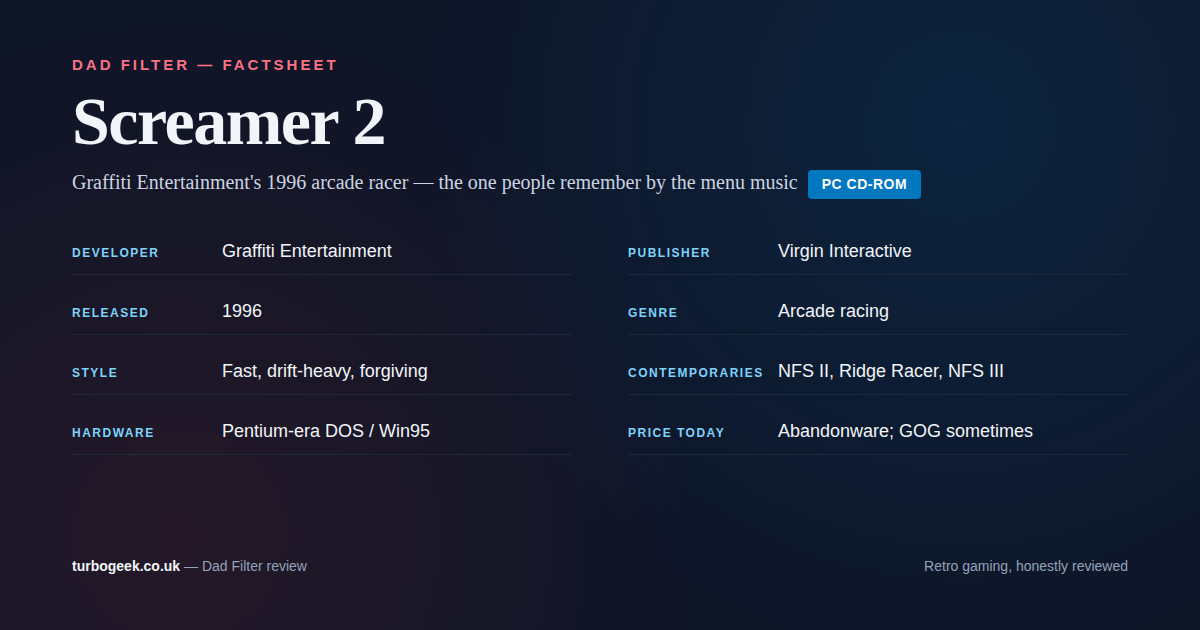
- Developer: Graffiti, the Italian studio that became Milestone
- Original release: MS-DOS, 1996
- Current legal availability: Steam and GOG
- Dad Filter: Buy for a specific 1990s PC memory; otherwise sample first
- Kid appeal: Low to medium
- Family play: Multiplayer exists, but modern setup needs more explanation than a current console racer
What Screamer 2 offers
Screamer 2 is an arcade-style racer built around six locations, multiple cars, championship and time-attack play, and a handling model that wants speed and controlled slides more than careful simulation.
Milestone’s own history lists Arcade, Championship, Time Attack, Multiplayer and Combat modes, with multiplayer for up to four players. I previously called the game single-player and reduced family play to hot-seat racing. That was incorrect.
The original multiplayer options belong to the DOS era, so “supports four players” does not mean four children can effortlessly join from a modern sofa. The official Steam and GOG releases package the game for current computers, but anyone buying specifically for multiplayer should check the store documentation and community setup guidance first.
The family PC version of arcade racing
Screamer 2 occupied a useful space in our house. It did not require a console, and it looked fast on hardware that spent most of its time in Windows applications. The CD-ROM, music and full-screen 3D presentation gave it weight.
I previously described it as the game for people who had not saved for a PlayStation. That is too broad to present as history, but it accurately describes my situation. The PlayStation was elsewhere. Screamer 2 was installed at home.
How the handling feels now
The car rotates easily once you understand what the game expects. There is less sense of weight transfer than in a modern racer, but calling it “on rails” understates the work needed to learn a fast line. The official store copy itself emphasises jumping, spinning, terrain and traction.
I also previously framed Need for Speed II as the more simulation-minded comparison. That was not useful; both games sit firmly on the accessible side of racing. A better distinction is that Screamer 2 feels like a compact DOS arcade machine: short tracks, immediate restarts and a handling model learned through repetition.
What my boys made of it
The seven-year-old wanted visible damage. The ten-year-old drove backwards because disrupting the race created a clearer joke than winning it. Neither response makes Screamer 2 a bad game. It shows how much the surrounding language of racing games has changed.
Modern children expect progression, customisation, dramatic crashes and a world beyond the event. Screamer 2 offers a car, a course and a timer. That purity can be refreshing to an adult with fifteen minutes and underwhelming to a child with several modern racers available.
Steam, GOG or an original CD?
| Version | Why choose it | What to check |
|---|---|---|
| Steam | Official purchase and convenient library access | Controller and multiplayer configuration |
| GOG | Official DRM-free DOSBox package | Current OS compatibility notes |
| Original CD-ROM | Period hardware and packaging | DOS setup, sound and 3dfx support |
I previously described abandonware as the realistic route and said the game only appeared occasionally on GOG. That is no longer true. Steam and GOG both sell official releases.
The Dad Filter
Worth buying?
For the right player. Buy it if the soundtrack, DOS racing or the Screamer series means something to you. New players should watch current gameplay and compare the price with other classic racers.
Kid appeal
Low to medium. Speed is universal. The limited presentation and progression are not.
Parent tolerance
Medium. Races are short and restarts are quick. The music is either an immediate route back to 1996 or something the rest of the house will ask you to turn down.
Family play
Historically stronger than I gave it credit for. The game includes multiplayer modes, but I have not retested a four-player setup on the current store builds. For a modern family, alternating time trials remains the simplest option unless an adult is willing to configure the original multiplayer model.
Time respect
Good. A race takes minutes and does not surround itself with a long ceremony.
Verdict
Screamer 2 is not abandonware, not single-player-only and not merely a worse Need for Speed. It is an officially available 1996 DOS racer with its own handling, strong music and a more substantial mode list than my original review acknowledged.
The emotional verdict remains narrower. I return because the family PC, the menu loop and the sense of making modest hardware do something exciting are tied together. My boys do not have that context, and the game does not manufacture it for them.
That makes Screamer 2 a good historical purchase and a selective modern recommendation. I enjoyed going back. I would not pretend everybody needs to follow.
Sources
Related: compare another 1990s racer in my V-Rally review, revisit the PlayStation generation in Tomb Raider, or browse the Gaming hub.
Leave a Reply