
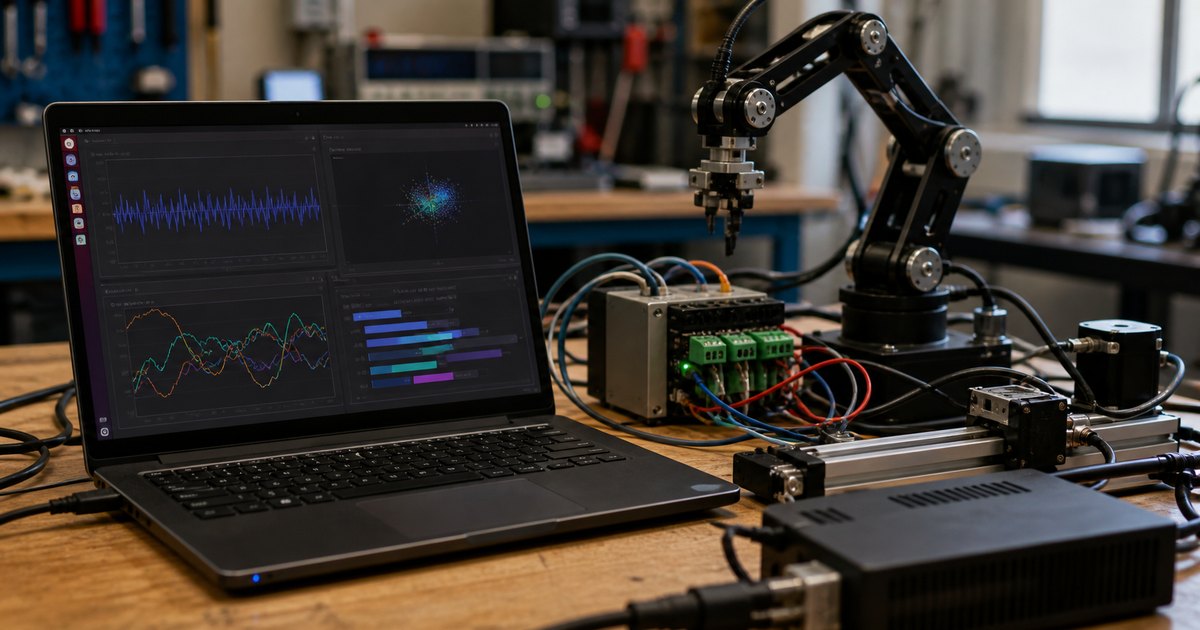
TL;DR – Real-time Ubuntu
- Canonical says the real-time kernel is freely available from Ubuntu 26.04 onwards: the simple install path is
sudo apt install ubuntu-realtime. - This is a distribution access change, not a universal recommendation: most Linux users still do not need a real-time kernel.
- Use it for deterministic latency cases: industrial, robotics, specialised media and similar workloads are the real audience.
- General-purpose servers and desktops should stay boring unless you have a specific reason.
Start here: If you only need the decision, jump straight to ‘Who should actually use it’ and ignore the temptation to install a real-time kernel just because it sounds more serious.
| Topic | When | What to do |
|---|---|---|
| Industrial or robotics | Latency guarantees matter | Real-time Ubuntu is worth testing. |
| Audio or media specialist | Timing is part of the workload | Possibly useful after validation. |
| General desktop | Normal apps and browsing | You probably do not need it. |
| Typical server | Web, files, containers, VMs | Stay on the normal kernel unless you have a specific case. |
Canonical’s Real-time Ubuntu page now says the real-time kernel is freely available for everyone from the 26.04 release onwards. That is a meaningful change because it lowers the barrier to evaluation. It does not change the basic truth that real-time kernels are still a specialised tool.
That distinction matters. Easy access is great. Easy misuse is not. The right admin response is to understand the use case, not to install a real-time kernel on a normal box and call it optimisation.
What changed in 26.04
The new story is access. Canonical explicitly ties the change to PREEMPT_RT being fully upstreamed and gives the simple package install path for Ubuntu 26.04 onward. Earlier releases still sit behind Ubuntu Pro in the traditional model.
That is good news because it lets more people test properly before making a business or engineering call. It should lead to better decisions, not louder myths.
# Inspect and install the generic real-time package on Ubuntu 26.04
apt policy ubuntu-realtime
sudo apt install ubuntu-realtime
uname -a
cat /sys/kernel/realtime 2>/dev/null || trueWho should actually use it
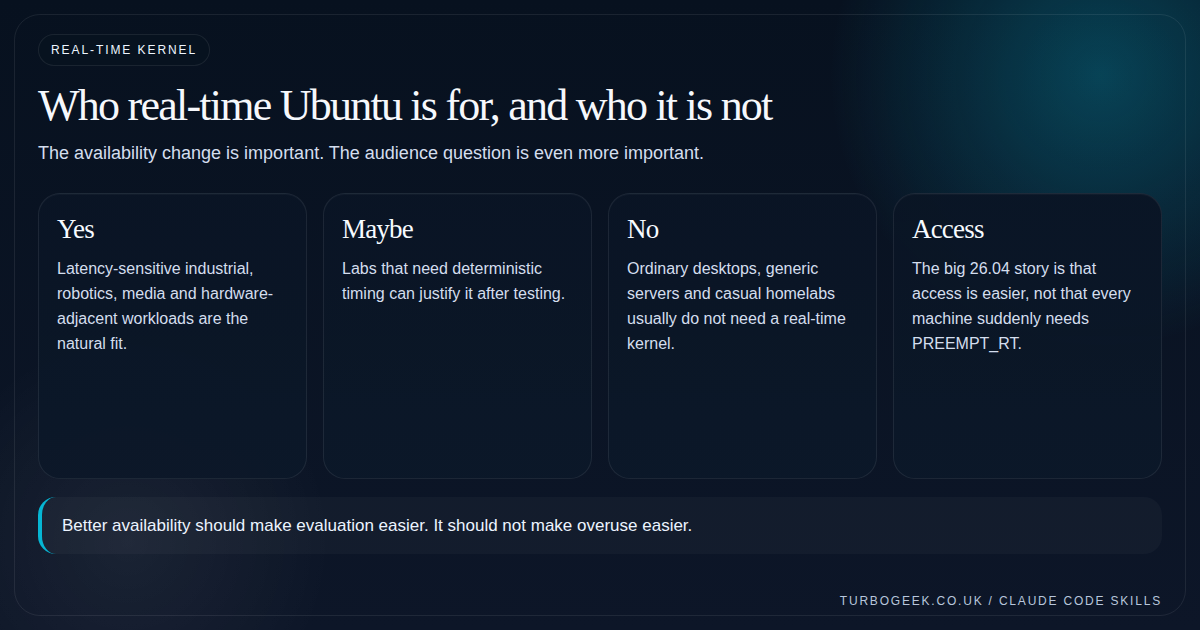
Real-time Ubuntu makes sense where latency determinism is part of the requirement, not just a nice-to-have. Industrial control, robotics, specialised media, and some hardware-focused edge deployments are the obvious candidates.
A normal desktop, a generic web server, or a casual homelab usually does not become better simply because it now runs a real-time kernel. In many cases it just becomes more specialised than it needs to be.
- Good fit: deterministic timing workloads.
- Potential fit: labs evaluating hardware-adjacent real-time behaviour.
- Poor fit: normal-purpose desktops and servers with no timing requirement.
What to watch before you commit
Kernel changes are never free. Driver support, service compatibility, and support expectations still matter. A real-time kernel should be justified by workload behaviour you can observe, not by aesthetics.
If you cannot describe the specific timing problem you are solving, you almost certainly do not need this kernel.
Verify you actually got the real-time kernel
Installation is the easy part. Confirming the right kernel is loaded is what saves you from a confusing afternoon when latency is still bad. Run these after installing and rebooting:
# Confirm what kernel you are actually running
uname -r
cat /proc/version

# Check if the real-time kernel package is installed and active
apt policy ubuntu-realtime
apt policy linux-image-realtime-generic 2>/dev/null || true

# Confirm PREEMPT_RT is in effect (look for "PREEMPT_RT" in /proc/version above)
zcat /proc/config.gz 2>/dev/null | grep -E '^CONFIG_PREEMPT_RT' || \
grep -E '^CONFIG_PREEMPT_RT' /boot/config-$(uname -r)If uname -r still shows generic rather than realtime, you booted the wrong kernel. Pick the right entry from GRUB and try again.
The practical verdict
Real-time Ubuntu being free in 26.04 is a good change because it makes evaluation easier and more honest. The correct outcome is not wider indiscriminate use. The correct outcome is more accurate use by the people who genuinely need it.
If you run ordinary Linux boxes, enjoy the fact that access improved and then keep using the standard kernel unless a real workload tells you otherwise.
Related next steps
- Ubuntu Server First 30 Minutes: The Setup Checklist I’d Use Every Time
- Linux SSH Hardening Checklist
- How to Check Disk Space in Linux and Find What Is Eating It
- Should You Upgrade to Ubuntu 26.04 LTS Right Away?
- Rust Coreutils and sudo-rs on Ubuntu 26.04: Will You Notice the Difference?
- Pop!_OS 24.04 LTS Upgrade: Should You Jump to COSMIC?
Leave a Reply