
TL;DR
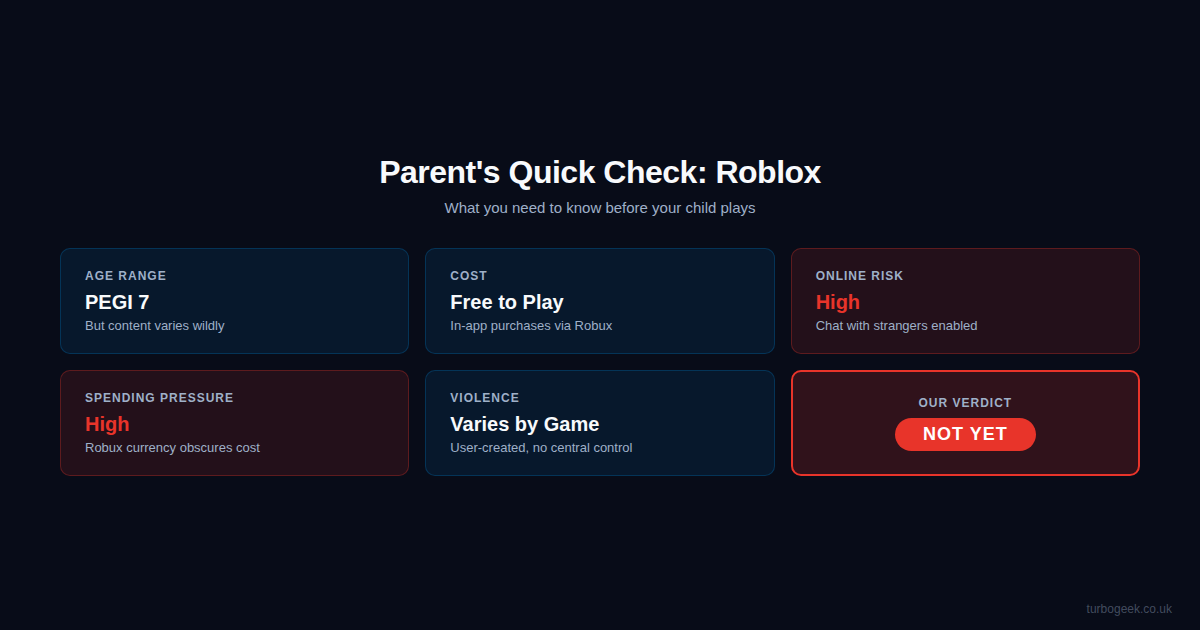
- Roblox is a platform, not a game — thousands of user-created experiences with wildly varying quality and safety
- PEGI 7 is misleading — the rating covers the platform shell, not the individual games on it
- Chat with strangers is enabled by default — and parental controls have known gaps
- Robux spending adds up fast — virtual currency obscures real costs, and 60% of households with Roblox players spend money monthly
- Peer pressure is intense — my 7-year-old told his teacher he plays Roblox despite never having touched it
- My verdict: not yet — my boys are 7 and 10, and I don’t think the platform is safe enough right now
My 7-year-old came home from school last term and told me his teacher asked the class who plays Roblox. His hand went up. He has never played Roblox. Not once. Not on my phone, not on a tablet, not on anyone else’s device. He lied because every other hand in the room was up and he didn’t want to be the odd one out.
That moment told me everything I needed to know about the pressure kids are under to play this game. And it made me more certain that my decision to say no — for now — was the right one.
I have two boys, aged 7 and 10. Neither of them plays Roblox. Their friends do. Their classmates do. They get hassled about it regularly. But I’ve looked into what Roblox actually is, and I’m not comfortable with it yet. Here’s why.
What Roblox Actually Is
The first thing parents need to understand is that Roblox is not a game. It’s a platform. Think of it more like YouTube but for games — thousands of experiences created by other users, many of them teenagers and young adults, with wildly varying quality, content, and safety standards.
When your child says “I want to play Roblox,” they’re not asking to play one thing. They’re asking for access to a sprawling marketplace of user-generated content. Some of it is creative and harmless. Some of it is violent, manipulative, or designed to extract money. As a parent, you can’t preview every experience your child might stumble into, because there are millions of them and new ones appear every day.
That’s fundamentally different from buying your child a copy of Minecraft, where you know exactly what they’re getting.
Why Every Kid Wants It
Roblox has over 100 million daily active users as of 2025, and around 40% of them are under 13. It’s not just popular — it’s the default. At my sons’ schools, playground conversation revolves around which Roblox games they played last night, which items they bought, and which YouTubers they watch playing it.
If your child doesn’t play, they feel left out. That’s not an exaggeration. My older son has learned to shrug it off, but my 7-year-old felt so excluded that he lied to his teacher about playing it. The peer pressure isn’t subtle — it’s constant, and it starts young.
I understand why kids want it. I don’t blame them. But I also don’t think “everyone else is doing it” is a good enough reason to hand my child access to a platform I have serious concerns about.
What Concerned Me When I Looked Into It
When my boys first started asking, I did what any reasonable parent would do — I looked into it properly. What I found put me off.
Strangers can chat with your child. Roblox has in-game chat enabled by default. While Roblox introduced mandatory age verification in January 2026 — requiring ID or facial scans to unlock chat features — reports from parents suggest the controls still have gaps. According to recent survey data, only 61% of parents believe Roblox’s parental controls are sufficient to prevent their child being contacted by a potential predator, and 29% discovered content or interactions they thought the controls should have blocked.
The content is unpredictable. Because games are user-created, there’s no central quality control in the way you’d get with a game published by a major studio. In 2025, multiple lawsuits were filed alleging that Roblox’s security measures were insufficient to protect minors, with cases involving grooming, sexual exploitation, and even real-world abductions linked to contacts made on the platform. Journalist Chris Hansen released a documentary in February 2026 investigating child safety failures on Roblox.
Scams target children directly. Because anyone can create a Roblox game, bad actors create experiences specifically designed to trick children into handing over account details, personal information, or Robux. My kids wouldn’t know how to spot these — and honestly, most adults would struggle too.
The Monetisation Problem
Roblox is “free to play.” That phrase should come with an asterisk the size of a billboard.
The platform runs on Robux, a virtual currency that you buy with real money. The exchange rate is deliberately confusing — 400 Robux costs around £4.99, but items in games might cost 75, 150, or 1,000 Robux. Children lose track of what they’re actually spending because the real-money value is obscured behind cartoon currency.
Research from the University of Sydney in 2025 interviewed children aged 7 to 14 about their spending on Roblox. The findings were stark: children described in-game purchases as “scams” and “cash grabs.” Researchers found that virtual currencies make it difficult for children to understand the real value of what they’re buying, leading to overspending, financial disappointment, and family arguments. The study’s title says it all: “Literally just child gambling.”
The numbers back this up. Among households with Roblox players, 60% spend money on the platform every month. While most spend under £25, the pressure to keep spending is constant — games are designed to make free players feel like they’re missing out. Popular games like Adopt Me!, Blox Fruits, and Pet Simulator 99 feature loot-box-style mechanics that encourage children to spend money on chance-based rewards.
I don’t want my children’s first experience of money management to be navigating a system designed to confuse them into spending more.
Age Ratings vs Reality
Roblox carries a PEGI 7 rating. On paper, that suggests it’s suitable for children aged 7 and up. In practice, that rating covers the platform itself — the launcher, the menus, the basic interface. It does not cover every individual game on the platform.
Some Roblox games contain realistic violence, horror themes, or simulated gambling. Others are perfectly fine for young children. The problem is that a PEGI 7 label gives parents a false sense of security. You see “7” on the box and think your child is playing something age-appropriate. But the game they launch five minutes later might have content you’d never approve of.
I believe age ratings exist for a reason. But when the rating doesn’t actually reflect what your child will encounter, it’s worse than useless — it’s misleading.
The Peer Pressure Problem
This is the hardest part. My boys don’t just want Roblox because it looks fun. They want it because not having it makes them feel different. When every conversation at school starts with “did you see that new Roblox game?” and your child has nothing to say, that hurts.
I get it. I genuinely do. But I’m not comfortable with the idea that my children need to play a specific game to belong. Age ratings exist for a reason, and I’d rather explain my decision and help them find other things to talk about than cave to pressure I don’t agree with.
We talk about it openly. I haven’t banned Roblox in some dramatic fashion — I’ve explained why I think they’re not old enough yet, what my concerns are, and that we’ll revisit it as they get older. They don’t love the answer, but they understand it.
What I’d Want to See Before I Say Yes
I’m not saying never. I’m saying not yet. Here’s what would need to change before I’d consider it:
- My kids being older — probably 12 or 13 at minimum, when they’re better equipped to handle strangers, spending pressure, and unpredictable content
- Better parental controls — specifically the ability to restrict access to a curated list of verified, age-appropriate games rather than the entire platform
- A supervised trial — sitting with them for the first few sessions, seeing what they gravitate toward, and setting clear boundaries on chat and spending
- Spending controls from day one — no linked payment method, a fixed Robux budget if any, and a conversation about how virtual currencies work
Roblox has made some moves in the right direction. The January 2026 age verification requirement is a step forward. But 47% of parents haven’t even enabled Account Restrictions, which suggests the tools aren’t obvious or easy enough to use. Until I’m confident the platform can protect my children without me having to monitor every session, I’m not ready.
My Advice to Other Parents
I’m not here to tell you what to do. Every family is different, and you know your children better than I do. But if you’re on the fence, here’s what I’d suggest:
- Play it yourself first. Spend 30 minutes on Roblox before you let your child near it. See what the chat looks like. See how the spending works. See what games come up.
- Don’t trust the PEGI rating blindly. It doesn’t cover individual games on the platform.
- Set up parental controls properly if you do allow it — and check them regularly, because updates can reset settings.
- Talk to your kids about spending. Make sure they understand that Robux is real money in a different wrapper.
- Don’t feel pressured. “Everyone else plays it” is not a safety argument.
I’ve said no for now. My boys are 7 and 10, and I don’t think Roblox is safe enough for them yet. They’ll survive the playground conversations. And when they’re older and better equipped to handle what the platform throws at them, we’ll have the conversation again.
If you’re looking for games I have approved for my kids, read my guide on why Minecraft got a yes. And if you want to understand how I approach these decisions as a dad who also happens to be a tech professional, check out why I review games differently. You can also browse all our family gaming coverage on the gaming hub.