
TL;DR
- What it is: Free-to-play multiplayer mech combat (6v6 battles, robot customisation) by Pixonic
- Platform / Price: iOS, Android, PC (Steam) — free with heavy in-app monetization
- Dad Filter verdict: Wait for Sale — fun core loop but relentless spending pressure makes this one to approach with caution
- One thing to know: The spending conversations this game forces are actually some of the most valuable parenting moments it has given us
New to TurboGeek Gaming? Start with the Dad Filter manifesto to understand how I score games, then browse the full gaming hub for more reviews.
What It Is
War Robots is a multiplayer mech combat game developed by Pixonic (now part of MY.GAMES). You build a hangar of robots, equip them with weapons, and fight 6v6 real-time battles across various maps. It is available on iOS, Android, and PC via Steam. It is free to play. PEGI rates it 12.
The core gameplay is genuinely good. Piloting a heavy mech into a firefight, flanking an opponent with a light robot, or holding a beacon under pressure — there is real tactical depth here. The controls are solid, the robots look fantastic, and the customisation options are deep enough to keep you tinkering for hours.
The problem is not the game. The problem is the business model wrapped around it. War Robots is one of the most aggressive free-to-play monetization systems I have encountered in a game my kids play, and that is saying something given we have also navigated Fortnite’s V-Bucks ecosystem.
What The Boys Think
Both boys discovered War Robots through YouTube content creators — the algorithm doing its work as usual. The 10-year-old was hooked immediately. He loves the mech customisation, spending ages in the hangar swapping weapons and comparing loadouts. He has strong opinions about which robots are “meta” and which are “trash tier,” and he will explain the difference at length whether you ask or not.
The 7-year-old loves the battles themselves. He charges in, guns blazing, and has a great time for about fifteen minutes until he runs into a player whose robot is clearly several tiers above his. Then frustration sets in. “That’s not fair, he just paid for better stuff” is something I hear regularly, and honestly, he is not wrong.
Here is the unexpected upside though: War Robots has prompted some of the most genuinely valuable conversations I have had with my boys about money, fairness, and how “free” games actually work. The 10-year-old now understands that when a game is free, you are the product. He can articulate why a game might deliberately frustrate you to push you towards spending. That is financial literacy education that no school worksheet is going to deliver with the same impact.
The 7-year-old is getting there too. He asked me recently why some games “make you feel bad for not buying things.” That question, from a seven-year-old, is worth more than anything the game itself has taught him about robot combat.
The Dad Filter
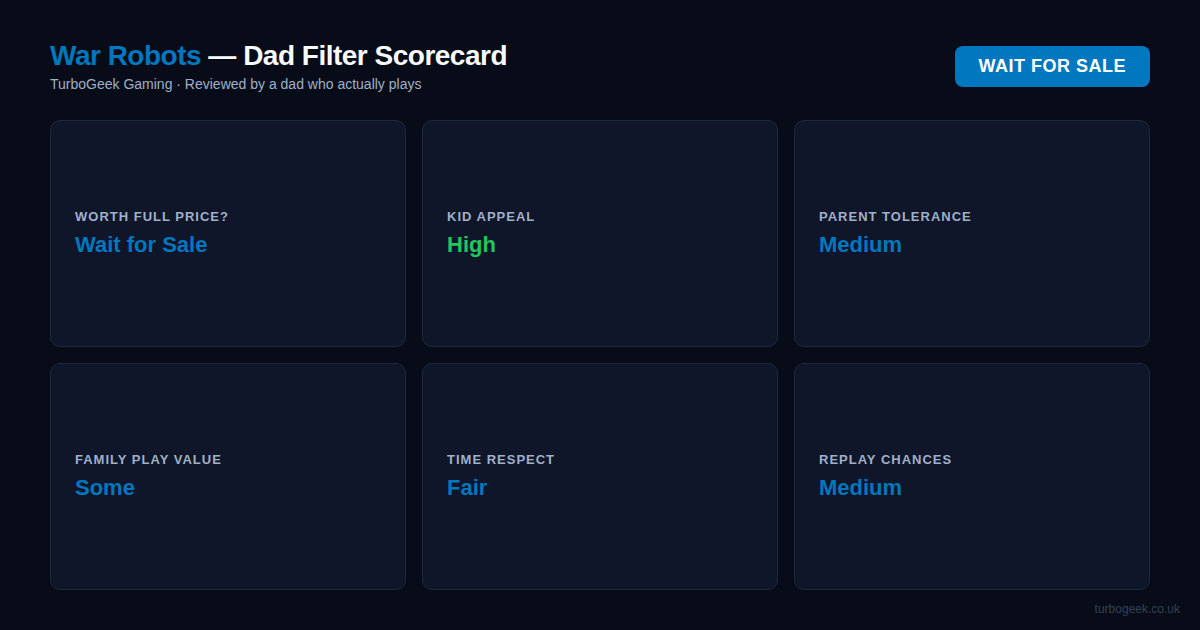
Worth Full Price? — Wait for Sale
It is free, but “free” is deeply misleading here. The real cost is the constant upsell pressure. Every menu screen has something to buy. Every progress barrier has a shortcut you can purchase. Every new robot or weapon comes with a price tag that makes your eyes water.
The core game is good enough that I would happily pay fifteen or twenty quid for a premium version without the monetization. But that version does not exist. Instead you get a game that is technically free but designed, at every level, to make you feel like you are missing out unless you spend. My advice: download it for free, set a hard spending limit of zero, and see how long the fun lasts before the grind becomes unbearable. For most families, that is a few weeks of solid entertainment — which is genuinely not bad for free.
Kid Appeal — High
Giant robots fighting each other. That is an easy sell to most kids, and mine were no exception. The robot designs are creative and varied — you have fast scouts, hulking brawlers, flying units, and support bots. The customisation is genuinely engaging; picking weapons, drones, and modules feels like building something personal.
The visual quality is impressive for a mobile game. Explosions feel chunky, robots have weight to them, and the maps have enough variety to stay interesting. My 10-year-old regularly shows me replay clips of “sick plays” with genuine excitement, and I have to admit some of them are actually impressive.
Parent Tolerance — Medium
The spending pressure is a constant battle. You will have “why can’t I buy this” conversations on a regular basis. The game runs limited-time offers with countdown timers specifically designed to create urgency, and explaining to a child why they should not buy something that disappears in three hours requires patience.
The gameplay itself is fine to watch. There is no gore — robots blow up, not people. The violence is mechanical, not visceral. The chat system exists but my boys have never engaged with it meaningfully. On the positive side, matches are short enough that “one more game” actually means one more game, not another forty-five minutes.
What drags this to medium rather than high is the emotional management. When your child loses a match because the opponent has clearly spent money on better equipment, you are dealing with frustration that feels genuinely unfair. Because it is.
Family Play Value — Some
You can play together on separate devices, which is a plus. The boys and I have teamed up for squad battles and there is a genuine thrill to coordinating an attack together. “Dad, go left, I’ll distract him” — that kind of teamwork is fun when it works.
But the competitive online nature means you are regularly matched against players who have spent significantly more money or time than you have. Family play sessions often end with one of us getting stomped by a clearly overpowered opponent, which is deflating. It is hard to enjoy a family gaming session when the experience keeps reminding you that you are at a disadvantage for not spending.
Time Respect — Fair
Individual matches run five to ten minutes, which is genuinely good. You can fit a couple of battles into a short play session, and the natural break between matches makes it easier to enforce screen time limits than with open-world games.
However, the game uses every time-based manipulation trick in the book. Daily login rewards that reset if you miss a day. Time-gated upgrades that take hours (or days) unless you pay to speed them up. Battle pass seasons with “you must play every day” task structures. Event timers creating artificial urgency. The message is constant: play every day or fall behind.
For an adult who can see through these mechanics, it is merely annoying. For a child who does not yet have that perspective, it creates an unhealthy relationship with the game where not playing feels like losing something. That is my biggest concern with the time design.
Replay Chances — Medium
The core loop is satisfying enough to keep you coming back — for a while. Building up your hangar, trying different robot and weapon combinations, climbing the leagues. There is genuine strategic depth that rewards experimentation.
But the pay-to-win grind eventually kills motivation. The gap between free players and paying players widens significantly at higher levels. My 10-year-old hit a wall after about two months where progress slowed to a crawl and every match felt like bringing a knife to a gunfight. He still plays, but less enthusiastically than he did in the first few weeks. The 7-year-old drifted away sooner, which might honestly be for the best.
The Verdict
Wait for Sale — and yes, I appreciate the irony of giving a free game that verdict. The core mech combat is genuinely good. Pixonic clearly has talented developers who have built something fun. But the free-to-play model is designed, from the ground up, to frustrate you into spending money. Every dopamine hit comes with a follow-up nudge towards your wallet.
Worth downloading? Yes, if you set clear spending rules with your kids first. I mean actually sit down and agree: we do not spend money on this game. Have that conversation before they install it, not after they have found something they desperately want to buy.
The conversations about monetization are genuinely educational. My boys now understand concepts like artificial scarcity, FOMO-driven design, and pay-to-win dynamics — not because I lectured them, but because they experienced it firsthand and we talked about what they felt. That has real value.
But if you want mech combat without the spending pressure, there are better options. A premium game with a one-time purchase price will always respect your family’s time and money more than a free-to-play title that needs to extract revenue from every session. The game is fun. The business model is not. Plan accordingly.
Related Reading
- Before You Let Your Kid Play Fortnite — another F2P game with spending concerns, reviewed through the Dad Filter
- TABS Dad Review — a game that gets the monetization right with a one-time purchase
- The Dad Filter Manifesto — how and why I score games this way
- TurboGeek Gaming Hub — all reviews and guides
Leave a Reply