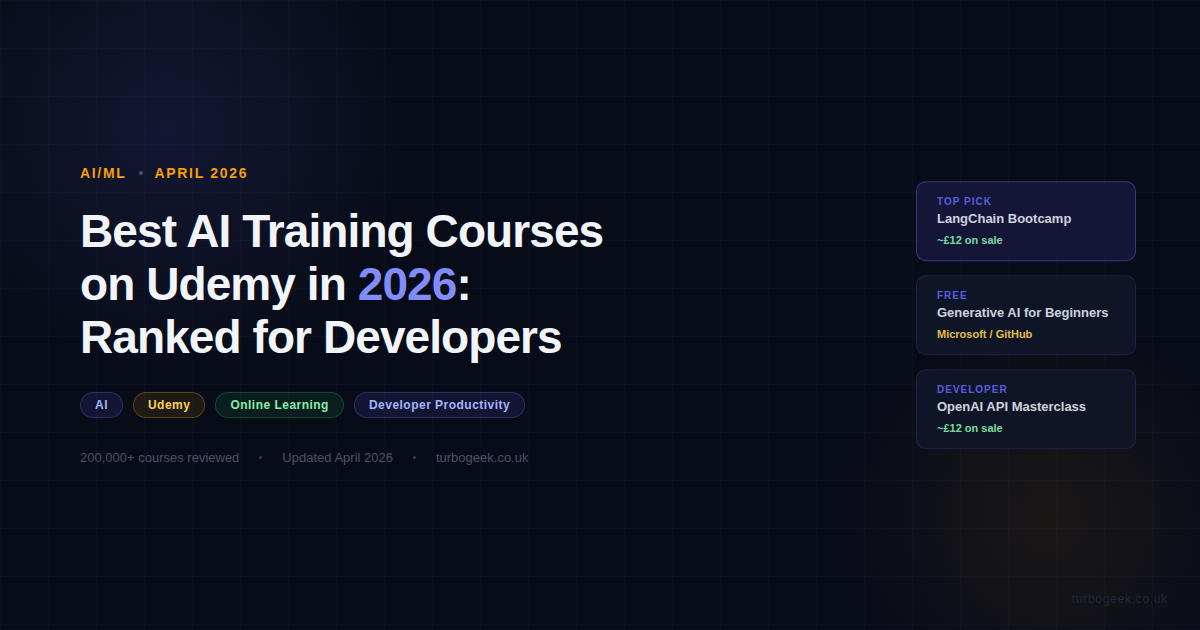
Udemy has over 200,000 courses. Searching “AI” returns thousands of results, most of them outdated. Instructors who recorded content in 2022 or 2023 are still selling it at full price, even though the APIs they demo have changed beyond recognition. These are the ones actually worth your time in 2026 — ranked by content quality, update frequency, and what you’ll actually be able to build after.
TL;DR — Best AI Courses on Udemy in 2026
- Never pay full Udemy price — sales run constantly and drop most courses to £10–£15
- Always check “last updated” — anything before 2025 may use deprecated APIs
- For absolute beginners: Microsoft’s free “Generative AI for Beginners” on GitHub is the best starting point
- For developers: LangChain Bootcamp and the OpenAI API Masterclass are the current top picks
- For prompt engineering: Anthropic’s own docs and prompt library are often better than paid courses
- Look for courses with real code, public GitHub repos, and reviews mentioning recent updates
| Course | Best For | Price (sale) | Updated |
|---|---|---|---|
| LangChain Bootcamp (Udemy) | Developers building LLM apps | £10–15 | 2025 |
| Python for ML & AI Complete (Udemy) | Python devs new to ML | £10–15 | 2025 |
| OpenAI API Masterclass (Udemy) | API integration developers | £10–15 | 2025 |
| Generative AI for Beginners (Microsoft/GitHub) | Absolute beginners | Free | 2025 |
| ChatGPT & LLMs Practical Course (Udemy) | Non-technical users | £10–15 | 2025 |
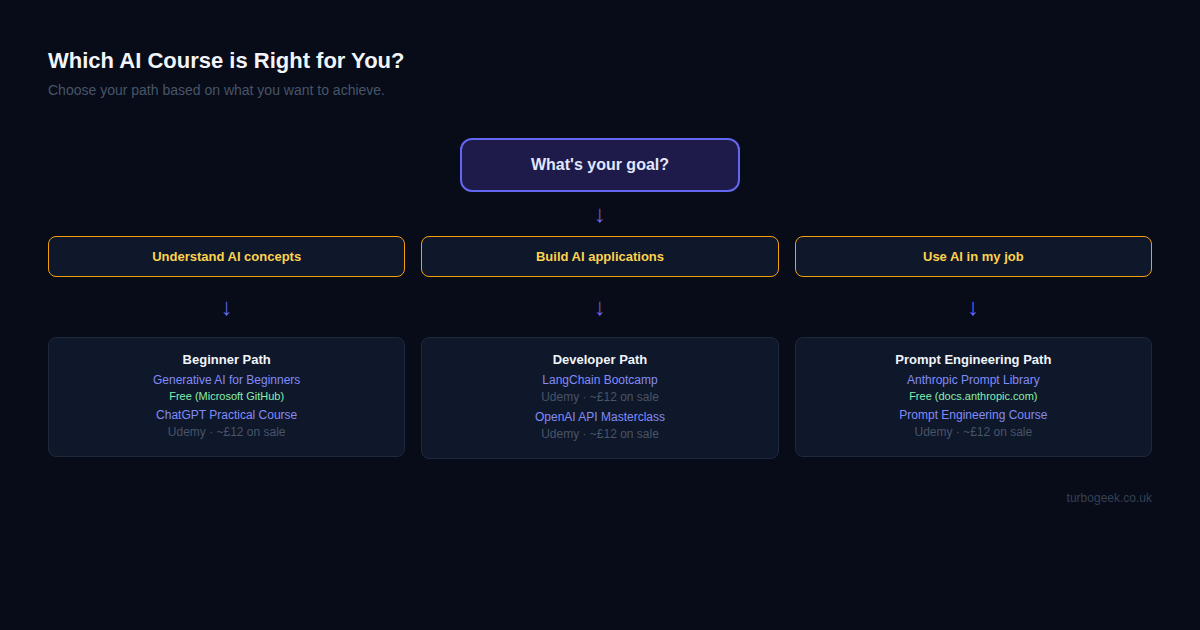
Not sure which level you’re at? Start with How to Pick an AI Course below — it gives you a framework before you look at specific courses.
How to Pick an AI Course (What to Look For)
Before you look at any specific course, run it through these four signals. They’ve saved me from buying outdated content multiple times.
Updated in the last 12 months. AI moves fast enough that 2023 content is often genuinely obsolete — not just a bit dated, but actively misleading. The LangChain API changed dramatically between versions. OpenAI’s function calling syntax has been revised. If a course hasn’t been touched since 2023, assume the code examples won’t run without significant changes.
Uses current model APIs. Check the course preview or read the reviews section for mentions of which models and SDK versions are used. A course still demoing GPT-3 completions in 2026 is not a course worth buying, even at £10.
Builds something you can show. Portfolio projects beat theory every time. The best AI courses leave you with a working application — a chatbot, a RAG pipeline, an agent. If the course is all slides and no code, skip it.
Reviews mention recent updates. Sort reviews by “Most Recent” and look for comments from the last three months. If recent reviewers are saying the content still works, that’s a better signal than five-star reviews from 2022.
Red flags to watch for: no code in the course at all; teaches that “prompt injection is impossible”; uses deprecated API patterns (old OpenAI completions endpoint, pre-1.0 LangChain); still focused exclusively on GPT-3. Any of these and I’d move on.
Best Courses for Absolute Beginners
If you’ve never written code and you’re trying to understand what AI actually is and what it can do for you, start here. This isn’t about building apps — it’s about building enough understanding to use AI tools intelligently.
Microsoft’s “Generative AI for Beginners” (free, GitHub). This is genuinely the best free resource I’ve found for non-technical learners. 18 lessons, maintained by Microsoft, updated regularly, and completely free. It covers what LLMs are, how prompting works, and how to start using AI APIs — without assuming any prior programming knowledge. Start here before spending a penny on Udemy: github.com/microsoft/generative-ai-for-beginners.
ChatGPT & LLMs Practical Course (Udemy). For learners who want the structure of a video course with exercises and a clear progression, a well-maintained practical course covering ChatGPT, basic prompt writing, and how to use AI tools in everyday work is worth the £10–£15 sale price. Look for one updated in 2025 with a strong completion rate and recent positive reviews. The key thing to check: does it focus on practical use cases, or does it spend most of its time on the history of neural networks? Skip the latter.
For beginners, resist the urge to jump straight into the most technical-looking course. Understanding what AI can and can’t do is more valuable at this stage than learning to write Python.
Best Courses for Developers (Hands-On)
If you write code and you want to build LLM-powered applications, the landscape is considerably richer — but the quality variation is also higher. Here’s what I’d actually buy.
LangChain Bootcamp (Udemy). The best course I’ve found for developers who want to build production-ready LLM applications. LangChain is the de facto framework for chaining models, building agents, and connecting to external data sources. A good bootcamp will cover chains, memory, retrieval-augmented generation (RAG), and agents — and should have a public GitHub repo with all the code. Check that the course version matches LangChain 0.2+ (the API changed significantly). Look for a course updated in 2025 with downloadable source code for every lesson.
OpenAI API Masterclass (Udemy). For developers who want to go deeper on API integration patterns — function calling, structured outputs, embeddings, fine-tuning — a dedicated OpenAI API course is worth the investment. The best ones cover the current responses API, tool use patterns, and how to build reliable production integrations rather than just toy demos. Again: verify the course uses the current SDK (openai Python library v1.x) and has been updated in 2025.
Python for ML & AI Complete (Udemy). If you’re a developer from a different stack — JavaScript, Java, C# — and you need to get up to speed on the Python data science and ML ecosystem alongside AI, a comprehensive Python ML course bridges that gap efficiently. Look for one that covers NumPy, pandas, scikit-learn, and then transitions into modern LLM work.
One rule I apply to all developer courses: if there’s no public GitHub repo with the course code, I don’t buy it. The repo tells you how maintained the course actually is.
Best Courses for Prompt Engineering and LLMs
Prompt engineering has matured into a real discipline. System prompts, few-shot examples, chain-of-thought reasoning, structured output formatting, tool use — these are learnable, transferable skills that make a meaningful difference to what you can get out of any AI model.
There are prompt engineering courses on Udemy, and some of them are decent. Look for courses that cover: writing effective system prompts, few-shot and zero-shot techniques, chain-of-thought prompting, handling structured outputs (JSON mode, XML formatting), and tool use / function calling. A 2025-updated course focused on practical prompting with Claude, GPT-4o, and Gemini is worth £10–£15.
Here’s the honest observation though: Anthropic’s own documentation and prompt library are often better than most paid prompt engineering courses. The docs.anthropic.com prompt engineering guide is thorough, current, and written by the people who built the model. The Anthropic prompt library gives you real worked examples across dozens of use cases. Before spending money on a prompt engineering course, spend two hours with Anthropic’s docs. You may not need the course at all.
That said, if you learn better from video and want structured exercises, a good Udemy prompt engineering course can accelerate your learning — just make sure it covers the current generation of models, not prompt patterns from the GPT-3 era.
Are Udemy AI Courses Worth It in 2026?
Honest verdict: yes, with significant caveats.
The pricing model works in your favour. Udemy courses are almost never worth their listed price — a £200 course is almost always available for £10–£15 during one of Udemy’s near-constant sales. If you’re disciplined about never paying full price, the value proposition is genuinely good. Sign up to Udemy’s email list and wait for a sale notification. You’ll rarely wait more than a week.
The quality problem is real. The platform has no meaningful curation filter, which means excellent courses sit alongside genuinely terrible ones, and they look identical in search results. The checklist from the first section — update date, API version, GitHub repo, recent reviews — is not optional. Apply it to every course before buying.
For structured learning — especially if you’re new to a topic and need a guided path — Udemy courses are genuinely useful. For reference material, when you know what you’re looking for, official documentation and free resources are usually better. Anthropic’s docs, the OpenAI cookbook, LangChain’s own documentation — all free, all more current than most Udemy courses.
My recommendation: use Udemy courses to get started on a topic, then graduate to official docs once you know enough to navigate them. At £10–£15 per course, that’s a reasonable trade.
Frequently Asked Questions
What’s the best AI course on Udemy for beginners?
For beginners with no coding background, Microsoft’s free “Generative AI for Beginners” on GitHub is the best starting point — 18 lessons, free, and regularly maintained. For a structured paid Udemy course, look for anything updated in 2025 with practical exercises, real use cases, and a sale price under £15. Avoid courses that spend more time on AI history than on showing you what to actually do with these tools.
Are Udemy AI courses up to date in 2026?
Quality varies significantly. Always check the “last updated” date — anything before 2025 may use deprecated APIs, outdated model versions, or frameworks that have changed substantially. Filter search results by “Last Updated” and look for courses updated in the last six months. Read the most recent reviews specifically, not the overall rating.
How much do Udemy AI courses cost?
Udemy runs frequent sales — often 90% off or more. Most AI courses are £10–£15 during sales, regardless of the listed full price. Never pay the listed price. Sign up to the Udemy email list and you’ll receive sale notifications regularly. A sale is almost always running within a few days of any given moment.
If you want to go deeper on AI tools for developers specifically, this guide to Claude Code’s hooks system and this post on Claude Code custom skills and commands cover Claude Code’s automation features in detail — no course required.
Leave a Reply