
Rechecked 22 June 2026. Availability, age rating and remaster details were checked against the official PlayStation listing.
The moment Tomb Raider started working for my boys was not the T-Rex or the dual pistols. It was a ledge.
I had spent ten minutes readjusting to Lara Croft’s deliberate 1996 controls when my older son began pointing at the screen: “You can get up there.” He was right. The younger one was less interested in route planning and wanted to know why Lara could not swim faster. Between them, they had found the two halves of the original Tomb Raider: reading a space carefully, then wrestling an old control scheme into doing what you meant.
That is why the game is still worth discussing. It is dated, occasionally awkward and far more patient than a modern action game. It is also atmospheric, intelligently constructed and unusually good at making a room feel like a problem you solved yourself.
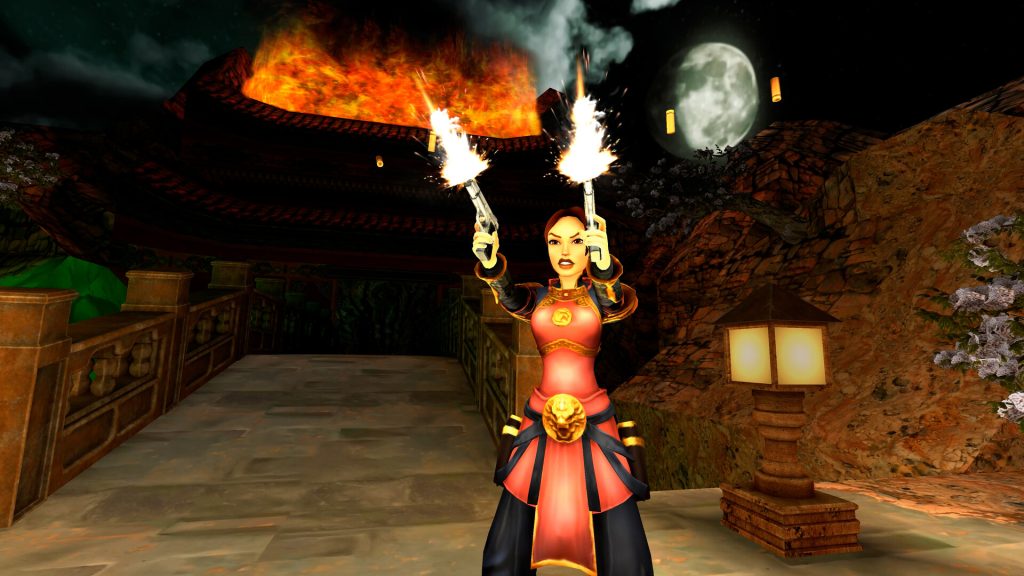
Quick verdict
- Original release: Core Design, 1996, for Sega Saturn, PlayStation and MS-DOS
- Best practical version now: Tomb Raider I–III Remastered for most players
- Dad Filter: Buy if you enjoy exploration and spatial puzzles
- Kid appeal: Medium; stronger with a child who likes solving routes
- Family play: Single-player, but excellent for an armchair navigator
What the original Tomb Raider actually is
Lara Croft is hired to recover part of an artefact called the Scion. The journey moves through Peru, Greece, Egypt and Atlantis, mixing platforming, swimming, switches, traps and relatively light combat.
The movement is deliberately measured. Lara can walk to an edge, hop back, take a running jump, grab a ledge and pull herself up. Modern games often smooth those actions into contextual animation. Tomb Raider asks you to understand the geometry and commit to the sequence.
That stiffness is a barrier for the first few minutes. Then it becomes the game’s grammar. A large room stops looking like scenery and starts looking like distances, surfaces and possible routes.
Why it mattered to me in 1996
I was sixteen when Tomb Raider arrived. Friends had PlayStations; I mostly encountered the machine in other people’s houses and through magazine demo discs. The game felt slower and stranger than FIFA or Ridge Racer because the quiet was doing so much work.
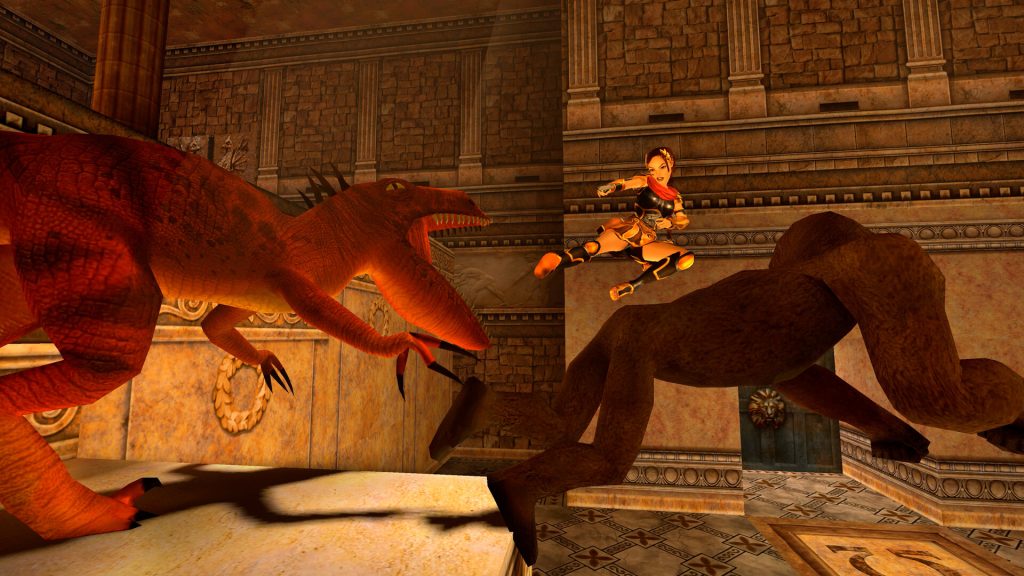
The famous T-Rex appears in the Lost Valley level. I had previously misidentified it as part of St Francis’ Folly; that was wrong. Lost Valley is the early moment when a lonely expedition suddenly becomes much larger and more dangerous. St Francis’ Folly is memorable for a different reason: its huge vertical puzzle chamber.
Those two levels explain why the game lasted. Tomb Raider could create spectacle, but it did not need constant spectacle. Footsteps, distant animal sounds and a room whose purpose was not yet clear were enough.
What held my children’s attention
Neither boy cared that Lara Croft became one of the defining female protagonists of the 1990s. That history matters, but it is not what makes a child lean towards the screen.
They responded to readable problems. A closed gate suggests a switch. A high ledge suggests another route. A flooded tunnel invites the question of where it emerges. My older son enjoyed spotting those connections. My younger son enjoyed the creatures and the moments when an apparently empty room stopped being empty.
The grid-aligned movement frustrated them when they held the controller. It worked better as a shared single-player session: I handled the jumps while they searched the room and argued about the route.
Original PS1 or the remaster?
| Version | Why choose it | Trade-off |
|---|---|---|
| Original PlayStation | Original hardware, controller and visual character | Ageing video output, physical-media cost and region-specific save behaviour |
| Original MS-DOS | Historically interesting PC version | More setup on modern systems |
| I–III Remastered | Modern platforms, manual saves and instant visual switching | Some atmosphere and visual cues feel different in the upgraded graphics |
The remaster lets you switch between original and upgraded visuals and create manual save points. That makes it the sensible recommendation for a family session. You retain the level design without making a child repeat a long section because the original save implementation was stricter.
The standard PlayStation list price was £24.99 when checked on 22 June 2026, with a temporary sale running at the time. Prices change, so use the official store listing rather than an undated figure in a review.
The Dad Filter
Worth buying?
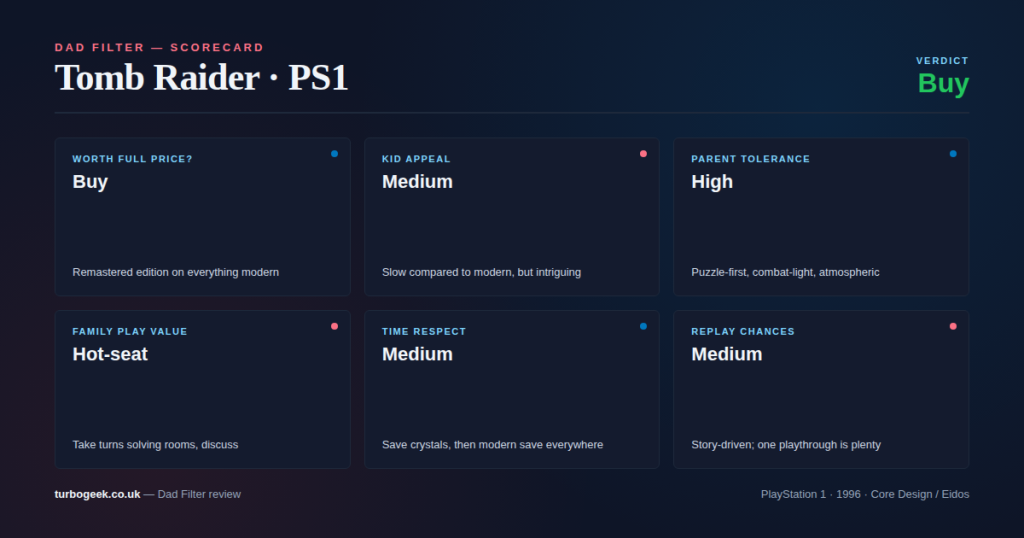
Yes. Buy the remaster if you want the easiest route into the original trilogy. Buy a PS1 copy because you specifically want the hardware experience, not because it is the most convenient version.
Kid appeal
Medium. A child who likes puzzles, maps or watching somebody solve a difficult room may connect with it. A child expecting constant action probably will not.
The current remaster carries a PEGI 16 violence rating. The game includes gun combat, animal attacks, human enemies and some dramatic deaths. Parents should assess the actual child rather than treating “old graphics” as the same thing as child-friendly content.
Parent tolerance
High. The restrained music and long quiet stretches are welcome. Combat is the weakest element, but it does not swallow the entire game.
Family play
Armchair co-op. One person controls Lara; everybody else can inspect the room. This worked better in my house than passing the controller after every failed jump.
Time respect
Much better in the remaster. Manual saves make a 20-minute session realistic. The original experience demands more tolerance for repetition.
What has genuinely aged
- Combat is imprecise and less interesting than exploration.
- The camera can work against you in tight spaces.
- The controls need to be learned on their own terms.
- Some deaths provide information only after they happen.
Those are real limitations. I would not tell a new player to “look past” them. I would tell them why the movement is deliberate, hand them the remaster, and see whether the first few rooms create curiosity.
Verdict
Tomb Raider did not invent the 3D action-adventure game on its own, and Lara Croft was not the first video-game character to become a mainstream cultural figure. What the game did achieve was still enormous: it helped define how exploration, character movement and large 3D spaces could work on the first PlayStation generation, while placing a female protagonist at the centre of a global franchise.
Thirty years later, the most convincing part is smaller. A room is still satisfying to understand. A jump still feels earned. A child can still spot the ledge before the adult holding the controller.
Related: visit the TurboGeek Gaming hub, read what happened when I played Lemmings with the boys, or compare another PlayStation-era memory in my V-Rally review.
Leave a Reply