
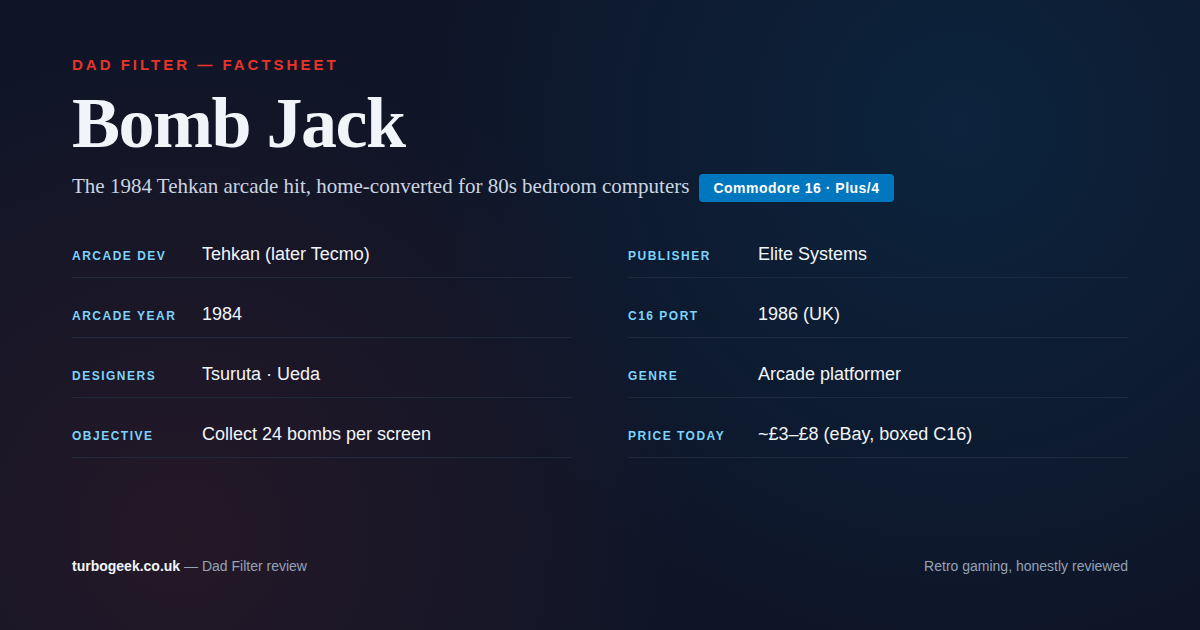
Bomb Jack was one of the cassettes that made our Commodore 16 feel like a proper games machine, even while I knew the friend down the road had a C64 that could do more.
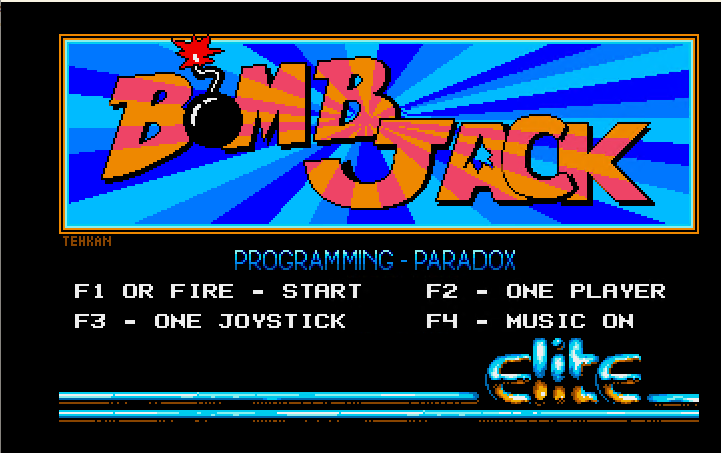
I cannot remember whether our copy came from an aunt, a bundle, or a Woolworth shelf. I remember the tape deck, the small kitchen television and the relief when the game loaded. Then Jack appeared, the first bomb lit up, and the rules explained themselves without a tutorial.
Forty years later, the Commodore 16 version is not the best Bomb Jack. That is precisely why it is interesting. It is a cut-down conversion for a constrained machine, tied to a very specific kind of British childhood.
Quick verdict
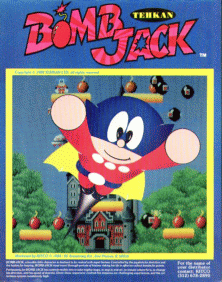
- Arcade original: Tehkan, 1984
- C16/Plus/4 conversion: Elite Systems, 1986
- Goal: collect 24 bombs while avoiding enemies and building a score
- Dad Filter: Play for the conversion, not because it is the definitive edition
- Kid appeal: Brief but real
- Family play: Single-player score competition
The arcade loop
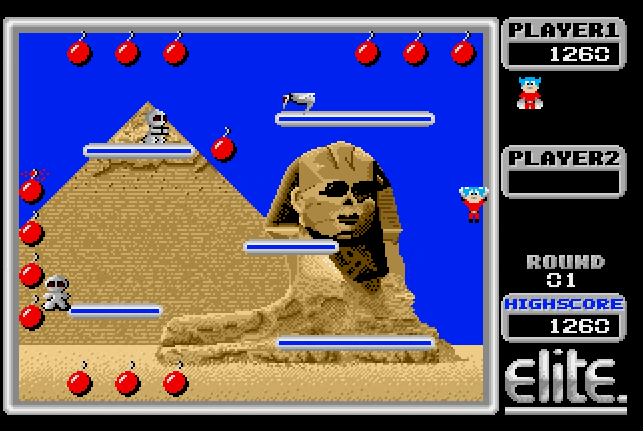
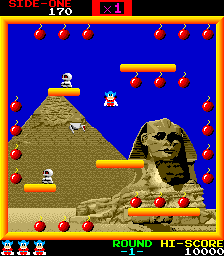
Bomb Jack places bombs around a compact platform layout. Collecting every bomb completes the screen, while collecting lit bombs in sequence builds a larger bonus. Jack can jump and glide, giving the movement a floaty control that is easy to understand and difficult to master.
The arcade game cycles through five background layouts with increasing difficulty. The Commodore 16 conversion adapts that structure, but I previously described this specific version as endless and said it never ended. The Plus/4 World record states that the conversion ends and then restarts without a reward. That is the accurate description for the port reviewed here.
What the C16 version changes
The Commodore 16 had 16 KB of RAM and no hardware sprites. A conversion could not simply shrink the C64 version. The C16 edition has chunkier movement and presentation, fewer technical luxuries, and the unmistakable feel of software forced into a small machine.
The archive also records an unusual detail: the two sides of the original tape used different background graphics. That is the sort of physical-release quirk that disappears when an old game is reduced to a filename.
Elite’s home versions collectively took Bomb Jack to the top of the UK combined-format chart for a week in April 1986. That result should not be attributed solely to the C16 edition, as I previously implied.
Why it mattered in our house
The C16 was the computer my parents could justify. It was plugged into a small television in the kitchen, and loading from cassette was part of the event. The machine made you wait long enough that a working game felt valuable before you had even pressed fire.
Bomb Jack rewarded that wait by beginning immediately. There was no manual-sized rule set to internalize. Jack moves, Jack glides, bombs light, enemies kill you. A life can disappear in seconds, but another attempt begins quickly.
That directness still feels good. It also makes it easy to show the game to children without delivering a history lecture first.
What happened when I showed the boys
The first response was predictable. My older son asked what the point was. My younger son wanted to know whether Jack could shoot the enemies. They wandered away.
A few minutes later, the younger one came back and asked for a turn. He understood the movement almost immediately. The older one then became interested in taking a turn and beating the score. That sequence is less tidy than claiming they loved it or hated it, but it is what happened: the graphics lost them, the visible rules brought them back, and the repetition eventually lost them again.
How to play it now
The cleanest historical experience is original hardware and an original cassette. In practice, most people will use a Commodore 16/Plus/4 emulator with a legally obtained .TAP or .PRG image.
Plus/4 World’s Bomb Jack record documents the releases, screenshots, archive formats, and conversion details. Check the legal status of game images in your jurisdiction and use software you are entitled to run.
Physical prices move too quickly for a permanent review. Search completed listings, check the cassette and inlay condition, and confirm whether you are buying the Elite or Encore release.
The Dad Filter
Kid appeal
Medium for ten minutes. The objective is clearer than the presentation. A child can understand the loop before appreciating why anybody played it for hours.
Parent tolerance
Medium. Short score runs are enjoyable. The music and repeated layouts become tiring during a long session.
Family play
Hot-seat score chasing. There is no simultaneous multiplayer, but one life or one completed screen per turn is enough to create a small competition.
Time respect
Excellent. A four-minute session still feels like Bomb Jack. There is no campaign state requiring you to return tomorrow.
C16, C64 or arcade?
| Version | Reason to play it |
|---|---|
| Arcade | The original movement, presentation, and scoring design |
| Commodore 64 | A stronger home conversion for most players |
| Commodore 16/Plus/4 | A specific conversion challenge and a specific memory |
If you are approaching Bomb Jack for the first time, start with the arcade version. If the brown Commodore keyboard, cassette noise and limited C16 palette mean something to you, this port has a value the technically superior versions cannot replace.
Verdict
Bomb Jack on the Commodore 16 is not an overlooked masterpiece hiding behind weak hardware. It is a compromised but recognizable conversion of an excellent arcade design.
What survives is the important part: clear movement, visible risk, a score and the immediate desire to try once more. My children did not need to share my memory for that loop to make sense. They only needed a turn.
Sources
Related: compare another old game that children can immediately read in my Lemmings review, or browse the TurboGeek Gaming hub.
Leave a Reply