
TL;DR — The Developer’s Dream
- The before — the friction, the maintenance backlog, the tasks that used to eat whole afternoons
- The shift — not faster code, but less standing between ideas and working software
- What is still yours — decisions, architecture, judgment: entirely yours
- The partnership — a collaborator who never loses context, never cuts corners, never gets tired
IN THIS SERIES
Before Claude Code, there was a list. Not a to-do list — more of a mental tax. The things I knew I should do but kept deferring: write the tests for that module, refactor the function that had grown into something nobody wanted to touch, update the documentation that was six months out of date. Important work. Dull work. The kind that accumulated quietly while I focused on the parts I actually wanted to build.
New to Claude Code? Start with What is Claude Code?, then Is Claude Code Safe to Use?
The Moment It Clicked
I was working on a side project — a data processing pipeline that had grown messier than intended over several months. I kept putting off the cleanup. One afternoon I opened Claude Code, described the problem, and watched it spend twenty minutes doing the work I had been avoiding: splitting responsibilities that had tangled together, writing tests for the new structure, updating the documentation, committing each logical piece separately with clear messages explaining what changed and why.
I reviewed the diffs. They were clean — cleaner than I would have written under deadline pressure. I merged it and went back to building features.
That was the moment. Not “Claude Code wrote some code for me.” The moment was: all that accumulated friction just disappeared. The things that had been piling up stopped piling up.
I had expected to feel like I was delegating. It felt more like suddenly having headroom I did not know I was missing. The backlog that had quietly cost me mental energy every time I looked at the repository simply stopped mattering in the same way.
What surprised me was how quickly the dynamic changed after that. Once I had seen what a twenty-minute cleanup session looked like, the calculus on every piece of deferred work shifted. The question was no longer “do I have the energy to tackle this today” but “what do I want to work on next.” That is a different problem to have.
What Changed
Three things changed in practice after I made Claude Code part of my daily workflow.
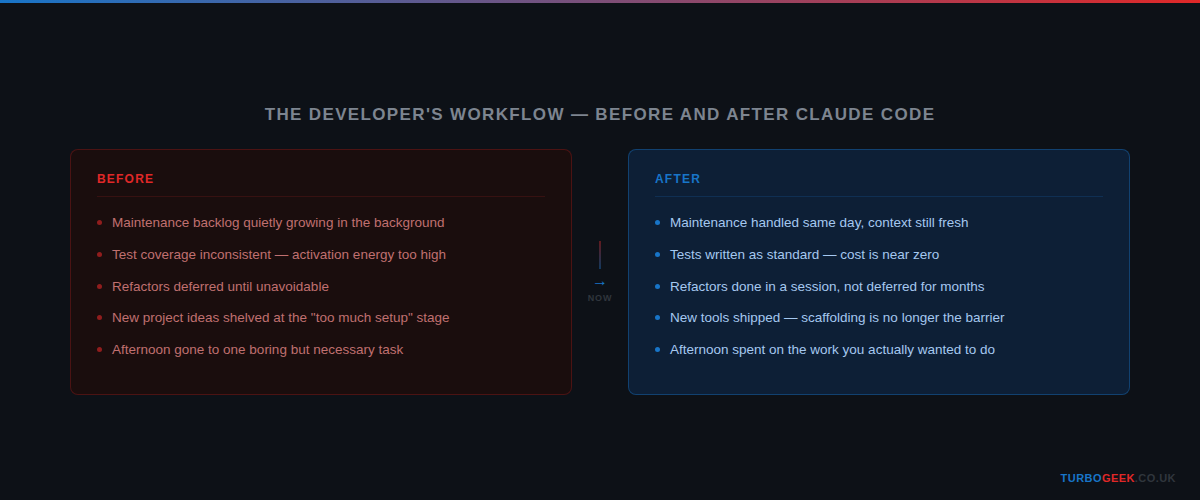
The ratio shifted. More time building, less time maintaining. The maintenance work did not disappear — it just stopped requiring a full afternoon of dreaded effort to get started. I handle things the same day now, when the context is fresh, rather than deferring them until they become unavoidable.
The ambition ceiling went up. I started tackling projects I would have previously dismissed as “too much setup.” The scaffolding that used to be a barrier — writing the initial tests, setting up the structure, getting the boilerplate out of the way — no longer is. I have shipped two small tools this year that I would have added to the “someday” list in previous years. They exist because the cost of starting dropped.
I write more tests. Not because I became more disciplined overnight, but because asking Claude Code to write them costs almost nothing. The activation energy dropped and the habit followed. My test coverage is better now than when I was writing everything manually, because I was never consistent enough to maintain it alone.
What Did Not Change
None of the decisions changed. Architecture is mine. Code review is mine. The judgment about what to build, when, and for whom — entirely mine. Claude Code does not have opinions about your product strategy. It has strong opinions about code quality, and I am glad for that. But it does not know your users, your constraints, your history. You do.
This matters because the “AI will replace developers” framing gets this exactly wrong. The hard parts of software development — deciding what to build, understanding the problem deeply enough to solve it correctly, knowing when a technically correct solution is the wrong answer — are still the developer’s job. They were always the job. What Claude Code handles is the translation: turning a well-formed requirement into working, tested code. That part was always mechanical. It just used to be mechanical work I had to do myself.
The distinction feels important to name explicitly, because it changes how you use the tool. If you approach Claude Code as a replacement for developer judgment, you will use it badly and be disappointed. If you approach it as a way to stop doing the parts of the job that were never the interesting parts — the ones that slowed you down between having an idea and seeing it work — then it delivers exactly what it promises.
The Partnership
What I have now is a collaborator who never loses context across a session, never cuts corners on tests when a deadline is close, never gets tired at the end of a long day, and keeps the entire codebase in mind at once. That is an unusual combination of qualities. No human collaborator has all of them.
Working with Claude Code does not feel like using a sophisticated tool. It feels like thinking out loud with someone who can implement the thought immediately. You describe the problem. They understand the codebase. You direct the solution. They execute it. You review, decide, and move on. The division of labour is clean and it plays to everyone’s strengths.
The developer’s dream was never “AI writes my code.” It was “nothing standing between me and the work I actually want to be doing.” That is what this is.
Related: How to Write the Perfect AGENTS.md file — AGENTS.md (and CLAUDE.md for Claude Code) is how you give the AI persistent knowledge about your project: its conventions, constraints, and context. The partnership described in this post gets significantly better once this is set up.
If you want to get the most out of Claude Code, the place to start is the skills system — the behaviour modules that change how Claude approaches tasks, not just what tasks it does. The 7 Claude Code Skills post covers the seven that will have the biggest impact on your day-to-day workflow.
Leave a Reply