
Your PS5 costs more. Your laptop RAM upgrade costs more. Cloud storage prices are creeping up. The cause is the same across all of them: a memory chip shortage driven not by supply problems but by AI demand. The companies building the AI infrastructure that underpins every chatbot, image generator, and recommendation engine you use every day are consuming memory at a rate that is squeezing everyone else out of the market — and the price you pay at the checkout is the result.
I have been watching this trend build for the past 18 months and it is not a temporary blip. This is a structural shift in who memory gets made for — and it has consequences for every consumer purchase involving silicon.
TL;DR — Why Memory Prices Are Up in 2026
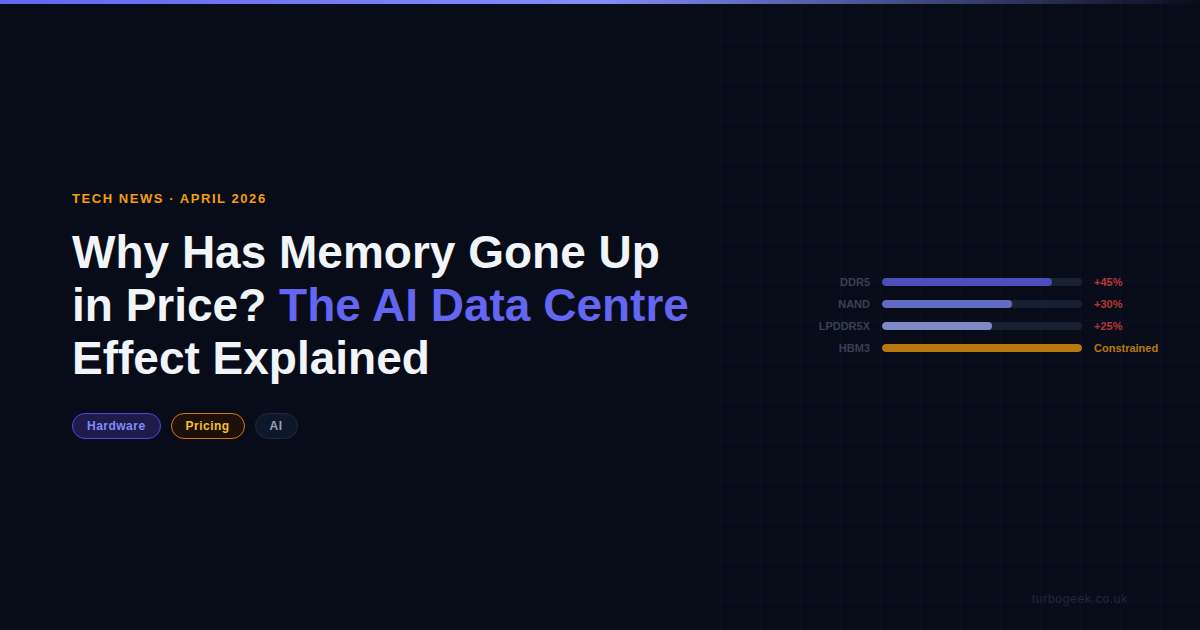
- DDR5 RAM is up 35–45% since early 2024; a 32GB kit that cost $80 now costs $110–$120
- NAND flash (SSDs, phones, USB) is up 20–30%; LPDDR5X (mobile) up 25%
- HBM3/HBM3E — the memory inside AI GPUs — is effectively supply-constrained
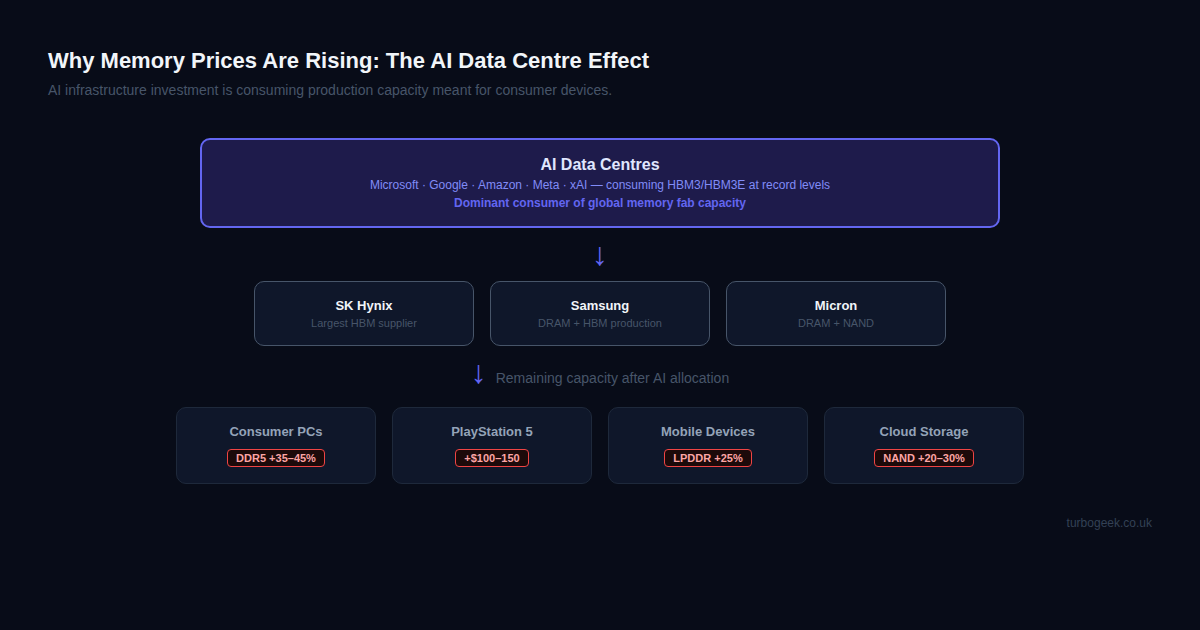
- AI data centres are consuming the bulk of global memory fab capacity, leaving less for everyone else
- New fab construction takes 2–3 years; prices are unlikely to fall before mid-2027
- The PS5 price increase is directly connected — Sony uses the same supply chains
| Memory Type | Typical Use | 2024–2026 Price Change |
|---|---|---|
| DRAM (DDR5) | PCs, laptops, consoles | +35–45% |
| NAND Flash | SSDs, USB, phones | +20–30% |
| HBM3/HBM3E | AI accelerators (H100, B200) | Supply-constrained |
| LPDDR5X | Mobile, thin laptops | +25% |
New to this topic? Start with The AI Data Centre Effect section below — it is the one thing that explains all the price increases at once.
What’s Actually Gone Up (and By How Much)
Let me put some concrete numbers on this because the scale surprised me when I first looked at the data properly.
DRAM (DDR5): Up 35–45% since early 2024. A 32GB DDR5 kit that you could pick up for around $80 in early 2024 now costs $110–$120 at most major retailers. That is not a rounding error. That is a significant jump in the span of about two years, during which time inflation in most other consumer electronics categories has been flat or declining.
NAND flash: SSDs, USB drives, and phone storage — everything that uses NAND — has gone up 20–30%. If you have noticed that 2TB SSDs seem more expensive than they were a couple of years ago, this is exactly why. NAND was the one memory type that had been falling in price for years. That trend reversed sharply.
LPDDR5X: The low-power variant used in flagship phones and thin laptops is up around 25%. This feeds directly into the bill of materials for devices like the iPhone, high-end Android flagships, and MacBooks. Manufacturers absorb some of this, but some flows through to price tags.
HBM3/HBM3E: This is the one that is not just expensive — it is effectively unavailable at any price for most buyers. High Bandwidth Memory is the specialised memory that sits directly on AI GPU packages. There is no surplus. Every unit that SK Hynix, Samsung, and Micron can produce is pre-allocated to AI chip orders, often a year or more in advance.
The AI Data Centre Effect
Here is the thing that changes how you think about all of this: it is not that there is a shortage of memory fabs. It is that the fabs are running flat out — they just are not running for you.
A single Nvidia H100 GPU contains 80GB of HBM3. Not 80GB of consumer RAM. Eighty gigabytes of one of the most complex, expensive-to-manufacture types of memory on the planet, bonded directly onto the GPU package using a process that requires extraordinary precision. A rack of H100s — the kind that Microsoft, Google, Amazon, Meta, and xAI are ordering in the hundreds of thousands — uses more memory than entire data centres did five years ago.
To put that in perspective: one rack of 8x H100s contains 640GB of HBM3. The entire global server fleet in 2015 held approximately 640GB of RAM in aggregate across thousands of servers. We are now putting that much high-end memory into a single rack, and the hyperscalers are ordering racks by the tens of thousands.
The memory fabs — SK Hynix, Samsung, and Micron — have responded to this demand signal exactly as you would expect. They have diverted production capacity toward HBM and AI-optimised DRAM, because the margins are better and the order books are full. The consumer market gets what is left over after the AI allocations are filled.
This is not price gouging. It is basic economics. When your best customer is Microsoft or Google and they will sign a multi-year contract for everything you can produce, you optimise for that customer. The 32GB DDR5 kit buyer is an afterthought.
How This Ripples to Consumers
The places where you feel this most are probably not where you would first expect.
Game consoles: The PlayStation 5 uses GDDR6 (a variant of DRAM) for its unified memory architecture, and its SSD uses NAND flash. Both are affected by the same supply dynamics. Sony cannot escape the market any more than you can. We covered the PS5 price increase in detail — including what Sony actually announced and whether it is worth buying now — in our dedicated post on the PS5 2026 price rise.
Laptops and phones: Every flagship phone and thin-and-light laptop is affected by LPDDR5X pricing. The headline device prices have not all moved yet — manufacturers have been absorbing costs and adjusting configurations (offering less storage at the same price point rather than raising the sticker price). But that buffer has limits.
NAS and home storage: NAS devices and external drives use NAND. If you have been planning a home backup expansion, prices are higher than they were in 2023 and are unlikely to return to those levels any time soon.
Cloud storage: This one is slower to show up because cloud providers lock in long-term supply contracts. But the structural cost base for storing data in the cloud has risen, and pricing adjustments from providers will follow over the next 12–24 months. AWS, Google Cloud, and Azure are not immune to their own infrastructure costs.
When Will It Come Down?
I want to give you an optimistic answer here, but the data does not support it.
SK Hynix, Samsung, and Micron are all investing in new fab capacity. Construction is underway on facilities in the US, Korea, and Japan. But semiconductor fab construction is not a quick fix: from groundbreaking to first wafer output typically takes two to three years. The fabs being built now will not be producing consumer DRAM at scale until 2026–2027 at the earliest, and HBM-specific capacity will arrive slightly sooner given the prioritisation.
The more important question is whether AI infrastructure investment will slow enough to free up capacity for consumers. I do not see evidence of that happening. The announced capital expenditure from Microsoft, Google, Amazon, and Meta for AI data centre build-out runs to hundreds of billions of dollars over the next several years. Each dollar of that build-out represents memory demand.
My honest assessment: consumer memory prices may ease modestly in late 2026 as some new capacity comes online, but a return to 2023-era pricing is not on the cards. The structural demand from AI has permanently raised the baseline. Think of it less like a commodity cycle and more like a permanent rerating of what memory is worth when AI is the primary buyer.
What You Should Do Right Now
Given all of that, here is my practical take on what to do if you are making decisions now.
Building or upgrading a PC: Buy now. RAM prices are not going to drop significantly in the near term, and there is a real risk they continue to edge upward as AI demand keeps growing. The 32GB DDR5 kit you buy today is the cheapest it is likely to be for the next 12–18 months.
Comparing cloud storage plans: The pricing increases you are seeing are structural, not temporary promotions ending. When comparing plans, factor in that prices are more likely to rise than fall over the next two years. Locking in longer-term plans now, where providers offer them, makes sense.
Buying a game console or phone: Do not wait for prices to come down. The supply chain pressures that are lifting prices are not going away. For the PS5 specifically — read our verdict on the PS5 price increase before you decide.
NAS or home storage expansion: If you have been putting it off, now is a reasonable time to move. NAND prices have been climbing and new capacity will not arrive quickly enough to bring prices back down in the near term.
Frequently Asked Questions
Why is RAM so expensive in 2026?
AI data centres are consuming the bulk of high-bandwidth memory production. The major memory manufacturers — SK Hynix, Samsung, and Micron — have diverted significant production capacity toward HBM3 and HBM3E for AI GPU packaging, leaving reduced supply for consumer DRAM. Consumer DDR5 prices are up 35–45% since early 2024 as a direct result of this capacity reallocation.
Will memory prices drop in 2026?
Unlikely before mid-2027 at the earliest. New fab capacity is coming online, but semiconductor construction takes two to three years from groundbreaking to production. AI infrastructure investment from the major hyperscalers shows no signs of slowing, which means memory fab capacity will continue to be preferentially allocated to AI customers. Some modest easing is possible in late 2026, but a return to 2023-era pricing is not expected.
Is it worth upgrading RAM now?
Yes, if you need to upgrade, buy now rather than waiting. Prices are not expected to fall meaningfully in the near term, and the risk is that they continue to edge upward as AI demand compounds. Waiting for a price drop that may not come for 12–18 months means running on inadequate RAM in the meantime — not a good trade-off.
This is the same supply crunch that pushed up PS5 prices — the memory inside every PlayStation 5 comes from the same fabs being prioritised for AI. Our full breakdown of the PS5 2026 price increase has the complete picture of what Sony announced, the numbers behind the rise, and whether it is worth buying now or waiting.